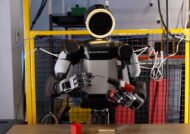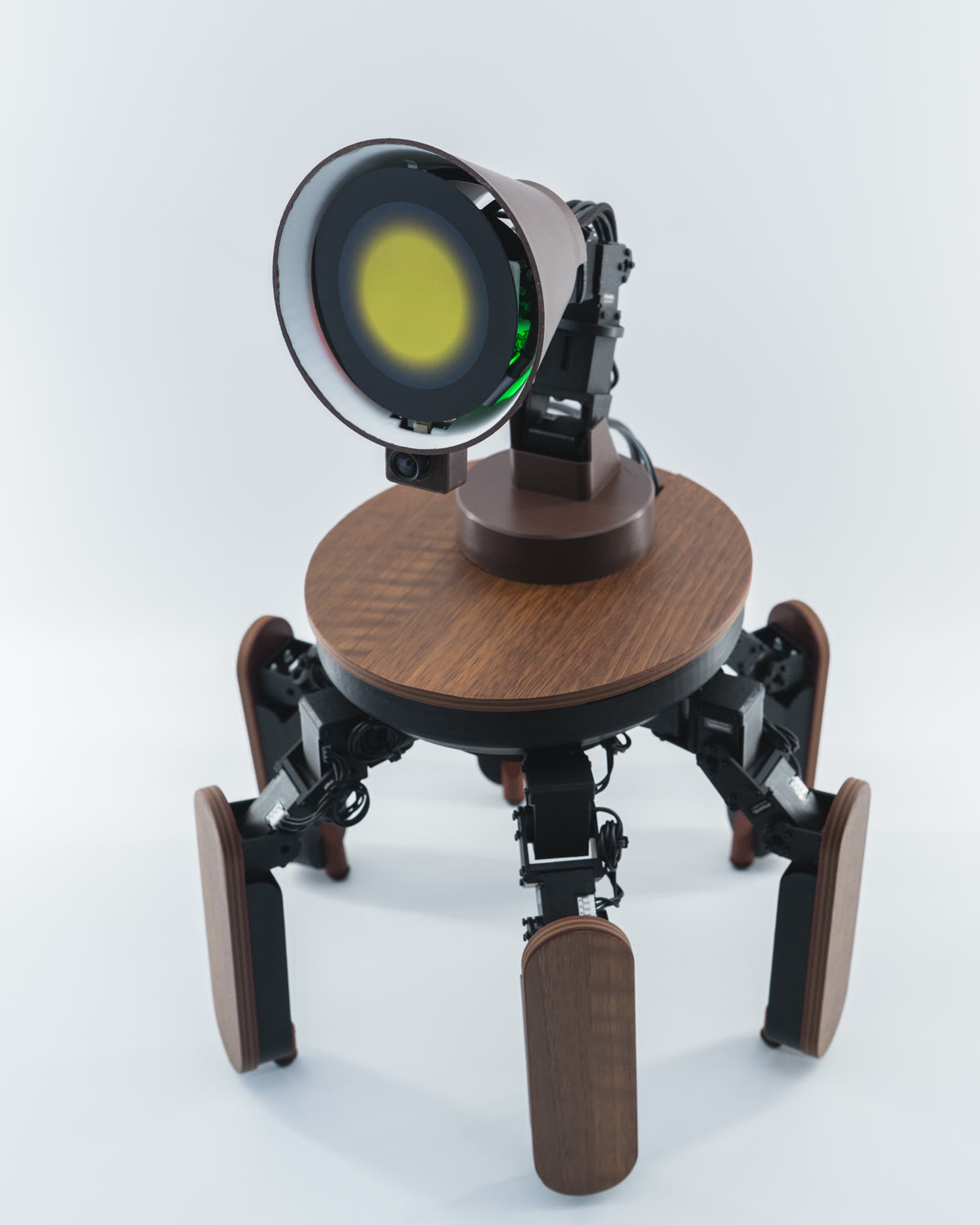
Jizai Inc. began early access sales of the Palmimo DevKit, a tabletop AI robot development kit, on September 3. The machine has 21 axes across six legs and a neck, and can be driven from a few lines of Python. It ships with an implementation that wires LLM tool calls directly to physical behavior, and the software is being released as open source in stages. The early access price is 598,000 yen excluding tax.
Waving with a Few Lines of Python
The Palmimo DevKit packages Palmimo, the general-purpose AI robot Jizai has been building, into a desktop-sized unit that owners can customize with their own code. Palmimo started as the machine shown at CES 2025 under the name Mi-Mo, and the rename coincides with its repositioning as a product aimed at developers.
The selling point is that no robotics background is required. Waving, walking, and turning the head are each a single Python method call. The official sample imports the SDK and then writes robot.wave() or robot.look(pitch=0.3, yaw=0.5), and passes a list of moves with durations to play a choreographed sequence such as forward, dance, and bow.
from palmimo_sdk import Palmimo

robot = Palmimo()
robot.wave()                    # wave a leg
robot.look(pitch=0.3, yaw=0.5)  # turn the head
The software is arranged in four layers. Your own code sits at the top, below it an SDK that receives calls like robot.forward(), below that a driver abstraction layer, and at the bottom the 21-axis hardware. Swapping the driver layer alone switches between the real robot and a dry-run mode, so the full motion API can be exercised before the unit arrives. New backends such as a simulator connect at the same layer.
A Raspberry Pi 5 Brain and 21 Servo Axes
The body measures 400 by 300 by 300 mm and weighs about 2 kg. It has 21 degrees of freedom: 18 in the legs, at 3 axes across each of 6 legs, plus 3 in the neck. The actuators are 21 DYNAMIXEL XC330-M288-T units running at 5V.
Compute comes from an onboard Raspberry Pi 5 with 16GB of memory, connected to the servos over USB-to-serial at 1 Mbps. The operating system is 64-bit Raspberry Pi OS, with Python 3.12 or later and the Python SDK. The face is a 2.8-inch round touch display at 480 by 480, driven by an RP2350, and it renders expressions.
Sensing consists of a 5MP USB camera, a ReSpeaker microphone array, and 3W stereo speakers. Power comes from a DC 5V adapter plus a 27W USB PD supply for the Raspberry Pi, and connectivity covers Wi-Fi, Bluetooth 5.0, and USB. A wooden top plate keeps the machine from looking too industrial in a living or office space.
Open Sourcing the Software First
Jizai frames the Palmimo DevKit as an open co-creation platform rather than a closed product. Alongside the start of early access sales, the company is opening the software first, including the Python SDK, drivers, and the AI agent implementation, and plans to widen the scope to the broader development stack including the simulation robot model. The repository is on GitHub, and developer documentation is published as well.
On the agent side, the kit bundles an implementation that connects LLM tool calls, the mechanism by which a model invokes functions, straight to robot actions. The model acting as the brain is swappable, and the robot can be tied to a company's own data and services through APIs, MCP, or SDKs. The example Jizai shows runs the full see, think, act loop: the robot notices a visitor waving, decides to greet them, and executes wave() together with speech.
The background Jizai cites is that the push toward physical AI, meaning AI with a body that acts in the real world, is accelerating worldwide while most open robots and development tools originate outside Japan. Arguing that growing the pool of engineers who can handle both software and hardware is essential, the company designed and built the kit domestically.
Price and Availability
Early access is aimed at Early Builders, meaning developers and researchers, and Early Partners, meaning companies and research institutions running proof-of-concept or service development work. The unit costs 598,000 yen excluding tax and arrives assembled and tested. There are no monthly fees, and a 30-day initial warranty covers early failures.
Separately, Jizai offers custom services with its own staff working alongside the customer. There are 3 forms: a supported track that supplies hardware and technical help to companies with their own development capacity, a full-support track where Jizai handles everything from app development to operations, and one-off spot engagements for training and technical lectures. Pricing is quoted individually based on scope.
Suggested uses include AI companions and human-robot interaction research, proof-of-concept work for reception and guidance in offices and stores, robot learning experiments such as Sim2Real and VLA fine-tuning, physical AI training programs at universities and companies, and service designs that coordinate multiple units. A working unit is on display at Tokyo Mirai Park on the first floor of Miraikan through September 23, as part of a Tokyo Metropolitan Government exhibition.
One caveat: the price is a corporate and research pricing for the unit itself, and it applies to the initial lot. Jizai says the terms may change for later lots, so buyers should not assume today's conditions will continue. Specifications may also change without notice as the product is refined.
Summary
The Palmimo DevKit is a tabletop AI robot with 21 axes across its legs and neck that can be driven from a few lines of Python. It is built around a Raspberry Pi 5 and DYNAMIXEL servos, and ships with an agent implementation that maps LLM tool calls onto physical behavior. The software is being opened up starting with the SDK and drivers, with the simulation environment to follow. The early access price is 598,000 yen excluding tax, and availability is limited to developers, researchers, and organizations running real deployments.