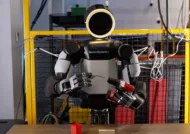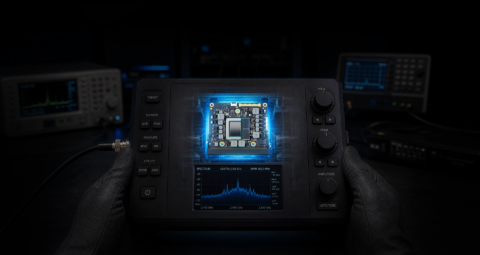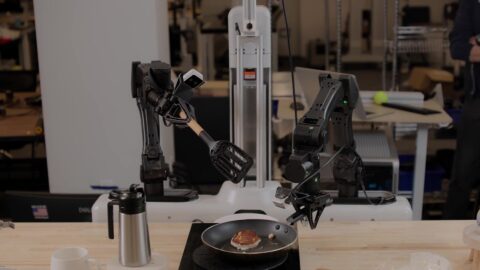
Yazaki, Cuebus and Yamazen are launching a joint demonstration on September 21, 2026 at Innovation Hub – REN, a newly opened facility in Susono, Shizuoka Prefecture, built around the urban three-dimensional robot warehouse CUEBUS. Parts pulled automatically from the warehouse are handed to an autonomous humanoid robot, which passes them on to the next process. It is an unusual pairing: two very different kinds of robots passing a baton to each other.
Rethinking the aisle
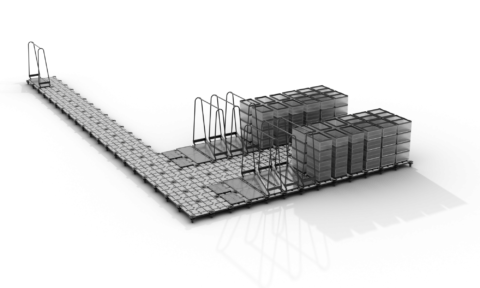
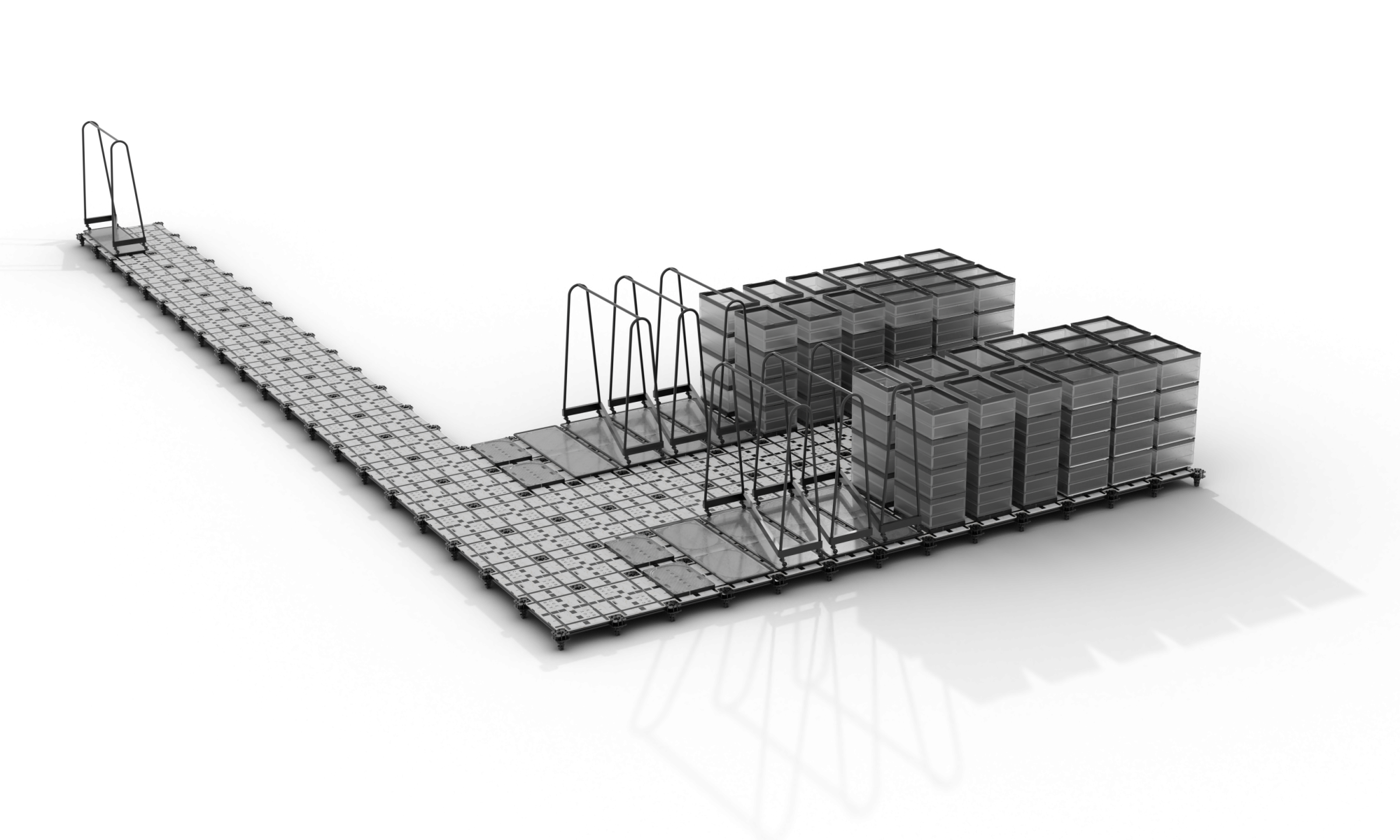
CUEBUS is a three-dimensional robot warehouse developed by Cuebus. Linear motors embedded in the floor move trays around, so the system does not need aisles for people to walk through. Cases can be packed together with no gaps and stacked vertically, with only the required item retrieved automatically. Cuebus says the approach stores more than 4 times as much in the same floor area as conventional flat shelving.
When people picture warehouse automation, they usually imagine a fleet of transport robots driving around. CUEBUS inverts that. What moves is the tray carrying the goods, which removes the travel time a robot would otherwise spend going to fetch a rack.
Innovation Hub – REN, the site Yazaki chose for the trial, was set up to test next-generation manufacturing using AI and robotics. The goal is to find out, with real hardware, how far labor-intensive and physically demanding steps can be reduced and how completely a limited footprint can be used.
A humanoid waiting at the outfeed
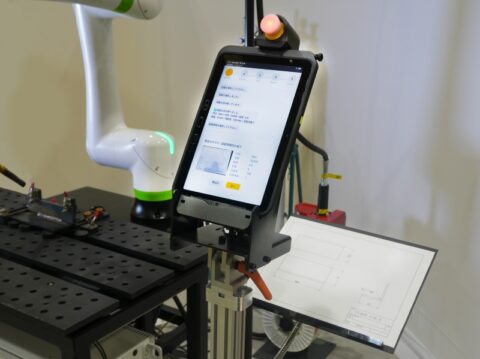
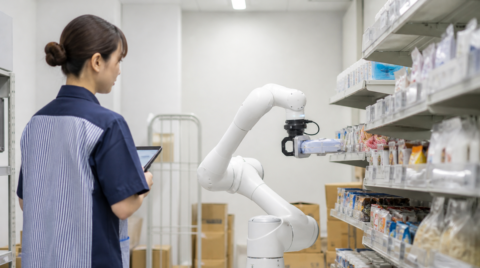
The interesting part of this trial sits at the CUEBUS outfeed. Parts and materials released automatically by the warehouse are picked up by an autonomous humanoid robot already installed at the facility and passed to the next process. Alongside that handoff, the three companies will measure how much the setup improves movement efficiency and inventory management.
Putting humanoids on factory floors is an increasingly common story, but verifying how they mesh with the surrounding equipment is still rare. A robot shaped like a person can use existing equipment as-is, yet the timing and positioning of a handoff depend entirely on the other side. Pairing one with CUEBUS, which controls what comes out where and when, is a way to cut down that uncertainty.
Yamazen joined as the partner behind the humanoid deployment, and the trial also covers integration with physical AI data. As a trading company handling both production goods and consumer goods, Yamazen takes the role of proposing automation for the shop floor.
The floor itself is the motor
A look inside CUEBUS makes its character clearer. The TILE that forms the floor contains linear motors and a large number of sensors, controlling the TRAY above it with 22,000 sensing cycles per second. A TILE measures 800 x 590 x 59 mm and weighs 17.8 kg; a TRAY measures 664 x 454 x 57 mm, weighs 11.5 kg and carries up to 100 kg.
The clever part is the TRAY, which has neither a motor nor a battery. Because the driving force comes from the floor, no cart ever stops to recharge, and there are far fewer parts that can break. Stopping accuracy is within 1 cm, so trays halt properly in front of a picking station.
Installation is deliberately undemanding. The system runs from a standard AC 100 V outlet and needs no anchor bolts. With no foundation work involved, layouts can be changed or expanded easily, which suits a trial where the point is to put it in place and see what happens.
Why a wiring harness maker is testing this
Yazaki was founded in 1941, holds a world-leading share in automotive wiring harnesses and operates in 46 countries and regions. Wiring harnesses differ in shape from model to model and are a textbook example of long, awkward parts. The field also involves managing large numbers of fine-grained part numbers while moving them between processes.
Cuebus says CUEBUS can transport long items such as 1,500 mm wide Z hanger racks as they are, by coordinating several units together. That strength lines up with what Yazaki's own shop floor deals with, and the fact that a parts maker is running the trial itself makes it less likely to end as a paper exercise.
Cuebus announced CUEBUS Pallet 200kg, a multi-level high-density automated warehouse, on September 4, 2026, and disclosed on September 8 that it had been selected for the Ministry of Land, Infrastructure, Transport and Tourism's fiscal 2026 demonstration program for automated logistics roads. The manufacturing trial arrives in the middle of that run.
Summary
What the three companies are after is a next-generation production model in which people, robots and different types of robots work together. The warehouse releases a part, the humanoid receives it, and the next process takes over. How smoothly that handoff runs is the thing worth watching. The trial begins on September 21, 2026.