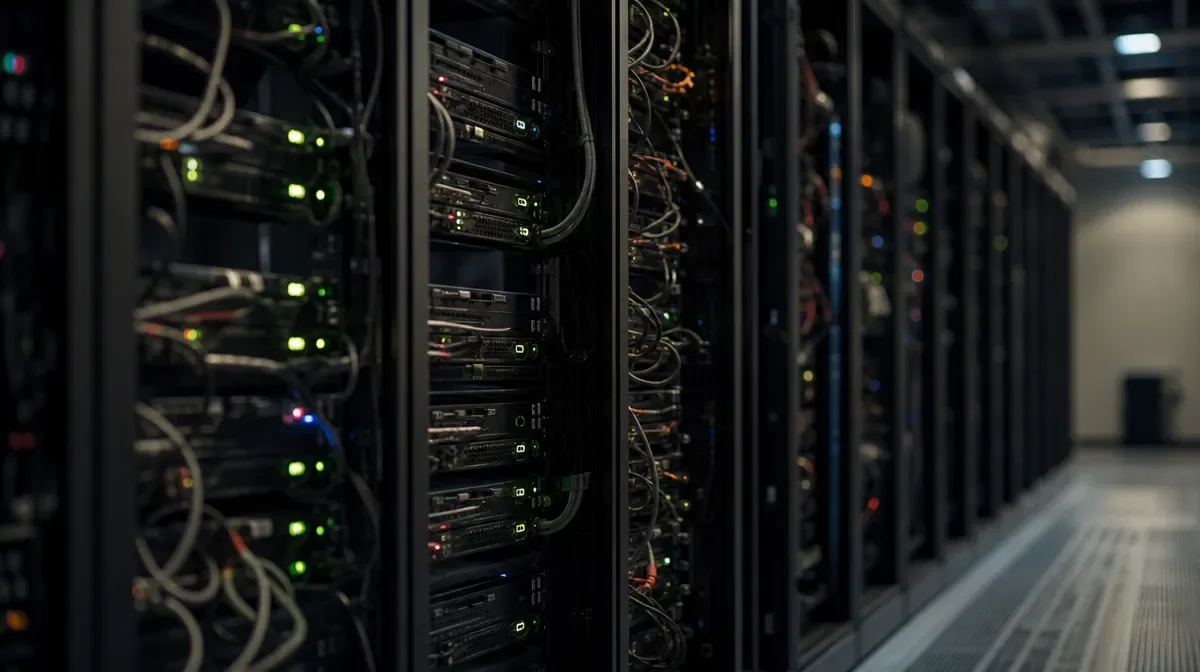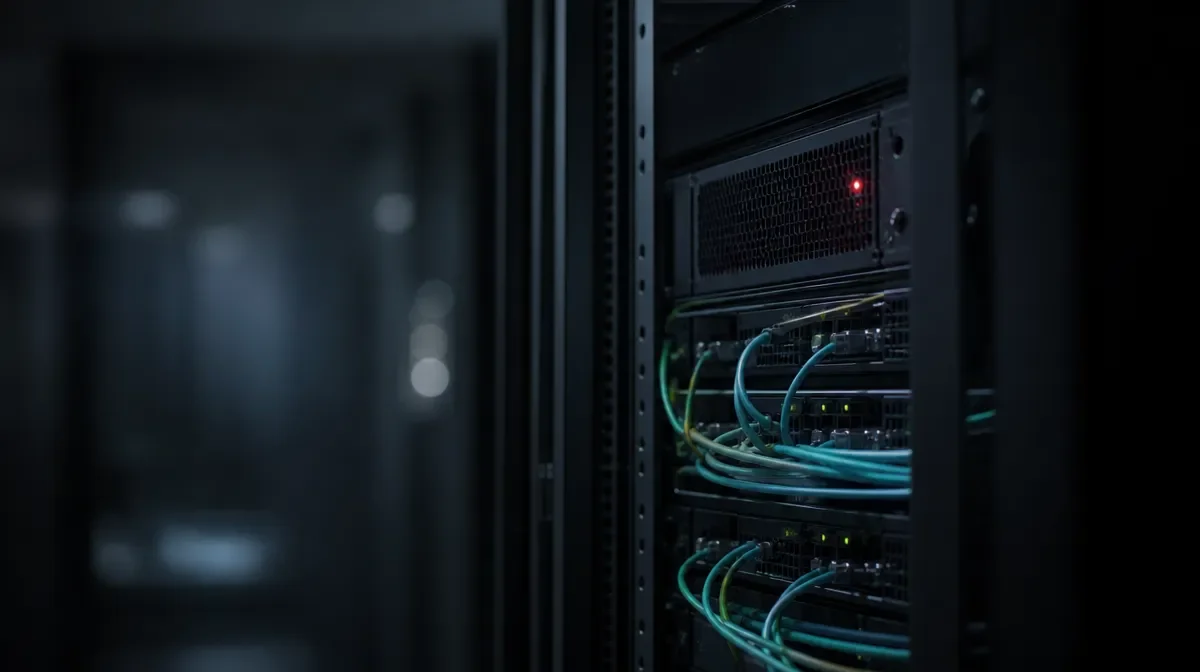

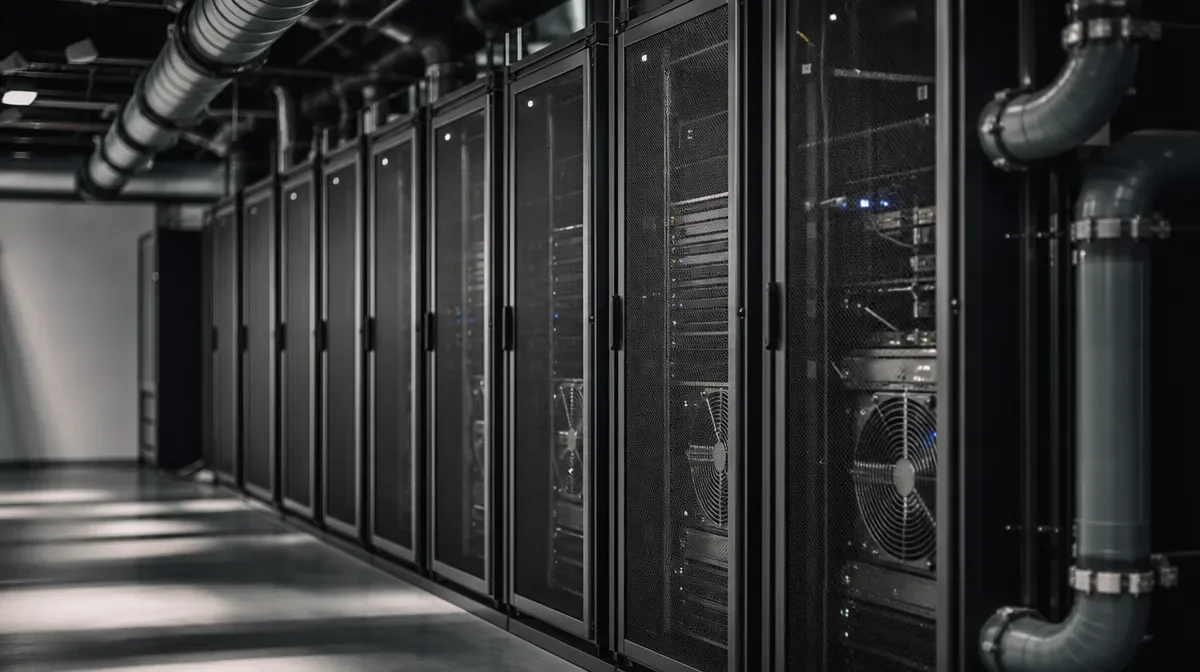
Hitachi, Ltd. announced on November 16, 2026 (JST) that it has built the Omika Data Center Lab, a demonstration facility for AI data centers designed to cut cooling power while keeping operations stable. The lab sits in the Omika area of the Ibaraki site of Hitachi's Research & Development Group in Japan. It runs liquid-cooled GPU servers and air-cooled servers in the same space, letting Hitachi test everything from optimizing the whole cooling system to controlling and operating the data center as a single process.
The lab is split into two areas mixing liquid-cooled GPUs and air-cooled servers
The lab is divided into two main areas.
- AI data center area: Liquid-cooled GPU servers and air-cooled servers operate together, with instruments that measure power and temperature. Real AI workloads are combined with simulated loads to reproduce a range of operating conditions
- Liquid cooling evaluation area: Several simulated liquid-cooled servers reproduce the heat output of next-generation GPUs. They are evaluated together with a CDU (Coolant Distribution Unit), which distributes coolant to each server, and cold plates designed for high-heat GPUs
Hitachi will also use the lab as an internal computing platform for AI and R&D. Under what it calls a "customer zero" approach, in which the company treats itself as the first customer and uses new technology in-house before others, it plans to run actual AI training on the lab while verifying cooling optimization.
Hitachi will test per-second temperature prediction and load-based cooling control
The technologies under test fall into two broad groups: control of the cooling itself, and the systems used to operate the facility.
On the control side, Hitachi will verify whether it can predict the temperature distribution inside the server room every second, with an error of 1°C or less against measured values. Building on that prediction, it will coordinate air-cooling and liquid-cooling equipment in real time according to server load, to avoid cooling more than necessary. For liquid cooling, the aim is to control and distribute coolant flow according to each GPU's heat output, lowering the power used by the pumps.
On the operations side, Hitachi says it has already set up an environment for remotely monitoring IT equipment and cooling systems, displaying and logging alarms, and remotely adjusting cooling-water temperature and flow. Going forward, it will develop and test technology that analyzes alarm and operating data to support responses to anomalies and remote adjustments, as well as inspection and maintenance based on equipment condition and risk. The goal is to let a limited number of staff keep the facility running.
The announcement does not give specific figures for how much cooling power could be saved. At this stage Hitachi has set out what the lab will test, and the size of any benefit will depend on the results of the verification work ahead.
Generative AI is making heat and power a growing challenge for data centers
The backdrop is the rising density of data centers driven by the spread of generative AI. Servers packed with high-performance GPUs produce a lot of heat, and air cooling alone is increasingly unable to keep up. Liquid cooling, which uses cold plates with coolant running through them against the GPUs, is being adopted as a result, but existing air-cooled equipment remains in place. That makes efficiently cooling environments where both methods coexist a key challenge.
In this field, Hitachi offers HMAX Data Center, a solution that operates a data center's power, IT and cooling equipment in coordination. HMAX Data Center is one of the company's HMAX by Hitachi solutions. Hitachi says it will use results from the new lab to expand HMAX Data Center.
The lab is also positioned as a forerunner of Chowa no Oka, a next-generation research base for social infrastructure that Hitachi is developing toward 2030. Hitachi says it will serve as a place to put research planned for Chowa no Oka into concrete form ahead of schedule. The company also intends to involve customers and partners in future demonstrations, but it has not named any specific companies.
Our Take: Cooling is shifting from a component problem to a whole-facility problem
What stands out to us is that Hitachi is testing everything from chip-level cold plates to facility-wide control and operations in one place. Making a data center more power efficient depends not only on the performance of individual cooling units but on how the whole facility responds as loads change. Pairing per-second temperature prediction with real-time control is an attempt to address exactly that question of how the equipment is run.
At the same time, no savings figures have been released yet, and the temperature-prediction accuracy is a verification target rather than a result. As AI data centers are built out in Japan under tight power constraints, the real question will be how large the benefits turn out to be. We will be watching how Hitachi reports the results, including its work on running facilities with fewer staff.
Summary
Hitachi has built the Omika Data Center Lab at its R&D site in Ibaraki, Japan, a demonstration facility modeled on AI data centers where liquid-cooled GPU servers and air-cooled servers coexist. While running actual AI training, it will test per-second temperature prediction, load-based coordination of air and liquid cooling, lower pump power through coolant flow control, and support for remote monitoring and maintenance. Hitachi plans to use the results to expand HMAX Data Center.
Sources: