Japanese AI startup higurashi Inc. released Haru-4B on November 13, 2026 (JST), a full-duplex speech dialogue foundation model that can listen and speak at the same time. It is a speech-to-speech model that takes audio as input and responds with audio, and it was trained with nine primary languages, including Japanese. The model weights are on Hugging Face and the code is on GitHub, both under the Apache License 2.0.
One Model Handles Backchannels and Interruptions
Most voice assistants have worked on a turn-taking basis, waiting for the user to finish speaking before replying. Haru-4B instead processes the user's incoming speech and its own outgoing speech simultaneously. The company says its goal is for people to talk with AI as if they were talking to another person, rather than feeling like they are operating an agent or assistant.
The model processes input and output audio together every 133 ms. Internally, it adds together three streams, the user's audio, the model's audio, and the model's text, and handles them with a single shared language model. According to the company, this cuts context length to one-third compared with interleaving the three streams. Audio is represented as a continuous 7.5 Hz latent representation, without discrete codebooks.
Built on Qwen3.5-4B and Trained on Over 40 Million Hours of Audio
The language model backbone is Qwen3.5-4B, released by Alibaba Cloud. The company explains that it chose a newer LLM with strong multilingual capabilities.
Pretraining used more than 40 million hours of audio spanning over 160 languages. The primary languages are English, Spanish, Portuguese, German, French, Chinese, Japanese, Russian, and Korean. The company says it excluded turn-based dialogue data generated with LLMs or speech synthesis. It also used more than 13 million hours of full-duplex dialogue data separated by speaker, including conversations up to 60 minutes long. Pretraining took about eight days on 256 NVIDIA B200 GPUs.
To build the full-duplex training data, the company also developed FastDialogueSidon, a model that separates and restores speech at the same time, and released it on GitHub. Development was supported by GENIAC, a generative AI development support program run by Japan's Ministry of Economy, Trade and Industry and NEDO, and by Amazon Web Services.
Runs on a MacBook With About 65 ms of Latency
The company reports latency of about 65 ms on a MacBook with an Apple M1 Max. It measured this with a native Swift app optimized with custom Metal kernels, int8 weights, and a wired microphone and headphones. The figure includes audio encoding, language model inference, audio decoding, and device input and output, but not the delay from splitting audio into frames. The company states that framing adds up to 133 ms of algorithmic latency on top of that.
The model can also run on GPUs through vLLM-Omni. On an NVIDIA B300, the company says audio encoding and decoding plus one language model step take about 15 ms combined.
Trying It Locally Requires a GPU With About 12 GB or an Apple Silicon Mac
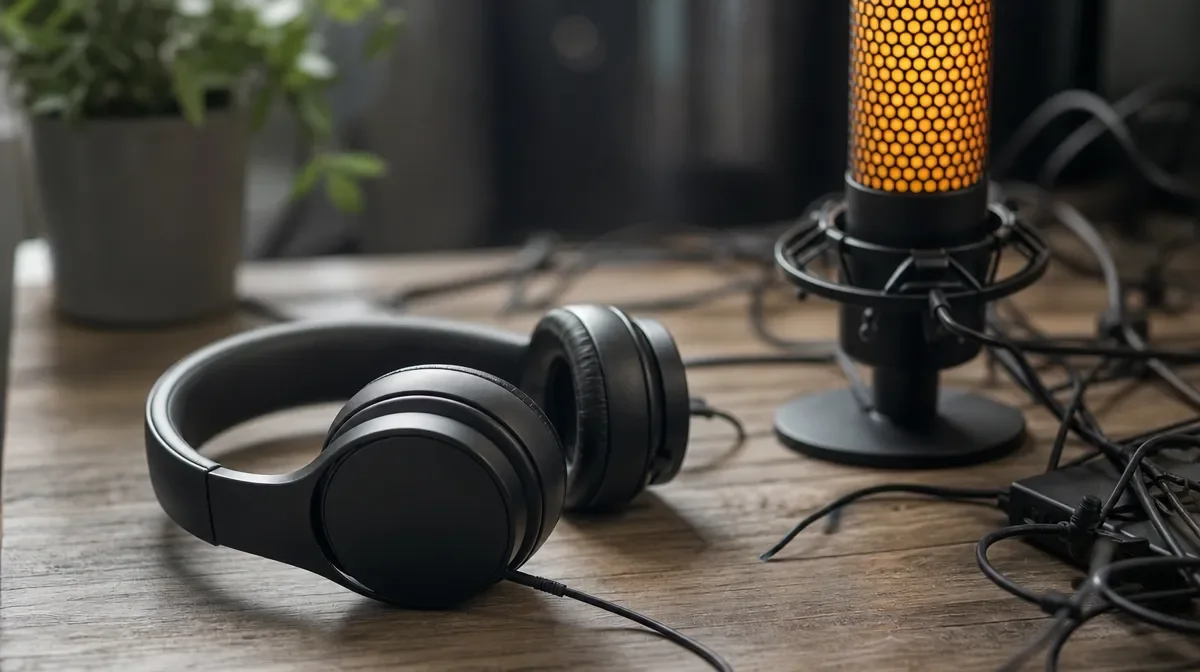
The GitHub repository includes a PyTorch implementation with a web demo server, an MLX implementation and macOS app for Apple silicon, and a plugin for vLLM-Omni. The model card says running it on an NVIDIA GPU takes about 12 GB of memory. It recommends wired headphones and a microphone, since Bluetooth devices add 100 ms or more of delay.
No voices are bundled. Users supply their own reference clip of three seconds to three minutes, and the model card asks users to only use voices they have the right to use.
It is worth noting that Haru-4B is a pretrained base model released for research. The model card states that it is not a reliable source of facts and does not follow instructions the way an assistant does. The company itself acknowledges that response quality is limited by the relatively small size of the language model, and that separation errors and noise can remain where speakers overlap.
Our Take
We see Haru-4B's significance less in raw intelligence and more in conversational tempo. If a 4B-class model can run on a laptop and handle natural exchanges, including backchannels and interruptions, the voice AI experience could change considerably. The release of weights and code under the Apache License 2.0 also makes it an accessible option for researchers working on Japanese spoken dialogue.
On the other hand, it has not yet been tuned to follow instructions, so it is not ready to serve as an everyday assistant. The company says it is pretraining a larger full-duplex model with more than 100B parameters and plans to publish a more detailed technical report and training code. The next question is how well the low-latency design of the small model holds up at that scale.
Summary
Higurashi's Haru-4B is a full-duplex speech dialogue foundation model trained mainly on nine languages, including Japanese. It achieves latency of about 65 ms on a MacBook, and its weights and code are available under the Apache License 2.0. While it is a research base model with limited response quality, it is a notable way to try human-like voice AI on your own machine.
Specifications and figures are based on what Higurashi announced on its official tech blog on November 13, 2026 (JST), and on the company's published pages.