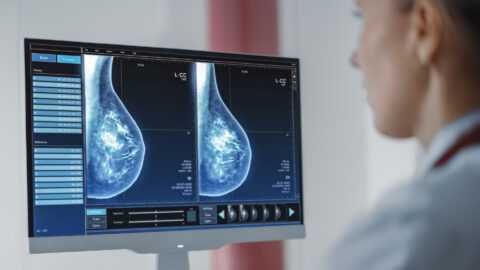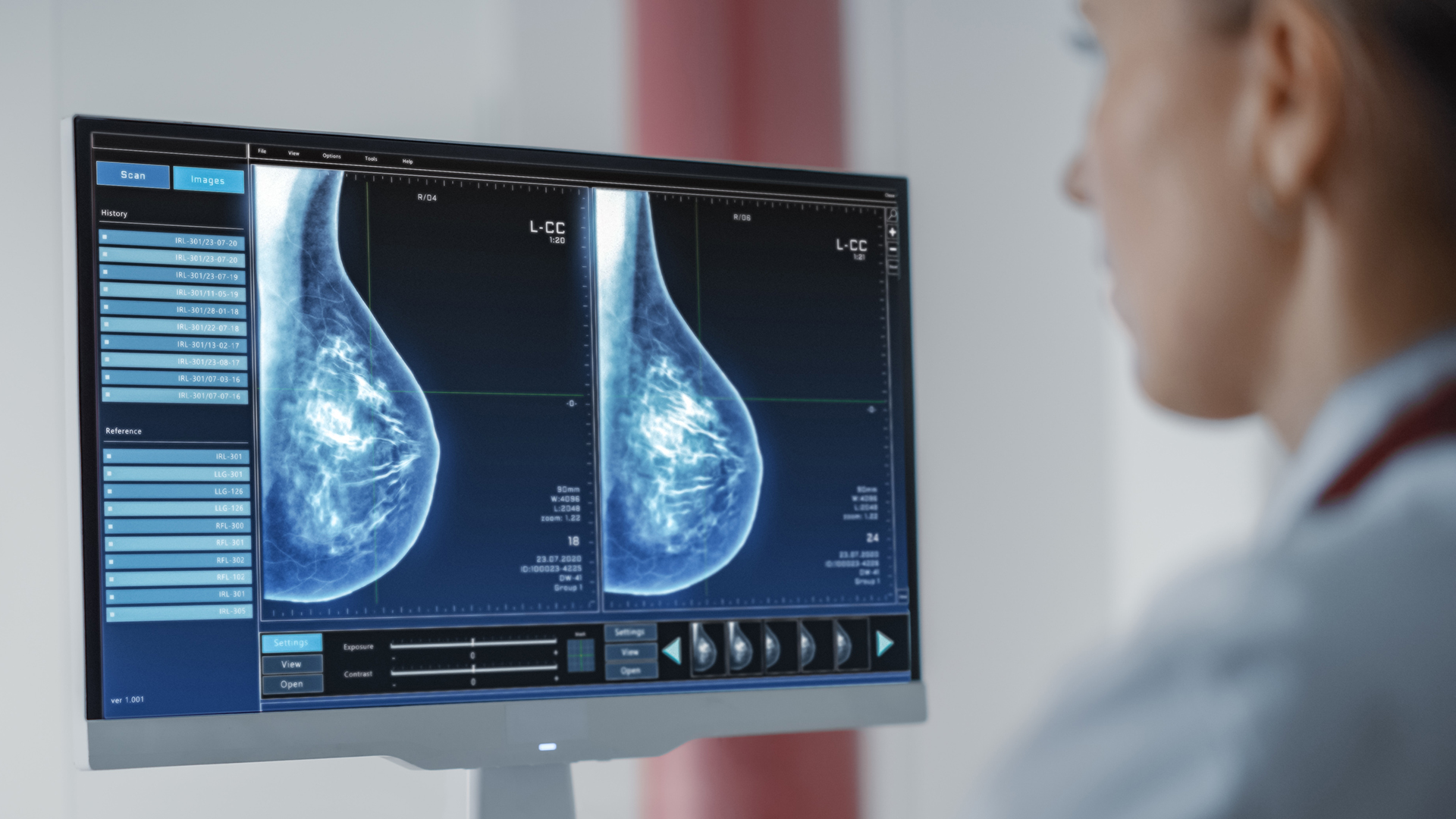
NVIDIA has used its official blog to highlight how startups in its NVIDIA Inception program are applying AI across breast cancer care[1]. The four companies featured are iSono Health (3D ultrasound imaging), Whiterabbit.ai (mammography analysis), Ataraxis AI (treatment response prediction) and SimBioSys (3D tumor modeling).
Three Gaps from Screening to Treatment
According to the blog, about 40 million mammograms are performed in the U.S. each year, yet a majority of women over 40 skip the recommended annual screening[1]. A projected shortfall of tens of thousands of radiologists over the next decade is also straining the people who read those images.
Gaps remain after diagnosis, too. Genomic assays that guide treatment are often sent to outside labs, and results can take weeks. The four startups aim to address both ends of the care timeline, and the steps in between, with NVIDIA AI infrastructure.
iSono Health: A Full 3D Breast Scan in About Two Minutes
iSono Health's ATUSA is a wearable, automated 3D quantitative ultrasound system with FDA clearance. It captures a breast volume in about two minutes per breast, compared with up to 45 minutes for conventional handheld ultrasound[1].
Its AI was trained on over 1.5 million ultrasound frames, and it uses NVIDIA GPU acceleration and open source medical imaging technology to automate image acquisition. The company says the resulting 3D scan is 28% more sensitive than a handheld 2D ultrasound. Because the whole breast is captured the same way each time, scans can be compared from year to year.
ATUSA is available through partner clinics in California, Texas, Georgia, Tennessee and Washington D.C. A multicenter clinical study with 3,200 patients is underway, with lead sites at UC Davis and Vanderbilt University Medical Center.
Whiterabbit.ai: Easing the Burden of Reading Mammograms
Whiterabbit.ai develops AI for breast cancer screening. Its FDA-cleared WRDensity software automatically assesses breast density and has been used in the care of hundreds of thousands of patients. The company also offers WRRisk, clinical decision support software that estimates long-term breast cancer risk[1].
Cofounder and CTO Jason Su describes radiologists as searching for roughly one cancer in every 200 mammograms, and hopes AI can act as a sidekick that reduces avoidable callbacks. Models are trained on NVIDIA GPUs at Washington University in St. Louis, and inference runs on NVIDIA GPUs deployed in the clinic.
Ataraxis AI: Predicting Treatment Response from Pathology Slides
Ataraxis AI builds models that predict treatment response and recurrence risk from digital data such as pathology slides already collected in standard workups. Current predictions are limited, and may require a separate biopsy with a two- to four-week wait[1].
One model predicts whether presurgical chemotherapy will shrink a tumor; another estimates five-year recurrence risk and the likely benefit of chemotherapy after surgery. Both have been validated across more than 10 institutions and are in active clinical use, running on premises, in an offsite data center and in the cloud with PyTorch and NVIDIA CUDA.
SimBioSys: 3D Tumor Models for Surgical Planning
SimBioSys creates 3D models of breast tumors, veins and other soft tissue to help guide surgery and treatment plans. It also offers a tool that estimates recurrence risk from 3D breast MRI data, tumor pathology and clinical data[1].
The company uses NVIDIA MONAI for training and validation data, and CUDA-X libraries including cuBLAS and MONAI Deploy for imaging, on NVIDIA GPUs in the cloud. CEO Stacey Stevens says combining imaging, pathology and genomic data generates insights beyond any single input.
Summary
The examples show startups building on NVIDIA GPUs and CUDA at every stage of breast cancer care: image capture, reading, treatment prediction and surgical planning. The blog notes that some of the technologies described are investigational and have not been approved by the U.S. FDA for commercial use.
Source: https://blogs.nvidia.com/blog/ai-breast-cancer-startups/