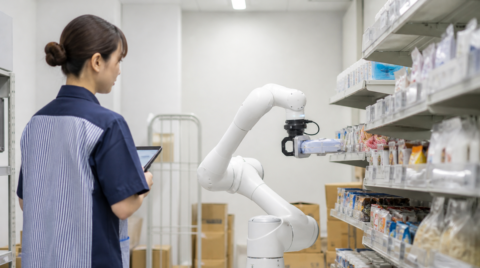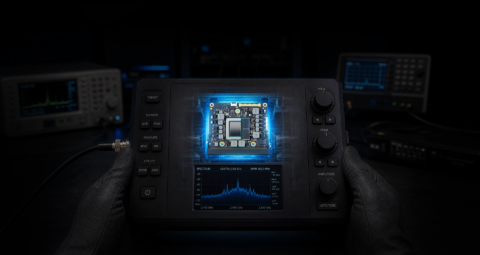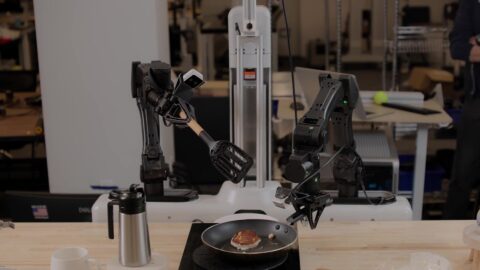
On July 15, 2026, NVIDIA introduced two new embedded modules for robots and edge AI devices: the Jetson T3000 and the Jetson T2000[1]. Both are built on the company's Thor architecture and are aimed at supplying compact, power-efficient AI computers to humanoids and autonomous machines as they move from the research stage into mass-market deployment. Their defining trait is delivering performance derived from the flagship T5000 in a far more manageable size and power envelope.
New Modules for the Era of Mass-Market Robots
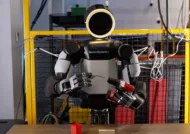
General-purpose robots and autonomous machines are moving out of research labs and into the real world, driving demand for compact, power-efficient AI computers that can run foundation models directly on the device. The newly announced T3000 and T2000 are positioned as mass-market modules built to meet exactly that demand.
The underlying Jetson AGX Thor platform is already becoming a foundation for the next generation of humanoid and robotic systems. According to NVIDIA, leading companies across industries — including 1X, Agile Robots, Amazon Robotics, Boston Dynamics, FANUC, Hitachi and Techman Robot — are building on the platform[1].
Performance and Configuration of the T3000
At the center of the announcement are the Jetson T3000 and the industrial IGX T3000 modules. In a compact chassis, they deliver 865 FP4 teraflops of AI compute while fitting into roughly half the size and power of the higher-end T5000[1]. The configuration pairs an NVIDIA Blackwell GPU with an eight-core Neoverse Arm CPU, 32GB of LPDDR5X memory, 273GB/s of memory bandwidth and 25 Gigabit Ethernet connectivity.
The industrial IGX T3000 adds integrated functional safety to the same performance and can run NVIDIA Halos for Robotics, a safety system for robots that operate alongside people. Despite its smaller footprint, NVIDIA says it achieves inference performance close to the T5000 for multimodal workloads such as large language models, vision language models, vision language action models and world foundation models. With memory prices staying high, the company notes that migrating to the T3000 also helps reduce costs.
The T2000 Targets Broader Edge AI, Expanding the Jetson Family
The other new module, the Jetson T2000, brings the Thor architecture to a wider range of edge AI devices. With 400 FP4 teraflops of compute and 16GB of memory, it serves as an entry point for developers building visual AI agents, autonomous mobile robots, industrial manipulators and similar systems[1].
With these two additions, NVIDIA's edge AI platform now spans a performance range from 70 TOPS to 2,000 teraflops. That gives developers more room to balance performance and cost, and NVIDIA says it can address virtually any edge AI workload.
Agent Skills and Cosmos 3 Edge Strengthen the Software Side
Alongside the hardware, NVIDIA also expanded the software that supports development. The newly released Jetson agent skills use AI agents to automate memory optimization, system configuration and deployment tasks that previously required manual effort and deep expertise[1]. They support the entire Jetson lineup, including Jetson Thor and Jetson Orin, and can shorten optimization work that used to take weeks down to days.
In practice, humanoid robotics companies UBTech and Agile Robots, along with industrial solutions provider Connect Tech, cut memory usage by up to 15GB, enabling a move from the Jetson AGX Orin 64GB to the 32GB module. Smart retail firm SandStar reduced usage by up to 4GB, and GROOVE X, the maker of the LOVOT robot, uses Jetson's heterogeneous AI accelerators to keep memory usage down. In transportation, NoTraffic cut memory usage by 30 percent on the Jetson TX2 NX, creating room to add AI features without adding hardware.
NVIDIA also introduced Cosmos 3 Edge, a lightweight world foundation model for Thor platforms. This 4-billion-parameter model helps devices perceive their surroundings through on-device inference, reason in real time and generate actions. Developers can post-train it for specific robots and sensors in about a day and deploy it on Jetson Thor for real-time visual analysis and motion control.
How to Get Started and When It Ships
Because the new modules share a chip architecture and software stack with the Thor family, moving development over is straightforward. Developers can start today using the Jetson AGX Thor developer kit, available through channel partners, and emulate the performance of the T3000 and T2000 while they build[1].
T3000 emulation mode becomes available later this month with JetPack 7.2.1, and T2000 emulation support will follow in a future release. As for the modules themselves, the Jetson T3000 and T2000 are scheduled to become available in the first quarter of 2027. Ecosystem partners including ADLINK, Advantech, AAEON, Aetina, Connect Tech and Seeed Studio are already providing Thor-based solutions.
Summary
The Jetson T3000 and T2000 pack T5000-derived performance into roughly half the size and power, and are designed to accelerate the spread of mass-market robots and edge AI. Software improvements such as agent skills and Cosmos 3 Edge arrive at the same time, and developers can get a head start with the developer kit. With availability set for the first quarter of 2027, the question now is how far the modules will push the real-world deployment of humanoids and autonomous machines.
Source: https://blogs.nvidia.com/blog/jetson-thor-robotics-edge-ai-agent/