Apple announced iPhone 18 Pro and iPhone 18 Pro Max on September 9. The headline change is variable aperture on the 48MP Fusion Main camera, the first time an iPhone lets you choose the lens aperture by hand. The chip is the 2-nanometer A20 Pro, and cooling is handled by a redesigned vapor chamber with three times the surface area. Pricing starts at 219,800 yen including tax, with pre-orders opening September 12 at 9 p.m. Japan time and availability on September 18[1].
The First iPhone Camera That Lets You Pick an Aperture
The new 48MP Fusion Main camera uses six laser-cut blades driven by a new rotor mechanism. Together they move smoothly between aperture values and adjust depth of field and exposure automatically[1].
Four settings are available, ƒ/1.48, ƒ/1.8, ƒ/2.8 and ƒ/4.0, and each can be selected manually in the Camera app[2]. In dim rooms the lens opens to ƒ/1.48 to gather light, while for group shots it stops down to keep the back row in focus. That kind of deliberate choice now works on a phone. Apple also gives developers an API for finer control across the aperture range in third-party apps[1].
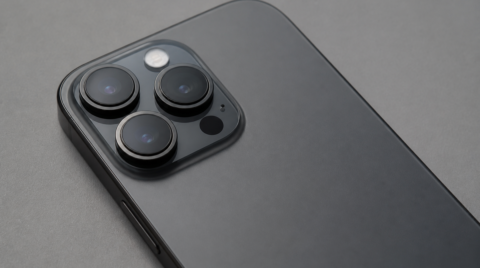
On the back, the Main, Ultra Wide and Telephoto cameras are all 48MP Fusion units, covering optical zoom from 0.5x to 8x. The front camera is an 18MP Center Stage camera[2]. For video, Cinematic effects can now be applied after the fact to footage shot at up to 60 fps, and Time-lapse records in 4K with Dolby Vision HDR[1].
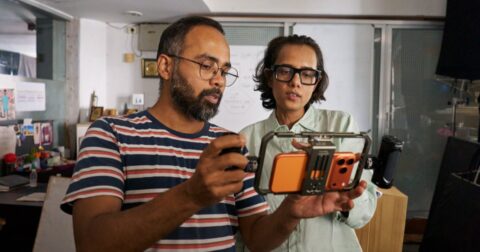
New Pro controls add manual shutter speed and white balance alongside aperture, plus a histogram for checking exposure[1]. There is far more room to dial in a shot than before.
Apple Reference Image Certifies What the Sensor Saw
The feature worth pausing on is Apple Reference Image. The Main camera's new sensor can sign every pixel it captures, and shooting in the new Reference mode sends that signed sensor data through Private Cloud Compute to become an unalterable reference image[1].
The result sits in Photos next to the main image like a digital negative. Comparing the two shows whether any edits were applied, and APIs in iOS and macOS 27 let third-party apps display reference images as well. Combined with upcoming support for the SynthID standard, this is Apple's answer to a world where AI-generated imagery is routine[1].
The feature is opt-in, and it is not available in China at launch for regulatory reasons. In the EU, capture is not available on iPhone 18 Pro models at launch either[3].
A20 Pro and a Vapor Chamber Three Times Larger
A20 Pro is built on the latest 2-nanometer process. Its new 6-core CPU integrates Neural Accelerators and carries 50 percent more memory bandwidth than A19 Pro. The 7-core GPU is up to 40 percent faster than A19 Pro, and the Dual 16-core Neural Engine adds up to 32 cores in total for double the AI processing power of A19 Pro[1].
The thermal design was rebuilt as well. Packaging inspired by M-series Apple silicon places the silicon die alongside memory, pulling memory out of the chip's thermal path so that A20 Pro attaches directly to the vapor chamber. That vapor chamber has three times the surface area of the one in iPhone 17 Pro, and sustained performance improves by up to 40 percent over the previous generation[1]. The emphasis is clearly on not throttling during long recording or gaming sessions rather than on peak numbers.
On connectivity, both models carry Apple's own N1 chip for Wi-Fi 7, Bluetooth 6 and Thread. The C2 modem in iPhone 18 Pro delivers meaningfully faster uploads than C1X while consuming 15 percent less energy[1].
Battery Life and the Move to eSIM Only
On eSIM-only models, iPhone 18 Pro is rated for up to 36 hours of video playback and iPhone 18 Pro Max for up to 45 hours. Reclaiming the space once used by the physical SIM allowed a larger battery, worth two extra hours of video playback[1].
Japan is among the countries, alongside the U.S. and Canada, that get eSIM-only models. More than 500 carriers worldwide support eSIM, including au (KDDI), NTT Docomo and SoftBank, so the practical impact is limited, though anyone relying on a physical SIM workflow should check in advance[1].
Charging reaches up to 50 percent in about 15 minutes wired, or 30 minutes wirelessly. Five minutes of wired charging on iPhone 18 Pro Max provides around seven hours of video playback, and a new model based on real-world usage data puts a full charge at up to 30 hours of use[1].
Pricing and Availability
iPhone 18 Pro has a 6.3-inch display and iPhone 18 Pro Max a 6.9-inch display, both Super Retina XDR with ProMotion and always-on. The enclosure is an aluminum unibody[2].
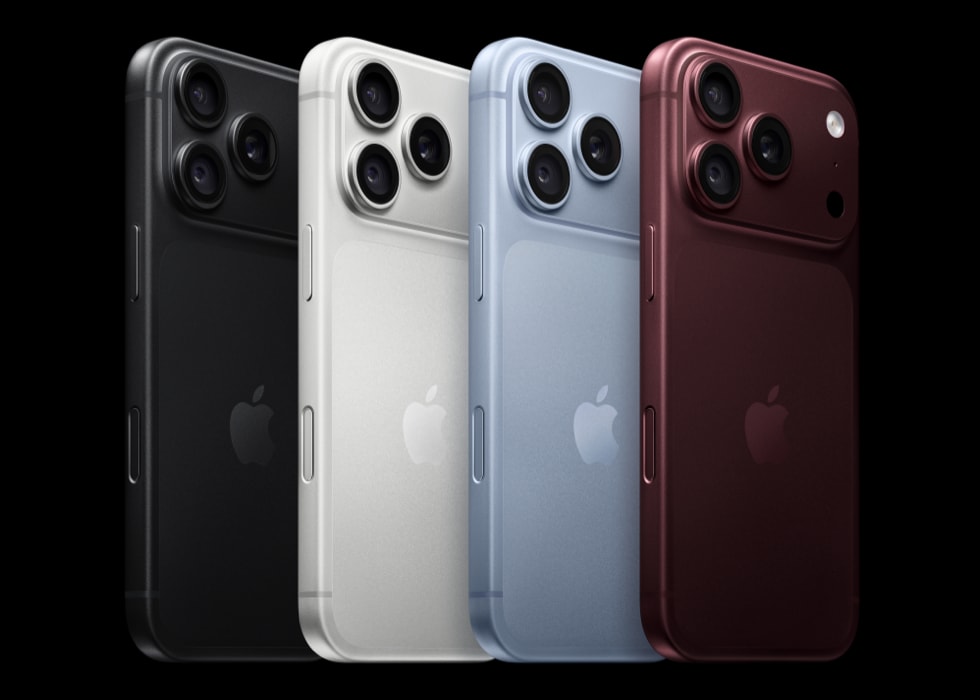
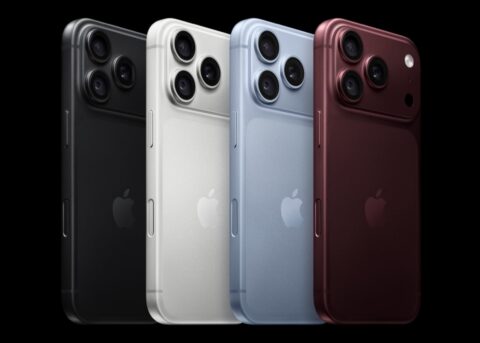
The finishes are black, silver, glacier and a new burgundy, with 256GB, 512GB, 1TB and 2TB storage options. iPhone 18 Pro starts at 219,800 yen including tax and iPhone 18 Pro Max at 239,800 yen, with the higher iPhone 18 Pro tiers at 254,800 yen for 512GB, 324,800 yen for 1TB and 429,800 yen for 2TB[1][2]. Apple Trade In credits range from 43,000 yen to 135,000 yen for an iPhone 13 or later[1].
Pre-orders begin September 12 at 9 p.m. Japan time in more than 65 countries and regions including Japan, with availability on September 18. Twenty more countries and regions follow on September 25. iOS 27 and Apple Intelligence arrive September 15, and the new Siri AI starts the same day as a beta, in English only at first, with Japanese support planned for October[1].
Summary
What sits at the center of iPhone 18 Pro is a camera that brings the discipline of optical aperture control to a phone. Choosing an aperture is nothing new in itself, but making it work both automatically and manually, then layering Apple Reference Image on top to vouch for the authenticity of the capture, shows where Apple is aiming. A20 Pro and the tripled vapor chamber follow the same logic, favoring sustained stability over headline speed. Siri AI does not speak Japanese until October, so anyone buying primarily for the AI features may want to see how it performs first.
Source [1]: https://www.apple.com/jp/newsroom/2026/09/apple-debuts-iphone-18-pro-and-iphone-18-pro-max/
Source [2]: https://www.apple.com/jp/shop/buy-iphone/iphone-18-pro
Source [3]: https://www.apple.com/newsroom/2026/09/apple-debuts-iphone-18-pro-and-iphone-18-pro-max/














![Newsed Phone Opens Store for Used iPhones With 100% Battery Capacity [PR]](https://claypier.com/wp-content/uploads/2026/07/newsedphone-battery-100-iphone-480x236.png)