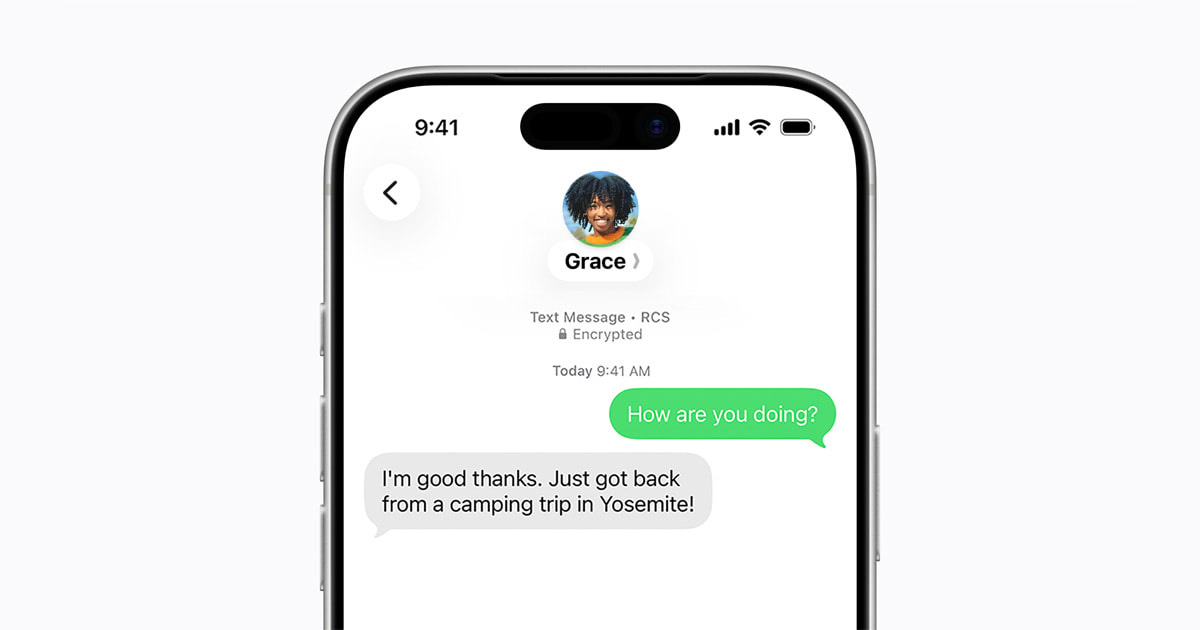
On May 11, 2026, Apple and Google began rolling out a beta version of end-to-end encryption for RCS messages exchanged between iPhone and Android devices[1][2]. On iPhones running iOS 26.5, a new lock icon now appears on encrypted conversations[1]. RCS, which has long been developed as the successor to SMS, finally gains cross-platform encryption.
What Changes With End-to-End Encryption for RCS
RCS (Rich Communication Services) is a messaging standard that supports high-quality image sharing and read receipts, and it has spread as a replacement for traditional SMS. Google Messages has encrypted conversations between Android devices end-to-end for years, but RCS conversations spanning iPhone and Android were not covered by encryption[2].
With this beta rollout, RCS messages exchanged between iPhone and Android are now covered as well. End-to-end encrypted messages cannot be read by third parties while they travel from one device to another[1]. Encryption is on by default, and it will be applied automatically over time not only to new conversations but also to existing RCS conversations[1]. Users can check whether a conversation is encrypted by the lock icon shown on the chat screen[1][2].
End-to-end encryption is a system in which only the sending and receiving devices can decrypt a message. Because the network path and the service provider in between cannot read the message, the risk of eavesdropping and data leaks is reduced. It is no small thing that this protection becomes standard in the default messaging feature of a smartphone.
An Industry-Wide Effort Aligned With GSMA Standards
This encryption support was not implemented independently by Apple and Google on their own; it was advanced as an industry-wide effort in cooperation with the GSMA, the standards body for the mobile industry[1]. The two companies have jointly led the development to make the cross-platform messaging format that replaces SMS more secure and privacy-conscious[1][2].
The technical foundation is the GSMA RCS specification known as Universal Profile 3.0. This specification incorporates the standardized encryption method called Messaging Layer Security (MLS), and because both Apple and Google support it, common encryption now works even between different operating systems[3]. The fact that it follows an industry standard rather than a single company's proprietary method offers the advantage that other device makers and carriers can follow suit more easily.
The Electronic Frontier Foundation (EFF) described this move as a "victory," praising as a step forward the fact that users can benefit from encryption through the standard messaging feature without any special action[4].
Conditions Apply, and Group Chats Come With Caveats
It is a convenient feature, but not every user can use it right away. For an encrypted conversation to be established, both the sender and the receiver must use a carrier that supports the latest version of RCS[2]. Some carriers can handle RCS itself but do not yet support the encryption layer, and the number of supported carriers is expected to expand gradually[1][2]. Because the rollout proceeds in stages according to device, carrier, and account, even users who meet the conditions may not be able to use it immediately[1].
Group chats require particular attention. If even one participant uses a device or carrier that does not support encryption, the entire group is not encrypted[4]. In addition, even though the contents of messages are protected, metadata such as who communicated with whom and when may still be collected and stored, so for uses that demand higher confidentiality, a dedicated encrypted messaging app may be a better fit in some situations[4].
For communication between Apple devices, Apple explains that iMessage, which has always been end-to-end encrypted, remains the best option[1]. This RCS encryption is positioned as a mechanism specifically for protecting conversations that span the different operating systems of iPhone and Android.
Summary
With Apple and Google delivering a beta of end-to-end encryption for RCS messages, we have entered an era in which the standard messaging feature spanning iPhone and Android also comes with encryption by default. The fact that it follows a GSMA industry standard gives reason to expect wider adoption ahead. At the same time, it is worth understanding that, for now, this is a conditional feature, given that a supported carrier is required and that group chats come with restrictions.
Source: https://thehackernews.com/2026/05/ios-265-brings-default-end-to-end.html
Source: https://www.eff.org/deeplinks/2026/05/victory-end-end-encrypted-rcs-comes-apple-and-android-chats

















![Newsed Phone Opens Store for Used iPhones With 100% Battery Capacity [PR]](https://claypier.com/wp-content/uploads/2026/07/newsedphone-battery-100-iphone-480x236.png)