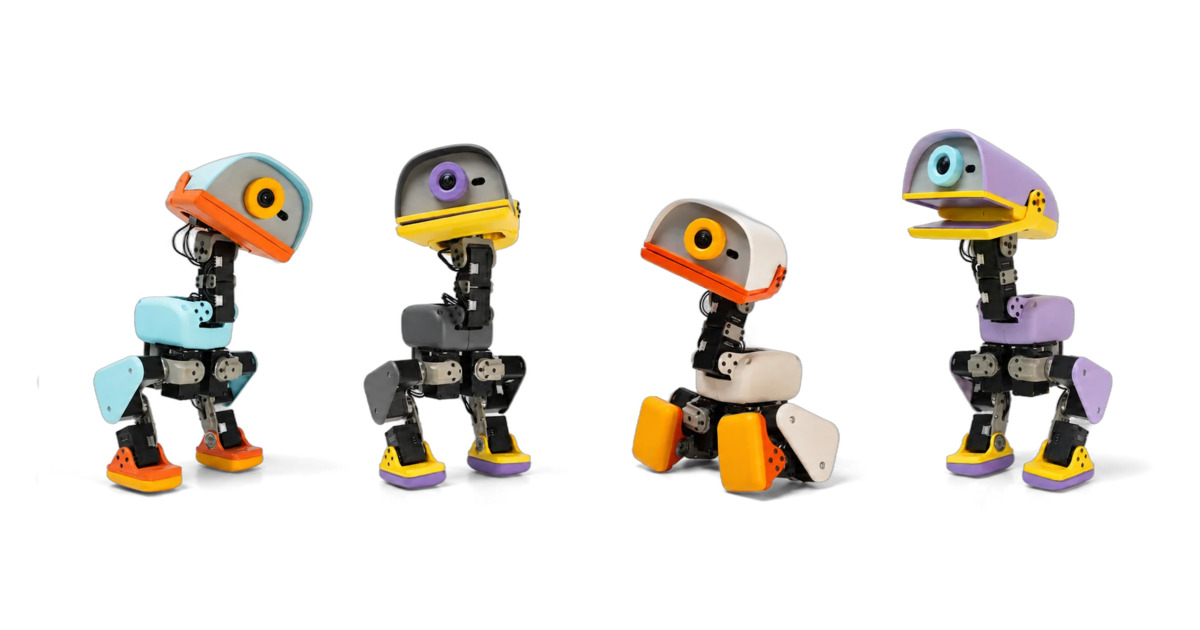
Pollen Robotics, the robotics team at Hugging Face, opened pre-orders for Microduck, a 25 cm biped robot, on August 27, 2026. It costs 399 USD (about 63,000 yen), and the first deliveries are targeted before Christmas. The robot is playable straight out of the box, but every behaviour it ships with, from walking to grabbing to standing back up, is a reinforcement learning model you can retrain in simulation and push back onto the hardware.
※1 USD = 159 JPY
A 25 cm duck for 399 USD
Microduck comes from Pollen Robotics, based in Bordeaux, France. The team was founded in 2016 by former Inria (French National Institute for Research in Digital Science and Technology) researchers, joined Hugging Face in April 2025, and now serves as its robotics group. Microduck is their second consumer robot after the desktop-sized Reachy Mini.
The robot stands 25 cm tall, measures 14 cm wide and weighs under 800 g. It has 15 degrees of freedom spread across its legs, neck and head. Four colourways are offered at launch, Cream, Graphite, Lavender and Sky, and only the shells differ between them.
At launch, sales are limited to North America and Europe. No purchase route from Japan has been announced yet, so domestic availability remains an open question.
An RK3566 inside, with LiDAR and NFC on board
The compute comes from a Rockchip RK3566 SoC with a built-in AI accelerator, paired with 1 GB of RAM and 32 GB of storage. Those numbers look modest next to a smartphone, but they are sized for the actual job, which is running a trained control policy at 50 Hz.
The sensor set is more generous than expected. Alongside the front camera there is a compact LiDAR built on an 8x8 ToF (time of flight, which measures distance from the round trip of light) matrix, plus two IMUs (inertial measurement units), one in the body and one in the head. NFC antennas sit in both the head and the beak, which opens the door to tag-driven interactions. Microphones and a speaker are included, and each robot gets its own generated voice.
The camera has a dedicated in-use indicator, inspired by the REC lights on video cameras. It reads as a deliberate answer to the discomfort of putting a camera-equipped robot in a private room.
Power comes from a removable NP-F550 battery, the 2600 mAh camcorder cell that is widely available off the shelf. Runtime lands around an hour depending on use. Because it is not a proprietary pack, replacements are easy to source, which matters in practice.
In the box you get the robot, the battery, a USB Type-C cable and a game controller. It arrives ready to move without a single line of code.
Seven moves, all of them rebuildable
Seven trained behaviours ship with the robot: a velocity-tracking walk, sitting down and holding the pose before standing again, a one-shot kick, dipping the beak to scoop an object off the ground, roller skating with the skates attached, and getting back on its feet from a fall. The beak can lift up to 800 g, roughly the robot's own weight.
The interesting part starts there. These behaviours are not fixed programs but swappable trained policies. You run reinforcement learning in the MuJoCo physics simulator, deploy the resulting policy on the real robot, watch how it moves, tune it, and train again. That entire loop is published. Training runs either on your own machine or on Hugging Face Jobs.
The SDK, the simulation environment and the RL training scripts are on GitHub under the Apache 2.0 license. A browser-based simulator is hosted on Hugging Face Spaces, so the training environment is available before any hardware arrives. What runs on the robot is what you can read, fork and retrain.
One caveat: only the software is open source. Pollen Robotics states plainly that the mechanical and electronic design files are not released, so this is not open-source hardware. That distinction is easy to miss.
Add-on packs, and the specs still in flux
Three add-on packs are offered separately. The Charger pack, with a dual charger and two batteries, is 39 USD (about 6,200 yen). The Dev pack, holding three spare motors, five motor cables, two batteries, a charger, ten NFC tags, a screwdriver and a screw pack, is 119 USD (about 19,000 yen). The Accessory pack, with a laser pointer, two rollers, a ball and ten NFC tags, is 39 USD. If you plan to work the robot hard, the spare motors in the Dev pack are a practical hedge.
Several specifications remain provisional: camera resolution and field of view, LiDAR range, radio versions, SDK languages, and any age recommendation. The 399 USD figure is described as an introductory price, before taxes and shipping. How much weight you give to those unsettled details is the deciding factor on whether to pre-order now.
Summary
Microduck packs an approachable 25 cm duck-shaped body and a complete reinforcement learning workflow on real hardware into a single 399 USD machine. Play with the controller on day one, then rebuild its movement yourself when that wears off. As an entry point into robotics development, the first step has never been this low. North America and Europe come first, and Japanese availability is still unknown.