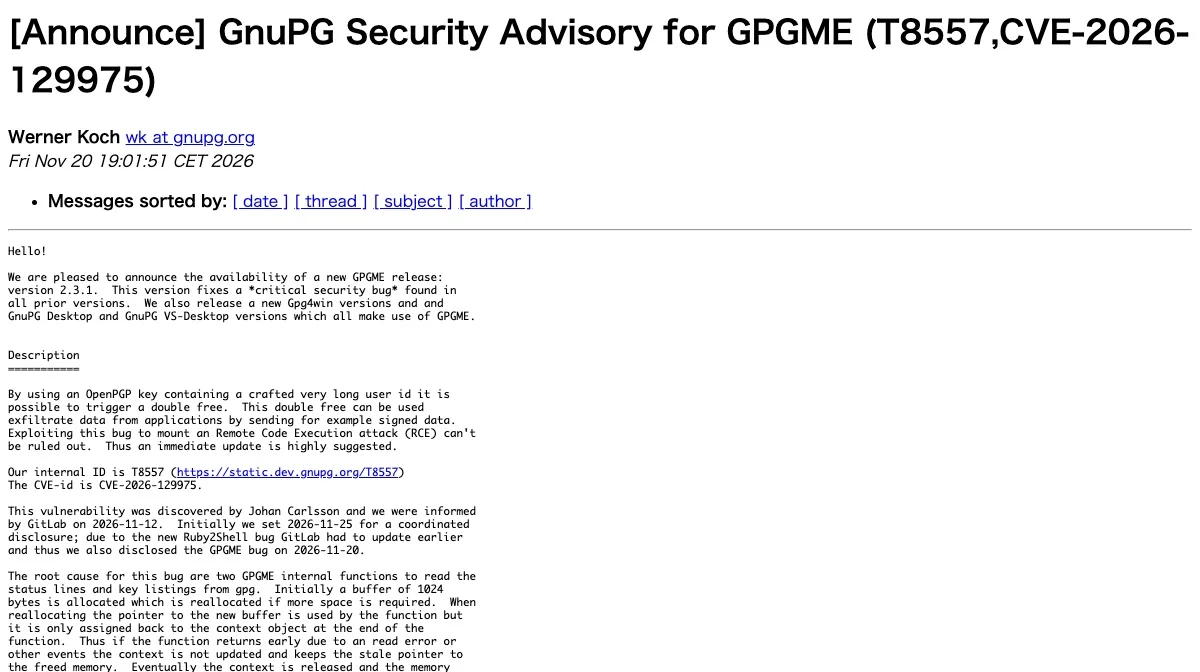
On November 20, 2026 (Central European Time; November 21 in Japan Standard Time), the GnuPG project announced a critical vulnerability in GPGME (GnuPG Made Easy), the library that lets applications use OpenPGP encryption. Tracked as CVE-2026-129975, the flaw causes a double free, meaning the same block of memory is released twice, when a specially crafted key is processed. The project has released GPGME 2.3.1 as a fix and strongly urges an immediate update. Full details are in the GnuPG project's security advisory.
A Crafted, Very Long User ID Triggers the Double Free
According to the advisory, the problem occurs when GPGME handles an OpenPGP key containing a crafted, very long user ID. The user ID is the field that records the key owner's name and email address, and packing it with an extremely long string is enough to trigger the double free.
The project says the bug can be used to exfiltrate data from applications, for example by sending signed data. It adds that a remote code execution (RCE) attack using the bug cannot be ruled out. As of this writing, the advisory does not include a CVSS severity score.
The Root Cause Is a Reallocated Buffer That Was Not Written Back
The cause lies in two internal GPGME functions that read status lines and key listings from gpg, the core GnuPG program. They start with a 1,024-byte buffer and reallocate it when more space is needed.
However, the pointer to the new buffer was only written back to the context object, which tracks the operation's state, at the end of the function. If the function returned early, for example because of a read error, the context kept a stale pointer to memory that had already been freed. When the context was later released, the same memory was freed a second time. The project also notes that an allocator's double-free checks may not catch this because other allocations happen in between.
Mail Clients, Samba, and More Are Affected
All GPGME versions before 2.3.0 are affected, whether the library is used as a shared library, as a Windows DLL, or statically linked into a program. Because version 2.3.0 was never publicly released, in practice every public release before 2.3.1 is vulnerable.
The project lists the following as examples of software that uses GPGME:
- Gpg4win
- GnuPG Desktop / GnuPG VS-Desktop
- Most mail clients
- Many XMPP (chat) clients
- Samba
- Flatpak
Fixes Arrive in GPGME 2.3.1 and Gpg4win 5.1.2
GPGME 2.3.1 was released with a date of November 19. The project asks users to update the shared library to 2.3.1 and to rebuild statically linked programs against 2.3.1. It says there is no need to update GPGMEPP (for C++) or GPGMEQT (for Qt).
For Windows, Gpg4win 5.1.2 has been released with the fixed GPGME, the Kleopatra key manager, and a PDF reader. New versions of GnuPG Desktop and GnuPG VS-Desktop are also out, though the advisory does not give their version numbers. For those who cannot update right away, a patch is provided that the project says will likely apply cleanly even to very old versions.
| Component | Status |
|---|---|
| GPGME | Fixed in 2.3.1 |
| Gpg4win | Fixed in 5.1.2 |
| GnuPG Desktop / VS-Desktop | New versions released (version numbers not stated in the advisory) |
| GPGMEPP / GPGMEQT | No update needed |
Disclosure Came Five Days Earlier Than Planned
The vulnerability was discovered by Johan Carlsson, and the GnuPG project says it was informed by GitLab on November 12. A coordinated disclosure was initially set for November 25. However, because GitLab had to ship an update earlier than planned due to a separate bug called "Ruby2Shell," the project disclosed the GPGME bug on November 20 as well.
Incidentally, version 2.3.1 also adds constants for post-quantum algorithms such as ML-KEM and ML-DSA.
Our Take
GPGME is not software that users interact with directly, but it is widely built into applications that handle encrypted email and similar tasks. The fact that simply receiving signed data or a key could become an entry point for an attack should not be taken lightly. On the other hand, a patch that is expected to apply even to old versions is available, so Linux distributions and app developers are likely to respond relatively quickly. That said, apps that statically link GPGME will remain vulnerable until their developers rebuild them. It would be prudent for users to check not only operating system package updates but also update notices for individual apps.
Summary
The GnuPG project has released GPGME 2.3.1 to fix CVE-2026-129975, a double-free vulnerability in the GPGME encryption library. It affects users of Gpg4win and GnuPG Desktop, as well as users of mail and XMPP clients that embed GPGME. For now, the remedy is updating to Gpg4win 5.1.2 on Windows and updating GPGME to 2.3.1 in other environments.