
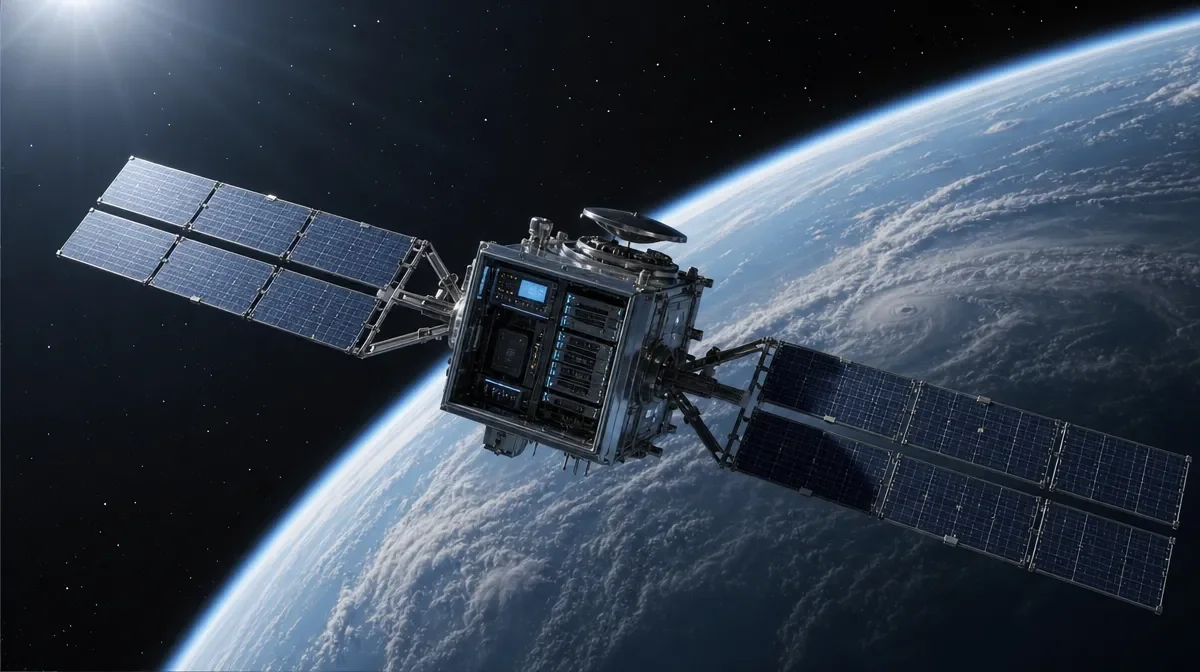
Google announced on November 19, 2026 (US time) in an official Google blog post that it has partnered with Blue Origin on Project Suncatcher, its research effort to scale AI compute in space. The plan is to launch satellites on Blue Origin's heavy-lift New Glenn rocket in the first quarter (January through March) of 2029. Google says this will be the first heavy-lift launch for Project Suncatcher.
New Glenn Will Carry Rack-Scale Satellites to Sun-Synchronous Orbit
The announcement was written by Travis Beals, Senior Director, Paradigms of Intelligence at Google. The mission is a dedicated launch for the project and will place satellites into sun-synchronous orbit. Google says each satellite will have roughly the capacity of a data center rack.
Google has not disclosed how many satellites will fly or the value of the contract. Beals describes the launch as building on the company's ongoing work with other satellite and launch partners, and as a crucial milestone on its long-term roadmap.
Announced in November 2025: TPU Satellites Linked by Optical Communications
Google unveiled Project Suncatcher on November 4, 2025, calling it a research "moonshot" (a long-term, ambitious research bet). The idea is to network solar-powered satellites carrying Google's Tensor Processing Unit (TPU) AI chips so that machine learning workloads can run in space.
According to a technical write-up from Google Research published the same day, the satellites would fly in compact constellations connected by free-space optical links, which use laser light to communicate through space. Google expects them to operate in a dawn-dusk sun-synchronous low Earth orbit, riding the boundary between day and night. In that orbit, it says, a solar panel can be up to 8 times more productive than on Earth.
| Item | Details from the November 2025 technical write-up |
|---|---|
| Inter-satellite link target | Tens of terabits per second |
| Bench demonstration | 800 Gbps each way (1.6 Tbps total) with a single transceiver pair |
| Example constellation | 81 satellites, mean altitude 650 km, cluster radius 1 km, about 100 to 200 m between neighbors |
| Radiation testing | Trillium (v6e) TPU exposed to a 67 MeV proton beam |
| Launch cost outlook | Less than $200/kg by the mid-2030s |
In the radiation tests, high-bandwidth memory (HBM) was the most sensitive component, with irregularities starting at 2 krad(Si). Google puts the expected shielded dose for a five-year mission at 750 rad(Si), and says a single chip showed no hard failures up to 15 krad(Si).
No Public Service Is Planned Yet
When it announced the project, Google said it was planning a "learning mission" with satellite operator Planet to launch two prototype satellites by early 2027. The Blue Origin partnership is a step beyond that, securing a way to send larger satellites into orbit.
Project Suncatcher remains a research project. As of this writing, Google has not announced any cloud service or other offering that businesses or consumers could use based on compute in orbit. For developers and users, nothing changes directly for now.
Our Take
As demand for AI compute grows, securing enough power has become a major challenge for data center operators. Putting compute in an orbit with steady access to sunlight is one long-term option for addressing that problem. With a concrete satellite scale of one rack and a 2029 timeframe now on the table, the project appears to be moving toward real-world testing.
That said, operating in space likely brings challenges that ground-based data centers do not face, including heat dissipation, maintenance when things fail, and radiation tolerance. Whether launch costs fall far enough also depends on the mid-2030s outlook. Still, Google itself calls this a long-term moonshot, and the 2029 launch should be an important step in gathering the data needed to judge whether it can become practical.
Summary
Google has partnered with Blue Origin on Project Suncatcher, its effort to scale machine learning compute in space, and plans to launch satellites into sun-synchronous orbit on New Glenn in the first quarter of 2029. The effort is still in the research stage and is mainly relevant to companies and developers following AI infrastructure and the space industry. Google has not said how many satellites it will launch or when the project might become a business, so further details are likely to emerge in future updates.