
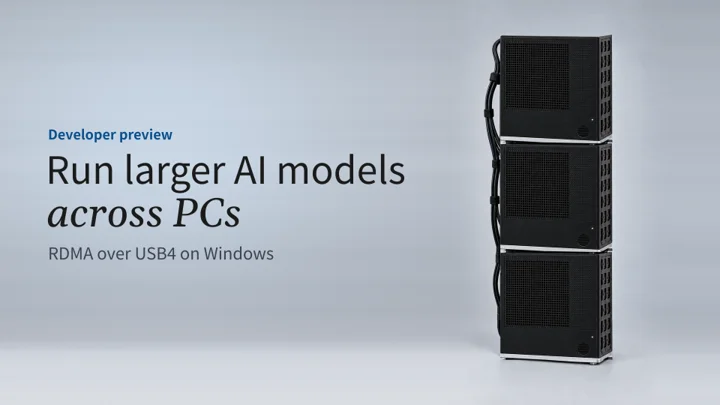
On November 19, 2026 (U.S. time), Microsoft announced RDMA over USB4, a feature that pools the memory and GPU compute of two or more Windows PCs connected directly with USB4 cables so that a single AI model can be split across them. The company introduced it on its Microsoft USB Blog. It will arrive as a developer preview in the Experimental channel (Future Platforms) of the Windows Insider Program soon, according to Microsoft. As of this writing, the supporting build has not been released.
Source: Microsoft USB Blog, "Introducing RDMA over USB4® on Windows: run larger local AI models across PCs"
Multiple PCs Become One Inference Setup Without Dedicated Network Gear
RDMA (Remote Direct Memory Access, a technique for reading and writing another computer's memory directly) has mostly been used with datacenter network adapters. The new feature runs it over the USB4 ports built into PCs. In Microsoft's words, "There's no RDMA network adapter to buy, no switch to configure, and no third-party driver to install."
Here is how it works. First, the Windows USB4 connection manager creates a peer-to-peer tunnel between each pair of PCs. Next, a new RDMA provider implements RDMA in software on the DMA rings of the USB4 host router. Applications see it as NetworkDirect, the RDMA API Windows already uses with datacenter adapters, so compatible inference frameworks do not need to know USB4 is underneath, the company says.
Round-Trip Latency Is About a Quarter of Ethernet over USB4
Latency was Microsoft's main focus. With tensor parallelism (splitting a model's computation across multiple devices), PCs exchange data many times for every token generated. For that reason, the company explains, "latency, more than bandwidth, sets the pace."
In measurements with two PCs, round-trip latency for small messages was about 28 to 50 microseconds, roughly one quarter of what Ethernet (UDP) achieves over the same USB4 link, according to Microsoft. Latency is the same on 40Gbps and 80Gbps ports. On the other hand, 80Gbps ports such as Thunderbolt 5 offer twice the bandwidth, the company says.
Models Over 100B Parameters Run on AMD and Intel Setups
The testing was done in collaboration with AMD and Intel. The main configurations and results Microsoft shared are below.
| Item | AMD setup | Intel setup |
|---|---|---|
| Processor | Ryzen AI Max+ 395 | Core Ultra Series 3 |
| Memory per PC | 128GB (unified memory) | 64GB (9,600MT/s) |
| Connection | USB4 40Gbps, 3 PCs in full mesh | Thunderbolt 4, 3 to 4 PCs in full mesh |
| Model | Qwen3-235B-A22B (4-bit quantization) | GPT-OSS-120B |
| Generation speed | About 18.5 tokens/s (Microsoft's testing) | 49.4 tokens/s (3 PCs), 54.2 tokens/s (4 PCs) |
On the AMD setup, three mini PCs ran Qwen3-235B-A22B, a 235-billion-parameter MoE model. Under the conditions AMD measured (1,600-token context, 2,048 tokens generated), generation speed was 21.98 tokens/s. The Intel figures were measured by Intel with a 1K-token context. Microsoft notes that GPT-OSS-120B does not fit in a single 64GB PC.
Microsoft describes these as the platforms it has tested so far, not the only ones that work. Results vary by model, framework build, and platform, the company says.
Use Requires Direct Cabling Between All PCs and Test Settings
For N PCs, each PC needs N-1 USB4 ports. Each pair of PCs is connected directly with one USB4 cable, and daisy-chaining causes performance to drop sharply, according to Microsoft. Every PC also needs the same RDMA-enabled Insider build, preview drivers, and NetworkDirect provider.
Setup involves enabling a registry value and turning on test-signing mode. Because test signing requires Secure Boot to be turned off, Microsoft recommends using dedicated test PCs rather than everyday devices. As a known limitation, there is no transport retry, so applications must re-establish dropped connections.
The NetworkDirect provider, samples, and the link-test tool ndping are already available as open source. Microsoft has also published sample code for llama.cpp whose RPC backend runs over NetworkDirect instead of TCP.
Our Take
The ability to run a model of more than 100B parameters, too large for one machine, just by linking a few mini PCs is a significant step. Since there is no need for expensive network adapters or switches, it should lower the barrier for developers who want to try local AI.
That said, at this stage it requires disabling Secure Boot and enabling test signing, which makes it a feature for testing only. The speeds shown were also measured by the vendors on specific configurations, so the same results are not guaranteed on other PCs.
Still, Microsoft says it is exploring bringing the feature to more PCs and silicon partners and to a future Windows release. Whether it becomes an official, easy-to-use feature will likely determine how widely it is adopted.
Summary
Microsoft has announced RDMA over USB4, which lets multiple Windows PCs connected directly by USB4 cables split and run a single AI model. It matters to developers who want to run large models locally and to owners of mini PCs with several USB4 ports. The developer preview is set to arrive soon in the Windows Insider Program's Experimental channel, and Microsoft has not yet given a specific date or build.