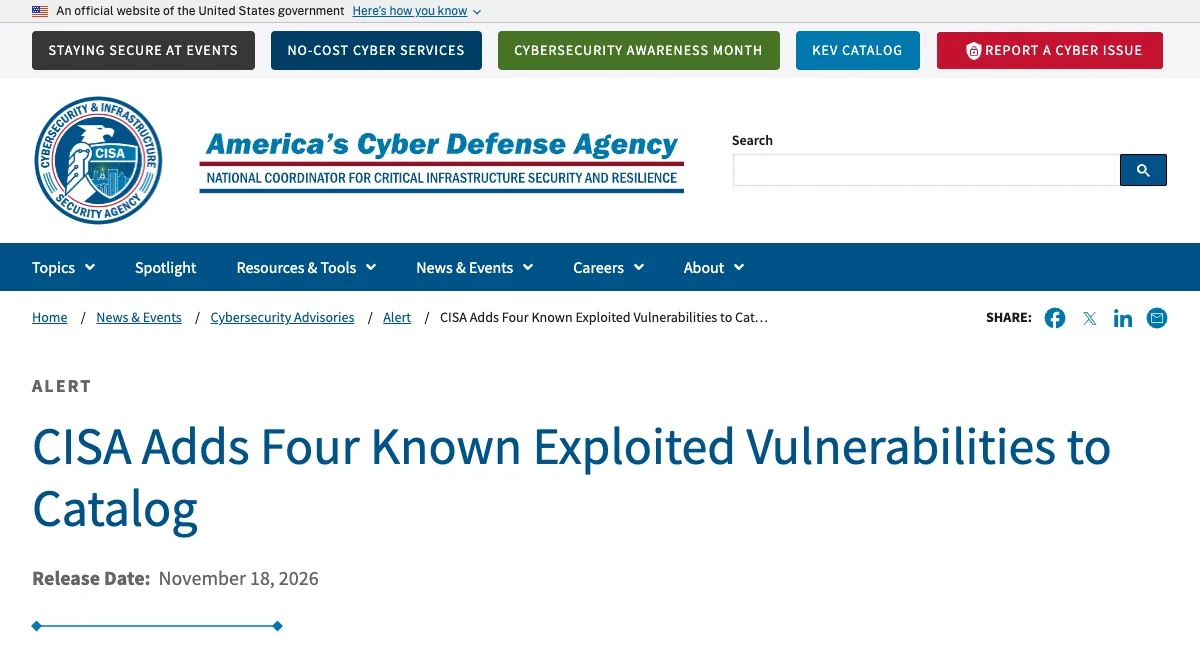
The U.S. Cybersecurity and Infrastructure Security Agency (CISA) announced on November 18, 2026 (U.S. time) that it has added four vulnerabilities to its Known Exploited Vulnerabilities (KEV) Catalog, based on evidence of active exploitation. The affected products are Synology's NAS operating system DiskStation Manager (DSM), BerriAI's LiteLLM, which brokers calls to AI models, the web services framework Apache Axis, and REDCap, a research data capture system from Vanderbilt University. All four flaws can lead to remote code execution.
All Four Additions Can Lead to Remote Code Execution
The four entries and the remediation deadlines set for U.S. federal agencies are as follows.
| CVE | Product | Vulnerability type | Federal deadline |
|---|---|---|---|
| CVE-2024-10441 | Synology DSM / BeeStation OS | Improper encoding or escaping of output | November 21, 2026 |
| CVE-2026-40217 | BerriAI LiteLLM | Unprotected alternate channel | December 2, 2026 |
| CVE-2026-90436 | Apache Axis 1.x | Unsafe reflection | November 21, 2026 |
| CVE-2026-90817 | REDCap | Code injection | November 21, 2026 |
The KEV catalog lists known use in ransomware campaigns as "Unknown" for all four. CISA has not disclosed the attack methods or the scale of any damage. The three entries with the shorter deadline are also flagged for forensic triage, which looks for signs of compromise.
Synology DSM Can Be Fixed With Updates Released in 2024
CVE-2024-10441 stems from the system plugin daemon in DSM and BeeStation OS (BSM). According to Synology's security advisory Synology-SA-24:20, it can allow remote attackers to execute arbitrary code, and it is rated Critical with a CVSS 3.1 base score of 9.8. The advisory was published on November 5, 2024, and covers vulnerabilities reported at the Pwn2Own 2024 hacking contest.
The fixed versions are 7.2.2-72806-1 for DSM 7.2.2, 7.2.1-69057-6 for DSM 7.2.1, 7.2-64570-4 for DSM 7.2, and 1.1-65374 for BSM. In other words, the flaw entered the KEV catalog nearly two years after fixes became available.
LiteLLM's Custom Code Test Feature Allows a Sandbox Escape
CVE-2026-40217 affects the /guardrails/testcustomcode endpoint in the LiteLLM proxy. According to BerriAI's security advisory on GitHub, the endpoint runs user-supplied Python code inside a hand-rolled sandbox, which can be escaped using bytecode-level techniques. Because the proxy process runs as root in the default Docker image, an escape allows arbitrary code execution in the proxy.
The advisory says versions 1.81.8 and later but earlier than 1.83.10 are affected, and the fix replaces the sandbox with RestrictedPython. In default configurations, calling the endpoint requires a proxy-admin credential. As a workaround for those who cannot update right away, the advisory suggests blocking POST requests to the endpoint at a reverse proxy or gateway.
Apache Axis 1.x Gets No Fix, and REDCap Is Attacked Through Public Surveys
CVE-2026-90436 affects the end-of-life Apache Axis 1.x line, through version 1.4. According to the CVE record, Axis loads and instantiates a class named in an inbound SOAP fault message, which can let an unauthenticated remote attacker execute code. Apache plans no new 1.x release and recommends migrating to Axis2/Java or applying a published patch. CISA also urges organizations to stop using products without a fix or to move to a supported version.
CVE-2026-90817 lets an unauthenticated attacker execute code on a REDCap server through public survey routing and the data import feature. Exploitation requires a valid public survey hash. The CVE record lists version 13.3.0 as affected and versions 16.0.49, 17.3.10 and 17.4.4 as unaffected.
The Deadlines Bind Federal Agencies, but CISA Urges Everyone to Act
KEV additions require remediation by U.S. Federal Civilian Executive Branch agencies under Binding Operational Directive BOD 26-04. The directive tells agencies to prioritize KEV-listed vulnerabilities on internet-facing assets that would give attackers total control of a system. It also asks agencies to check whether a system was compromised before the fix was applied.
The directive applies only to federal agencies. However, CISA encourages all organizations to adopt risk-based vulnerability management and prioritize remediation of KEV-listed vulnerabilities. Organizations running DSM-based NAS devices, LiteLLM as part of internal AI infrastructure, or REDCap for research data management should check their versions and consider applying fixes or workarounds.
Our Take
The Synology DSM flaw was fixed back in 2024. Its addition to the KEV catalog now likely reflects the many NAS devices still running without updates. At the same time, it is notable that AI middleware such as LiteLLM appears on the list. Proxies for using LLMs internally are easy to set up, and some may be deployed with their management APIs reachable from outside.
That said, the LiteLLM issue requires admin credentials by default, so careful credential management and blocking the endpoint should limit the damage considerably. The tougher problem is a product like Axis 1.x that will never get a fix. It may survive as a component of older business systems, so planning a migration early is the realistic path.
Summary
CISA has added four vulnerabilities in DSM, LiteLLM, Apache Axis and REDCap to its KEV catalog as actively exploited. Companies and research institutions using these products should consider applying fixes, or stopping use and migrating. The federal deadline is November 21, 2026 for three of the flaws and December 2 for LiteLLM.