
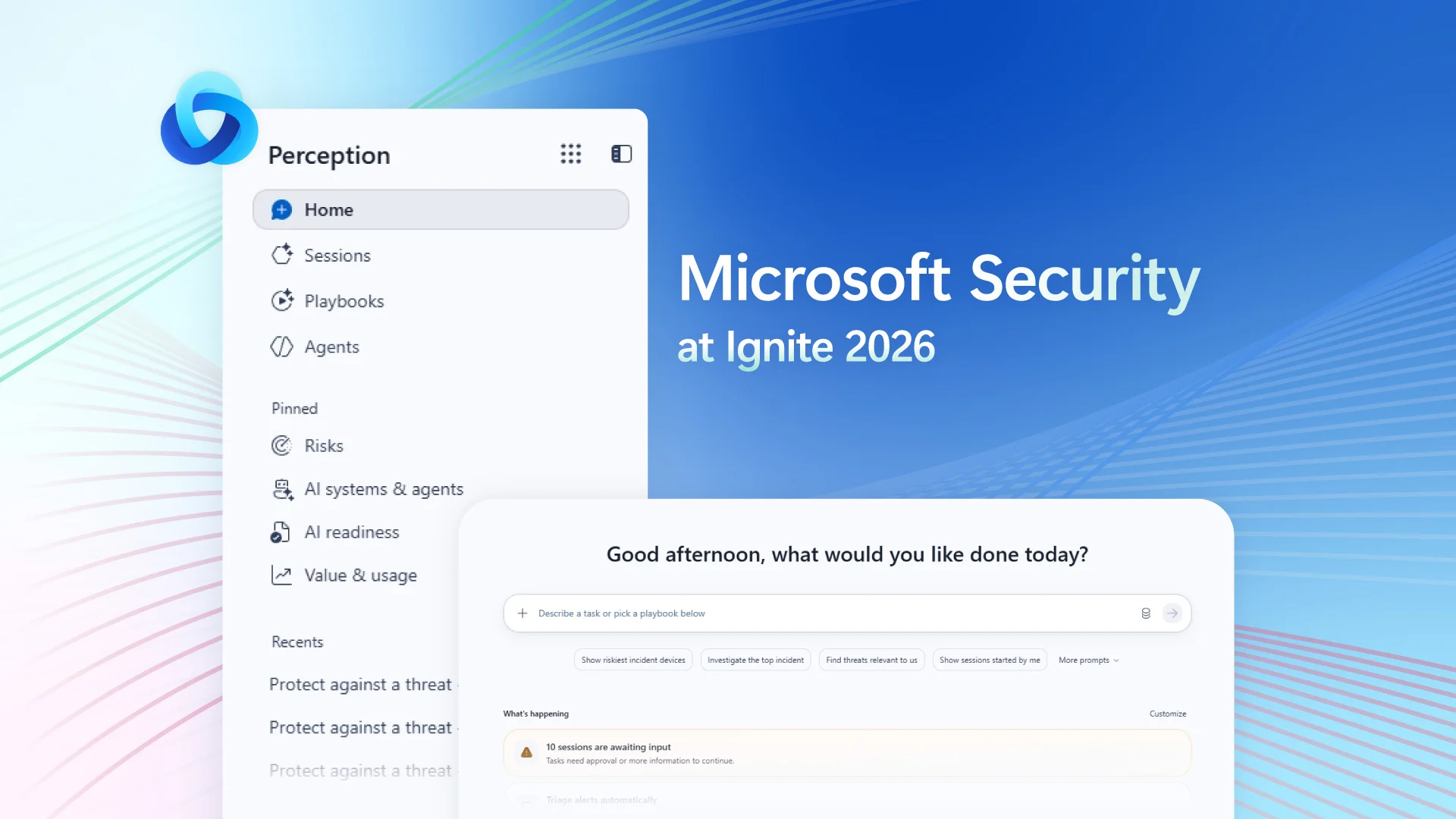
Microsoft announced on November 17, 2026 (US time), alongside its Microsoft Ignite 2026 event, that Microsoft Perception (Perception) is now generally available. The service uses a team of AI agents to automate security operations, and details are published on the Microsoft Perception product page and the official Microsoft Security blog. Red team agents probe for weaknesses from an attacker's point of view, blue team agents handle detection and investigation, and green team agents handle remediation and risk reduction, all coordinated through what Microsoft calls "playbooks."
Red, blue, and green agents work together through playbooks
Microsoft describes Perception as an agentic system in which specialized AI agents reason over an organization's security data, tools, and workflows, and hand work off to one another. According to the product page, red agents simulate attacks, blue agents detect and triage, and green agents remediate and harden.
The agents Microsoft named at launch, and their availability, are shown in the table below.
| Team | Agent | Availability |
|---|---|---|
| Red (attack simulation) | Recon Agent | Generally available |
| Red (attack simulation) | Web App Pen Test Agent | Preview |
| Blue (detection and investigation) | Alert Triage Agent / Attack Investigation Agent / Detection Authoring Agent / Threat Intelligence Agent | Generally available |
| Green (remediation and risk reduction) | Posture Prioritization Agent | Generally available |
| Green (remediation and risk reduction) | Risk Reduction Agent | Public preview |
As an example playbook, Microsoft cited "Protect web app," which runs a penetration test against a web app, surfaces the weaknesses that matter, and drives the fix through to code in GitHub. The Risk Reduction Agent proactively suggests "shielding" for a vulnerability when a patch cannot be applied right away, the company says.
Humans approve high-impact actions
The scope of automation is set by the customer. According to Microsoft, the organization's team sets the guardrails (what agents are allowed to do), and high-impact actions require sign-off. Automated triggers can also launch a playbook when an incident meets criteria the organization defines in advance.
The product page says agents inherit existing governance and compliance policies and run with least-privilege access by default. Every agent action is logged and can be audited afterward.
AWS and Google Cloud are also covered
Playbooks that combine green team agents to prioritize security posture risks cover Amazon Web Services (AWS) and Google Cloud in addition to Microsoft environments. That means companies using multiple clouds can surface risks with the same system.
Microsoft is also offering, in preview, integrations that connect to SIEM, SOAR, and ITSM products through MCP and APIs, as well as the ability to bring in signals from AWS, Okta, and Salesforce.
Consumption-based pricing, with no unit prices disclosed
Perception uses consumption-based pricing and can be purchased either pay-as-you-go or through the "AI Flex Plan," a single commitment usable across several Microsoft AI services. The AI Flex Plan comes in 1- or 3-year terms, paid monthly or up front. A usage dashboard in the Microsoft Defender portal lets customers set a budget and track spending, and a cost estimator is also available.
As of this writing, Microsoft has not disclosed specific unit prices on its official pages. The company also says Perception and Microsoft Security Copilot are complementary and priced separately.
A surge in vulnerabilities is the backdrop
In its announcement, Microsoft said more than 96,000 vulnerabilities were published to CVE in 2026, up sharply from roughly 40,000 in 2024. It added that only 26% of vulnerabilities in the US CISA Known Exploited Vulnerabilities catalog were remediated in 2025.
Microsoft positions Perception as a way to respond to this situation at "machine speed."
Our Take
Connecting attack simulation, detection, and remediation in a single system, and extending coverage to AWS and Google Cloud, is a clear advantage for companies that use multiple clouds. However, because pricing is consumption-based and unit prices have not been published, costs may be hard to predict depending on how heavily the agents are used. The more remediation is automated, the larger the business impact of a wrong decision is likely to be. Even so, with human approval built in for high-impact actions, starting with narrowly scoped use cases should make the adoption decision easier.
Summary
Microsoft has begun general availability of Microsoft Perception, which coordinates red, blue, and green team AI agents through playbooks. The announcement directly affects security teams at companies that run their security operations around Microsoft Defender. As of this writing, some agents and the integrations with outside services remain in preview.