
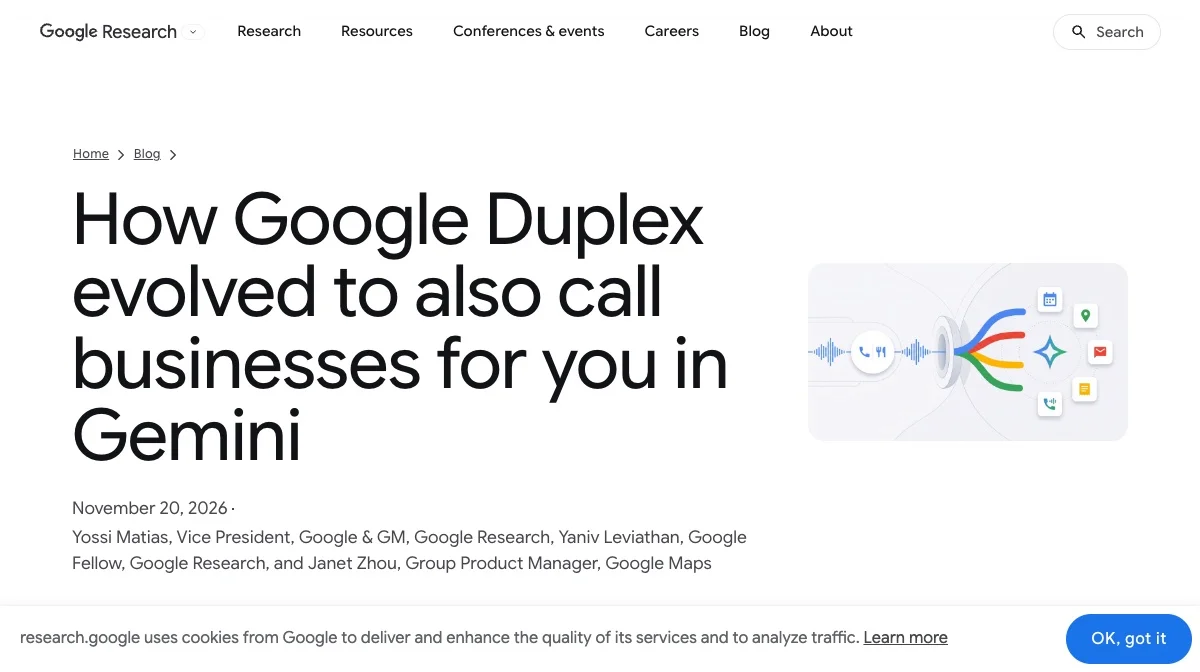
Google said on November 20, 2026 (local time) that it has built Google Duplex (Duplex), its technology for having AI place phone calls to businesses on a user's behalf, into Tasks in Gemini in the Gemini app. The company announced the new Tasks in Gemini features on November 17 in an official blog post, and a Google Research blog post now explains the technology behind the calling feature. According to Google, Duplex has moved over eight years from purpose-built models to a stack centered on Gemini since it was first shown in 2018.
Gemini Finds a Business, Calls It, and Handles the Request
Google describes Tasks in Gemini as a way to hand off chores that take several steps, such as booking, paying bills, and shopping. Users switch the toggle on the home screen from "Chat" to "Task." In one calling example Google shared, Gemini found nearby shops on Google Maps and called two of them at the same time.
The research post lists dinner reservations and hair appointments as typical uses. It also cites checking holiday hours and asking for a window seat or extra room for a stroller. Scheduling car maintenance around calendar conflicts is another example.
Tasks in Gemini also analyzes utility bills, makes payments through the Agent Payments Protocol (AP2), and communicates with users over email and RCS (Rich Communication Services), Google says.
Calls Disclose the AI Up Front, and Businesses Can Opt Out
Google says every call opens by disclosing that it is an automated system calling from Google. Businesses can opt out of automated calls in their Google Business Profile settings. They can also simply say "Please stop calling my business" during a call.
Businesses do not need to install software, adopt a booking system, or train staff. Google describes this as the "No setup and zero adaptation" design principle. Details gathered on calls, such as happy hour specials, patio seating, and pet-friendliness, are reflected in Google Maps.
From Custom Models to LaMDA, and Now Gemini
Duplex was introduced in 2018. At first it was limited to narrow domains and used custom recurrent neural network (RNN) models trained on anonymized phone conversations. During the COVID-19 pandemic, Google focused it on automatically verifying business information. Google shared in 2023 that business information sourced from Duplex calls had been shown in Search and Maps more than one trillion times.
Starting in 2019, the technology reached five consecutive Pixel generations as Pixel Call Assist features. Google says its models still power Call Screen and Hold for Me. In 2022, Duplex used the LaMDA dialogue model in live calls. Because early generative models were less predictable and sometimes slower, Google built a "hybrid" stack that paired generative models for phrasing with deterministic state tracking and strict policy guardrails.
Today, tasks are described to the system in free-form text. Gemini handles multimodal understanding, planning, and dialogue generation together. Google says it uses its newest Gemini 4 Hydrogen and Gemini 4 Neon models, but it has not said which model handles which part of a call. Agentic calling had already expanded to Google Search and Ask Maps in 2025 and 2026.
Tasks Is Rolling Out in Japan, but Calling Coverage Is Unclear
On November 17, Google said the Tasks in Gemini update is rolling out free of charge in the U.S., Japan, South Korea, Canada, Australia, and India, powered by Gemini 4 Hydrogen. Some advanced features start in the U.S., and texting over RCS requires a U.S. phone number.
A footnote says calling through Gemini is not available in five U.S. states: Indiana, Louisiana, Minnesota, Montana, and Nebraska. As of this writing, Google has not said whether Gemini can call businesses in Japan or which languages the calling feature supports.
Our Take
Many businesses still take reservations only by phone, so an AI that calls them is practical: it bridges the gap with shops that do not offer online booking. Eight years of safeguards, such as identifying itself as an AI at the start of a call and letting businesses opt out, likely laid the groundwork for a broad consumer rollout.
That said, the picture for Japan is unclear. Japanese phone conversations involve honorifics and a wide range of phrasing, so the feature would likely need per-language tuning. Handling calls from an AI could also become a new burden for businesses. Still, Tasks in Gemini itself is already rolling out free in Japan, so whether the calling feature follows will be the next thing to watch.
Summary
Google has built Duplex's calling capability into Tasks in Gemini, so Gemini can phone businesses to make reservations and ask questions for users. The change matters to people who find phone bookings a hassle and to the businesses that receive the calls. Google has not announced when calling will reach Japan or which languages it will support.