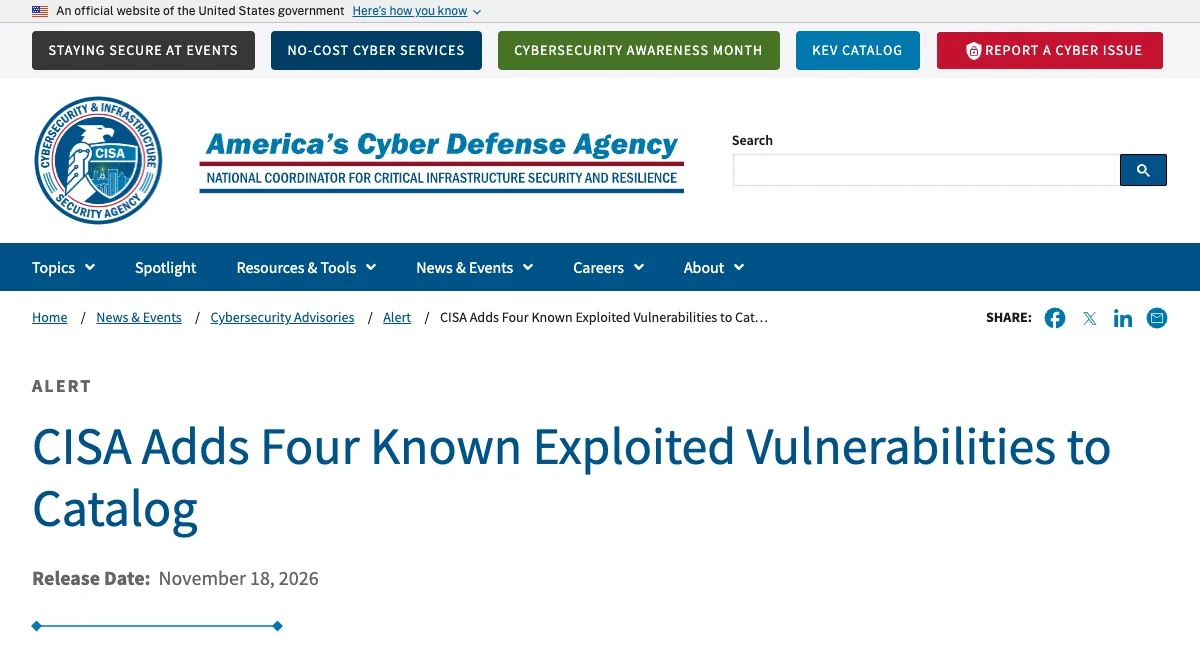
The U.S. Cybersecurity and Infrastructure Security Agency (CISA) announced on November 20, 2026 (U.S. time), in an alert titled "CISA Adds Four Known Exploited Vulnerabilities to Catalog," that it has added four flaws to its Known Exploited Vulnerabilities (KEV) catalog. The affected products are Broadcom's VMware vCenter, Cisco's Cisco Expressway Series, the open-source blogging platform Apache Roller, and SAP's SAP NetWeaver. CISA said the additions are based on "evidence of active exploitation."
Three of the Four Flaws, in vCenter, Expressway, and Roller, Score CVSS 9.8
The newly listed vulnerabilities are shown below. CVE IDs and names follow CISA's alert, and CVSS (Common Vulnerability Scoring System) scores are those published by each vendor.
| CVE | Product | Weakness | Potential impact | CVSS |
|---|---|---|---|---|
| CVE-2026-123890 | VMware vCenter | Authentication bypass | Unauthorized access to vCenter without credentials | 9.8 |
| CVE-2026-76466 | Cisco Expressway (Expressway-C / Expressway-E) | Hard-coded credentials | Unauthenticated command execution as root | 9.8 |
| CVE-2026-129448 | Apache Roller | Deserialization of untrusted data | Unauthenticated arbitrary code execution | 9.8 |
| CVE-2025-42884 | SAP NetWeaver Enterprise Portal | Improper injection of JNDI settings | Reading or modifying server information | 6.5 |
In other words, the vCenter, Expressway, and Roller flaws let an attacker with no credentials take over a system over the network. The SAP NetWeaver flaw is limited to reading or changing information and carries a score of 6.5.
Vendors' Fixed Versions and Workarounds
The vCenter flaw was disclosed on November 19 in Broadcom's security advisory VMSA-2026-0009. It is an authentication bypass in the VMware Directory Service that allows an attacker with network access to vCenter to gain unauthorized access without authenticating. Fixed versions are 9.1.1.0200 for the 9.1 line, 9.0.2.0200 for the 9.0 line, 8.0 U3m for the 8.0 line, and 5.2.5 for VMware Cloud Foundation 5.x. No workarounds are available.
The Cisco Expressway flaw affects only devices running in a cluster. According to Cisco's security advisory, persistent cookies and insufficient validation of client certificates could let an unauthenticated attacker execute operating system commands as root. Releases X15.5.3 and earlier are fixed by upgrading to X15.5.20, while X14 and earlier require migration to a fixed release. Notably, when the advisory was published on October 21, Cisco stated it was not aware of any malicious use, and that statement had not been updated as of this writing.
For Apache Roller, an Apache Software Foundation representative posted a notice on November 17 to oss-security, a mailing list for sharing open-source security information (oss-security archive on openwall.com). The notice states plainly: "This issue is being actively exploited." Versions 4.0.0 through 6.1.4 are affected, and the cause is that the XML-RPC endpoint deserializes data before authenticating the requester. The issue is fixed in 6.1.6 and later. Users who cannot upgrade immediately are asked to set "enabledForExtensions" to "false" in WEB-INF/web.xml, or to remove the "/roller-services/xmlrpc" mapping, and then restart Roller. Disabling XML-RPC in the administration UI alone is not enough, according to the notice.
The SAP NetWeaver Enterprise Portal flaw was disclosed in November 2025 and affects EP-BASIS 7.50 and EP-RUNTIME 7.50. The fix is provided in SAP Note 3660969.
vCenter Exploitation Dates Back to September
Broadcom's advisory credits Mandiant with reporting the vCenter flaw. On November 20, Google Threat Intelligence Group and Mandiant published an analysis on the official Google Cloud blog. It says ARMORY CASTLE, a suspected China-nexus espionage group, exploited the flaw in early September 2026. The group reportedly entered internal networks through another device, then moved through vCenter to reach ESXi hosts and virtual machine data.
CISA's KEV catalog lists November 23 as the due date for all four flaws. Remediating KEV-listed vulnerabilities is mandatory for U.S. federal civilian executive branch agencies. Private companies and organizations have no such obligation.
Organizations Running These Products Should Patch and Check for Compromise
All four affected products are server software run by companies and organizations. vCenter sits at the center of virtualization management, and Expressway is used to connect video conferencing and calls with outside parties. Because these flaws allow takeover without authentication, leaving the systems reachable from the internet or a broad internal network could let damage spread across the entire infrastructure.
In this alert, CISA also asks federal agencies not only to apply the fixes but also to check whether they were already compromised before patching. If an attacker got in before the update, patching alone will not remove them.
Our Take
The vCenter, Expressway, and Roller flaws can be attacked directly over the network by attackers with no credentials, so CISA's short deadline is understandable. vCenter in particular just had a separate authentication bypass in the same VMware Directory Service fixed in July (VMSA-2026-0006), and now a similar hole has turned up again. On the other hand, as the Cisco case shows, a vendor's notice may not keep up with real-world exploitation, and judging urgency from vendor information alone could delay a response. That said, fixes are already available from every vendor. Organizations running these products should treat the KEV listing as a signal to update and check for compromise quickly.
Summary
CISA has added four vulnerabilities in vCenter, Cisco Expressway, Apache Roller, and SAP NetWeaver to the KEV catalog as known exploited flaws. Administrators at companies and organizations running these products are affected, and the three CVSS 9.8 flaws in vCenter, Expressway, and Roller in particular need prompt updates. The catalog lists November 23 as the due date for federal agencies.