
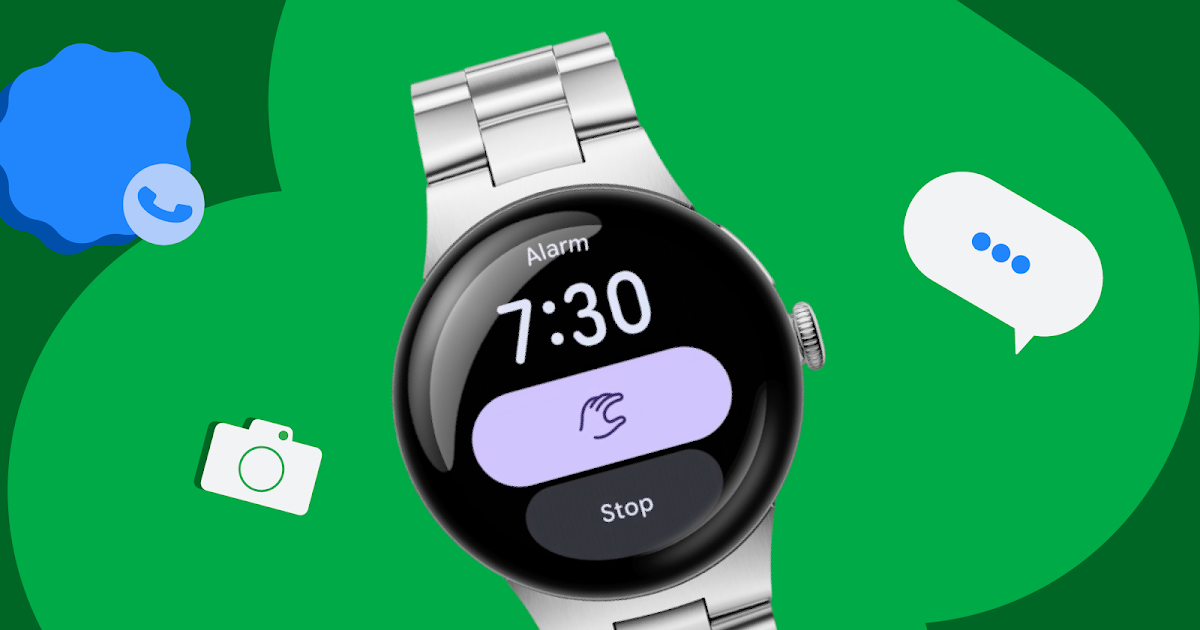
Google has opened one-handed gestures, which let people operate a smartwatch without touching the screen, to third-party apps starting with Wear OS 7. A framework for device makers and an API for app developers arrived together. Spotify has already adopted it, letting users start and stop music with a double pinch.
Finishing the task with only the hand wearing the watch
One-handed gestures are built for situations where the other hand is busy, such as carrying bags or cooking. Everything happens with the hand the watch is on.
The capability itself is not new. It first appeared on Pixel Watch with Wear OS 6.1, covering a narrow set of actions like starting and stopping a timer, answering calls, and controlling media. Those actions belonged to the system, and third-party apps had no way in.
Wear OS 7 adds two entry points. One is a framework that lets device makers map gestures to actions. The other is an API that lets app developers wire gesture control into their own apps.
Two roles only: primary action and dismiss
The framework defines just two gesture roles, a deliberate choice that keeps the vocabulary small enough to remember.
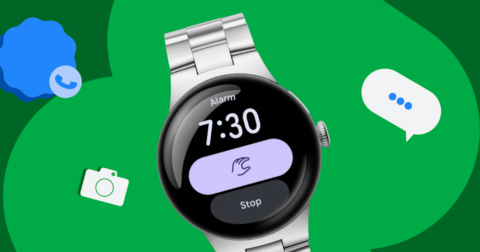
The first is the primary action, mapped to a double pinch on Pixel Watch. It is meant for the single most important action on a given screen, with examples including taking a photo in a camera app, starting or stopping a timer, and accepting an incoming call.
The second is the dismiss action, mapped to a wrist turn on Pixel Watch. By default it maps to system back, which makes it a natural way to close an interruptive screen or return to the watch face. It can be overridden for specific cases, such as silencing an incoming call.
The primary action can also drive scrolling. Reading through a notification before replying, or paging through workout metrics, are the kinds of journeys where the user should not have to tap to continue.
Developers can bolt it onto existing UI
Implementation is available from the 1.7 beta release of Compose for Wear OS. Moving the dependency to the 1.7.0 beta makes the one-handed gesture Modifier available.
There are three steps. Define a configuration that describes the nature of the interaction, initialize an indicator state suited to the component such as a button or a scrollable list, then apply the Modifier to the interactive composable. Callbacks let you hook into both the moment the system prepares the gesture and the moment it fires.
Because it attaches to an existing interactive composable, there is no need to rebuild the screen structure. The underlying platform support requires Wear OS 7, which is API level 37.
The framework handles how hints appear
Touch-free control only helps if people know where a gesture works. That is the job of gesture indicators.
These are animated hints that show where a gesture is available, and the framework manages their cadence and appearance. Developers do not leave them permanently on screen. Instead the system surfaces them often enough to be useful without becoming intrusive, and users who find them frequent can dial the cadence back in system settings.
Separate indicators exist for buttons, for scrolling, and for horizontal and vertical paging, so the right one is chosen to match the UI.
Spotify goes first, Pixel Watch 3 and newer for now
Spotify is cited as an early adopter. By adopting the one-handed gesture Modifier, it lets users toggle play and pause with the primary gesture, which on Pixel Watch is the double pinch. The result matches pressing the physical play and pause button, without touching the screen.
Supported hardware today is Pixel Watch 3 and newer. The gesture framework itself is available to every Wear OS device manufacturer, so there is room for other smartwatches to follow.
Summary
Wear OS 7 opens one-handed gestures, previously limited to system functions, to third-party apps. The roles are narrowed to a primary action and a dismiss action, mapped on Pixel Watch to a double pinch and a wrist turn. Developers integrate them through the new Modifier in the 1.7 beta of Compose for Wear OS. Supported devices are Pixel Watch 3 and newer, though the framework is open to other manufacturers.