At REAL Summit 2026, its annual conference held at COEX in Seoul on September 8, Samsung SDS announced its entry into the robot transformation (RX) business. In 2027 the company will introduce a robot orchestration platform that runs factory production equipment and several different types of robots as a single system. Partnerships with OpenAI and Anthropic were presented at the same event, a sign that the company's main battleground is expanding from software into the manufacturing floor itself.
An 88 percent adoption rate against a 6 percent profit impact
In his keynote, CEO Lee Jun-hee framed AI transformation as something far more fundamental than adopting AI to save time and cost. It is not about improving parts of an existing workflow with AI, but about redesigning the way people work from scratch. It is about becoming a company that acts before a customer asks. AI changes how work gets done; AI transformation changes the business itself.
He backed that up with a McKinsey & Company survey. While 88 percent of companies worldwide have introduced some form of AI into their work processes, only 6 percent said AI is making a meaningful contribution to profit. To close that gap, Lee pointed to three things: redesigning work processes, securing data in an AI-ready form, and optimizing the operation of multiple AI agents. REAL Summit 2026 drew more than 15,000 participants on-site and online.
Path planning that keeps robots from colliding sits at the core
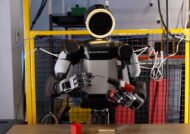
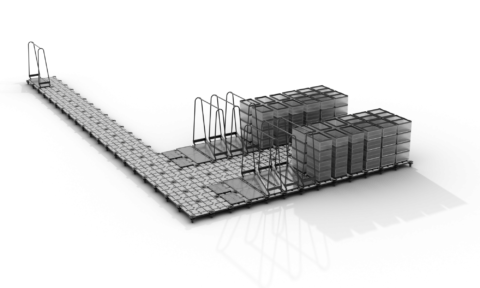
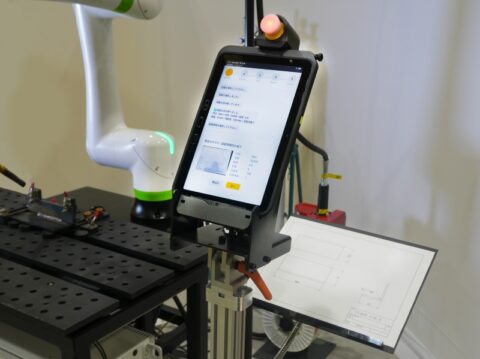
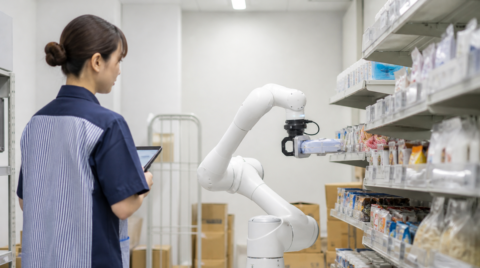
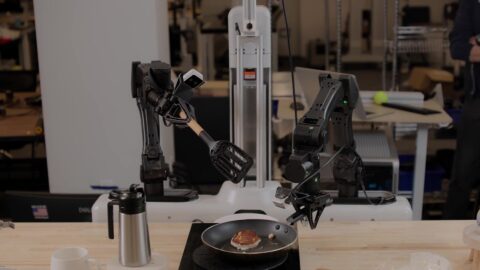
The centerpiece of the RX business is the robot orchestration platform due in 2027. Its core function is designing optimal movement paths so that robots handling separate jobs such as packaging, assembly and material transport do not run into one another. It also detects breakdowns in real time and reassigns work to other robots, so that a single stalled machine does not bring an entire plant to a halt.
The foundation is the company's existing presence on production floors. Lee said that over 25 years Samsung SDS has delivered manufacturing execution systems (MES) and equipment and logistics automation to more than 430 manufacturing clients in semiconductors, secondary batteries and biotechnology. Rather than selling robots as new hardware, the approach is to add one control layer on top of production lines that are already running.
Joseph Ahn, executive vice president of the Digital Factory Business Unit, said the company is first targeting automation demand at manufacturing sites including those of Samsung's manufacturing affiliates, and is considering global expansion once the performance of general-purpose robots has been verified. At its booth, Samsung SDS showed solutions driving robots from Samsung affiliate Rainbow Robotics and from Wuzi, a Chinese robot hand specialist.
Team REX brings in Toyota-rooted Walden Robotics
The framework supporting RX is Team REX (Robotics Excellence), a partnership that gathers 10 global physical AI companies. Rainbow Robotics and Walden Robotics are among them.
Walden Robotics was founded by researchers formerly at Toyota Research Institute, part of Toyota, and positions itself around general-purpose robots that actually work on manufacturing and logistics floors. It launched with 300 million USD (about 46 billion yen) in funding at a valuation of 1.1 billion USD (about 170 billion yen). The round, led by Toyota and Deviation Capital, also included NVIDIA, Boeing and Samsung Ventures. Samsung SDS has signed a strategic investment and cooperation agreement with the company, and the two plan to jointly identify use cases for manufacturing sites.
※1 USD = 154 JPY (as of September 8, 2026)
In a video message, Walden Robotics CEO Russ Tedrake said physical AI is a technology that will drive innovation in manufacturing, but that large-scale field deployment capability and business understanding are essential to applying it on real production floors and producing measurable results. He described Samsung SDS as having the best capabilities in that area and welcomed the partnership.
OpenAI and Anthropic, with Samsung SDS out in front among Korean firms
Model-side partnerships are deepening as well. Samsung SDS will join OpenAI's Daybreak Partner Program as a pilot partner. Daybreak gives a limited set of verified partner companies access to OpenAI's most advanced models so they can test for cybersecurity vulnerabilities.
The company was the first partner in Korea authorized to consult on ChatGPT Enterprise deployments, and in July it became the first Korean company to form a strategic partnership with Anthropic. At a press conference, Lee said both OpenAI and Anthropic place heavy weight on the security capabilities of their partners, and that being selected for the Daybreak pilot lets Samsung SDS run its own security verification and assess software used at customer sites. He sees it as a chance to raise security standards across Korean industry. OpenAI Korea's general manager and Anthropic Korea's representative director appeared at the event, and OpenAI CEO Sam Altman sent a video message.
Summary
What stands out here is the bet on coordinating many kinds of robots rather than on any single machine. Unglamorous functions such as collision avoidance and reassignment after a failure are exactly what matter once the number of robots on a floor grows. The open question is whether 25 years of MES deployments can be extended directly into a control layer. How many concrete use cases Samsung SDS and the 10 Team REX members can accumulate before the platform arrives in 2027 will be the first real test.