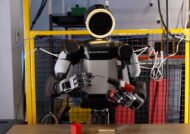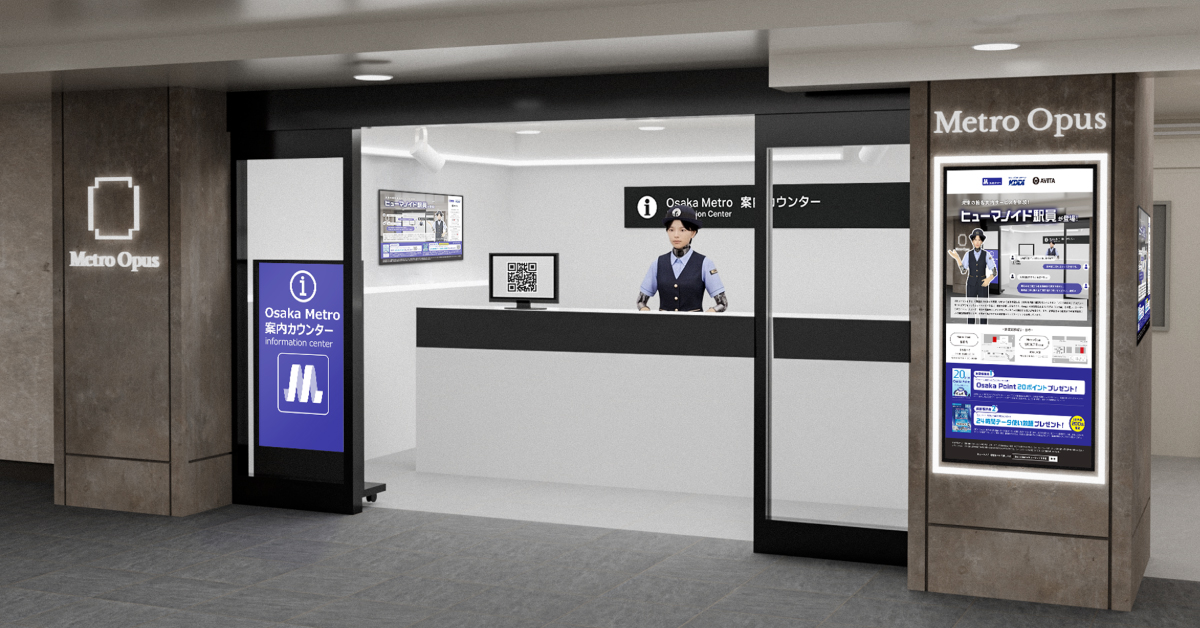
Osaka Metro, KDDI and AVITA are running a field trial that puts a humanoid robot behind the information counter at subway stations. Wearing an Osaka Metro uniform, the "humanoid station attendant" uses Google's generative AI model Gemini to answer questions about transfer routes and nearby sightseeing spots. The first half at Umeda Station has wrapped up, and from September 9 the trial moves to Tanimachi 9-chome Station, running through September 15.
A uniformed humanoid stationed next to the ticket gates
The trial runs from August 31 to September 15, 2026. For the first stretch, August 31 through September 6, the robot was placed at Metro Opus Umeda, located just outside the north ticket gate of Umeda Station on the Midosuji Line. For the second stretch, September 9 through September 15, it moves to Metro Opus Tanimachi 9-chome east, on the east side of the east ticket gate at Tanimachi 9-chome Station on the Tanimachi and Sennichimae Lines. Hours are 11:00 to 20:00 daily, except for the opening day of August 31, which started at 13:00. No reservation is needed, though visitors may have to wait when the counter is busy.
The robot is based on a humanoid designed by Hiroshi Ishiguro, a professor at Osaka University, president and CEO of AVITA, and the producer of the "Future of Life" pavilion at Expo 2025 Osaka, Kansai, Japan. That design has been reworked with updated functions, dressed in an Osaka Metro uniform, and placed on the floor as a station attendant.
Gemini reads tone and inflection, not just words
The conversational core is Google's Gemini model. Beyond recognizing what is said, it detects the tone, speed, inflection and emotional nuance of the speaker's voice in real time.
Response speed is the other headline feature. Serial processing from speech recognition through to reply produces ultra-low-latency responses, which the companies say makes the nonverbal side of the interaction — pauses, gestures, timing — feel natural. With a human-shaped robot, a few seconds of silence before an answer reads as awkwardness, so cutting latency directly affects how finished the whole thing feels.
The attendant covers station layouts and complicated transfer routes as well as recommended sightseeing information for the surrounding area. It handles multilingual conversation including English and Chinese, which fits the Umeda and Tanimachi 9-chome locations and their steady flow of overseas visitors.
The three companies note that answers from the humanoid attendant are reference information only, with no guarantee of accuracy or completeness. Visitors are asked to avoid personal problems or specialist consultations.
QR codes let riders take the directions with them
To keep the interaction from ending at the conversation, the trial includes QR code-based smart guidance. The humanoid displays a QR code on the screen it holds, and scanning it with a smartphone lets the visitor carry away a detailed route map to their destination.
Station directions tend to feel clear on the spot and then blur once you start walking. Moving a spoken explanation onto the visitor's own screen is a practical way to cover a known weakness of conversational AI.
How the three companies split the work, and what data is collected
The roles are clearly divided. Osaka Metro contributes its know-how and expertise in station customer service and verifies demand and passenger acceptance of humanoid-led guidance. KDDI builds the operating infrastructure using assets such as its communications technology and AI data centers, and plans and runs the trial. AVITA develops the humanoid itself along with the communication technology and dialogue system.
KDDI and AVITA announced a strategic business alliance in the physical AI field on March 2, 2026, and began Gemini integration for their jointly developed humanoid on July 30. Placing the robot in a station is the field deployment that follows from that work.
Data handling has also been disclosed. The humanoid carries an RGBD sensor, a microphone and eye cameras. Footage from the RGBD sensor is used to estimate the visitor's age and gender and to track distance and facial expression, then converted to text data and promptly discarded. Microphone audio is likewise converted to text and the audio itself discarded. The eye cameras run continuously so that service interactions can be monitored, but nothing is recorded. Information collected by AVITA is deleted promptly after the trial ends. As a precaution, visitors are asked not to speak personal information such as names, addresses or contact details.
Perks for visitors who try it
There are also giveaways at the venue. Cards for signing up for povo2.0 Giga Charge are handed out, and visitors can enter an Osaka Point campaign. The Giga Charge cards are limited to one per person and available while supplies last.
Entering the Osaka Point campaign requires downloading the e METRO app and registering as an e METRO member. Entry is limited to one per person across both venues and the entire period, a campaign code provided at the venue must be entered, and the points are awarded later as limited-time points valid through March 31, 2027.
Summary
The humanoid station attendant trial by Osaka Metro, KDDI and AVITA continues from September 9 to September 15 at Metro Opus Tanimachi 9-chome east. A Gemini-powered robot reads tone and inflection while guiding riders on transfers and sightseeing, and the QR code hand-off lets them take a route map with them, forming a single continuous experience. What the three companies want to measure is less whether the technology works than how far robot-led customer service is accepted in an everyday setting like a subway station. Depending on the results, humanoid robots moving into frontline work as an answer to labor shortages could take another step forward.