
Huawei will introduce the MateBook Fold PC Ultimate Design 2026, an 18-inch foldable notebook, at its product launch on August 5. The machine appeared on stage for the first time at a technical briefing for HarmonyOS computers, where the company confirmed it runs on a new processor called Kirin X90 Plus and delivers a 25 percent gain in overall performance. The display carries over the same 18-inch foldable OLED panel as the previous generation, while the hinge and the laminate stack have been reworked.
The new Kirin X90 Plus takes center stage
The most concrete detail out of the briefing was the name of the processor. The MateBook Fold PC Ultimate Design 2026 uses Kirin X90 Plus, and Huawei says overall performance as a PC climbs by 25 percent.
Huawei frames that figure as the result of hardware, software, and cloud working together rather than raw silicon. The company points to 4 contributing factors: architecture design, the PC chipset itself, HarmonyOS behavior, and the HarmonyOS app ecosystem. The message is less about a generational chip jump and more about stacking gains across the OS and applications until they show up as perceived speed.
A 25 percent increase matters for a device of this kind. Driving an 18-inch high-resolution panel built from a dual-layer structure while staying thin enough to avoid heavy cooling leaves little headroom. Whether that headroom exists decides how comfortable it is to keep switching between folded and unfolded modes.
The 18-inch foldable OLED stays unchanged
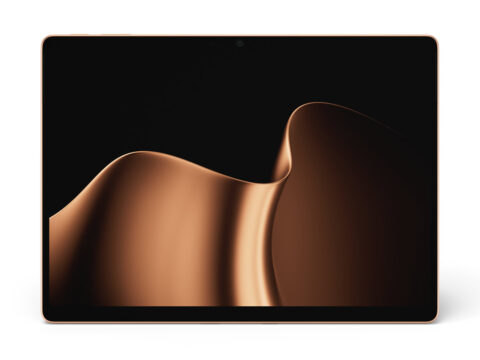
The display carries over from the previous model. It measures 18 inches and uses a dual-layer flexible OLED panel. The screen-to-body ratio is 92 percent, resolution is 3.3K, peak brightness reaches 1,600 nits, coverage spans the P3 gamut, and HDR Vivid is supported.
On paper those numbers are unchanged, yet for a foldable PC they are hard to fault. Eighteen inches unfolded is close to a desktop monitor in working area, and folded it behaves like a notebook of roughly 13 inches. The dual-layer OLED construction exists to buy brightness and panel lifespan, which together with crease visibility is exactly where opinions on this category tend to split.
By leaving the panel specification alone, Huawei has put its development weight on durability and on software-side processing speed. Refining a design instead of waiting for the next panel generation also says something about how early foldable PCs still are in volume production.
Hinge and laminate rebuilt for durability
Durability is the headline this time. The hinge uses a waterdrop mechanism named Basalt, which spreads the load placed on the crease as the machine opens and closes.
On the panel side, Huawei combines ultra-thin glass with a non-Newtonian fluid laminate. A non-Newtonian fluid stays soft under slow pressure and stiffens against sudden impact. According to Huawei, the structure improves impact resistance by 90 percent, raises bend resistance tenfold, and pushes stylus click durability to 500,000 presses.
Almost every worry about a foldable device comes down to how long the screen lasts. At 18 inches, with more surface area and more flex than a phone, that worry translates directly into hesitation about buying one. The numbers still need verification on retail units, but this is a reasonable place for engineering effort to land. Calling out stylus durability separately also suggests pen input is treated as a core use case.
Memory and file handling are addressed in software
Huawei also detailed the software work. A technology called Ultra Space Memory raises memory compression speed by 50 percent and cuts the time needed to open large files by 40 percent. A built-in Ark Engine lifts the opening speed of heavy files in WPS Office by 30 percent.
Squeezing more out of compression speed rather than adding memory is a practical choice for a thin machine where RAM is soldered to the board. Naming WPS Office is equally telling: office work inside China is clearly the main battleground. Foldable PCs tend to be discussed in terms of visual impact, but what actually drives a purchase decision is the waiting time in everyday tasks.
Where the previous generation sits, and why August 5 matters
The original MateBook Fold Ultimate Design was announced in May 2025 and went on sale in China on June 6 of that year. It was the first PC to ship with HarmonyOS 5, weighing 1.16 kg and measuring 7.3 mm unfolded and 14.9 mm folded. It carried 32 GB of memory, up to 2 TB of storage, and a 74.69 Wh battery, and shipped with a 140 W USB Type-C charger.
Pricing was 23,999 CNY (about 560,000 yen) for the 32 GB and 1 TB configuration and 26,999 CNY (about 630,000 yen) for the 2 TB version. Sales were limited to mainland China, and no global rollout was announced. The 2026 model will likely occupy the same position, which means importing remains the only route for buyers in Japan.
Exchange rate: 1 CNY = 23.35 JPY (as of August 1, 2026)
The launch takes place on August 5, and the event is expected to cover several products, including the nova 16 SE smartphone and the MateBook Pro S notebook. Within the foldable PC category itself there is almost no competition, so the main question is whether pricing moves away from the previous generation.
Summary
The MateBook Fold PC Ultimate Design 2026 is a second-generation machine that keeps the 18-inch foldable OLED, raises performance by 25 percent with the new Kirin X90 Plus, and rebuilds durability through the hinge and laminate stack. Software improvements such as faster memory compression and quicker file loading sit alongside those changes, making this an update aimed at usability rather than spectacle. Price and sales regions remain unknown, and both will be settled at the August 5 launch.