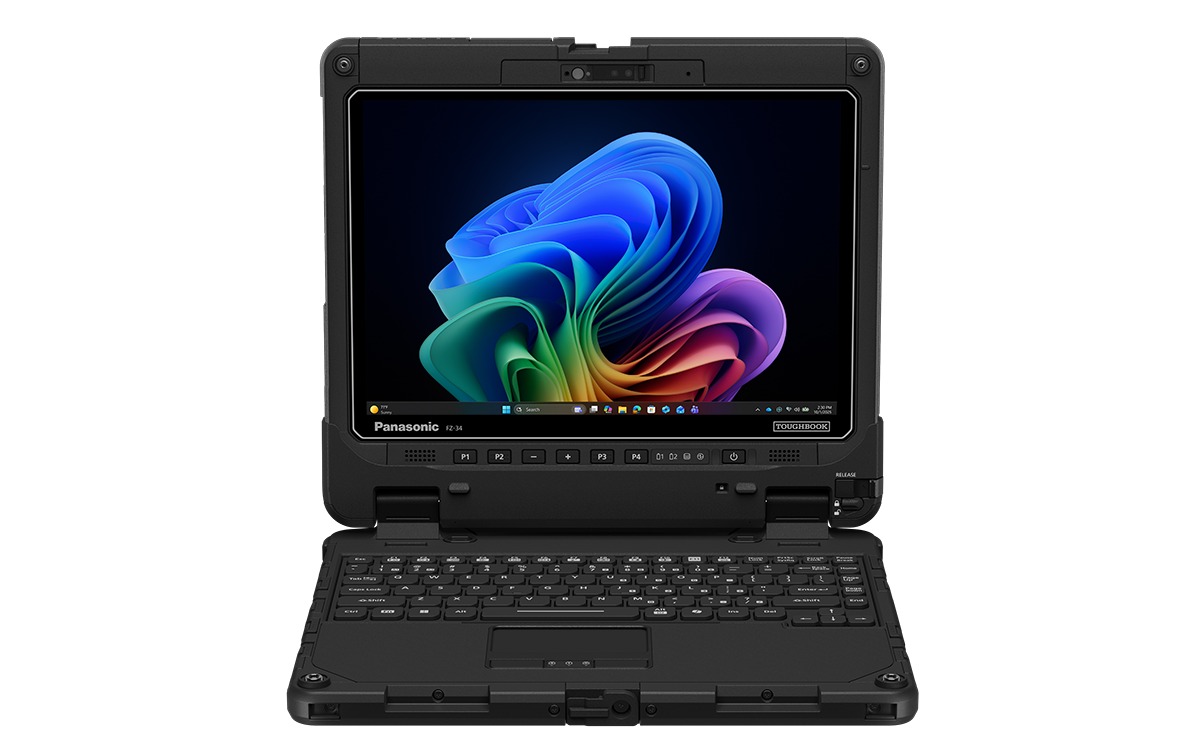
On September 15, 2026, Panasonic Connect announced the FZ-34, a new model in its TOUGHBOOK line of rugged PCs. It is a 12.4-inch detachable 2-in-1 that goes on sale in October 2026 at an open (dealer-set) price. The FZ-34 runs on Intel's Core Ultra Series 3 (Core Ultra 5 335), making it the first TOUGHBOOK to meet the Copilot+ PC requirements. The battery has moved to pouch cells, cutting weight while delivering about 13 hours on a single pack and up to about 26 hours with the optional second battery. The environmental hardening against drops, dust, water spray, and temperatures from sub-zero to scorching heat carries over, and expansion modules can now be swapped by users themselves.
A full redesign of the field 2-in-1 in TOUGHBOOK's 30th year
TOUGHBOOK debuted in 1996 as a rugged PC for business use and marks its 30th anniversary in 2026. According to Panasonic Connect, the brand has held the top global share in the rugged notebook market for 24 consecutive years (the company cites VDC Research's Q1 2026 tracker).
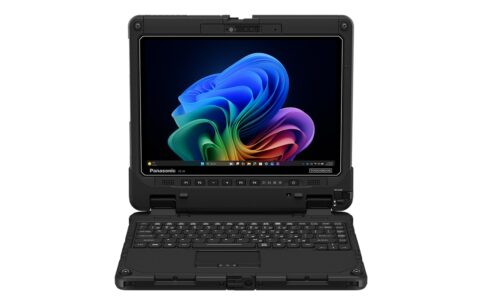
The FZ-34 succeeds the 12-inch-class detachable CF-33 family. With the keyboard removed it works as a rugged tablet; attached, it becomes a rugged notebook. The keyboard section can also be flipped for a presentation style or rotated 360 degrees into a convertible style. The idea is to cover both jobs with one device: shooting photos and checking drawings as a tablet on site, then typing up reports as a notebook back at the office.
Two SKUs are offered: the standard FZ-34CY90XAJ and the FZ-34CY90HAJ wireless WAN model with 5G and LTE. Both ship with Windows 11 Pro.
Core Ultra 5 335 makes it the first Copilot+ TOUGHBOOK
The processor is the Intel vPro-capable Core Ultra 5 335, paired with 16GB of LPDDR5x memory and a 512GB PCIe SSD. That is a three-generation jump from the Core i5-1345U in the previous model, and Panasonic Connect says the PCMark 10 score is up 40 percent.
Core Ultra Series 3 features a strengthened NPU (a dedicated AI engine) that clears the 40-plus TOPS bar required for Copilot+ PC certification. This unlocks Windows 11's on-device AI features such as Recall (preview), Click to Do, Live Captions, and Windows Studio Effects. Because AI processing can run entirely on the device even where connectivity is unreliable, data need not leave the machine, which is a practical benefit for business deployments.
On the tablet itself you get two Thunderbolt 4 ports, USB 3.2 Gen 1, and Gigabit Ethernet, with Wi-Fi 7 and Bluetooth 5.4 for wireless. The keyboard section adds two USB 3.2 Gen 1 ports, USB 2.0, Gigabit Ethernet, HDMI output, a serial port, and an SD card slot.
180 cm drops, IP66, and operation from -10 to 50 degrees Celsius
Ruggedness remains the core of the TOUGHBOOK proposition. As a standalone tablet, the FZ-34 is tested to MIL-STD-810H with 180 cm drops onto plywood (26 orientations) and 120 cm drops onto steel plate (26 orientations). In notebook form, Panasonic applies its own tests: 120 cm drops (26 orientations, plywood) and 90 cm drops (6 orientations, concrete).
Dust and water protection is rated IP65, or IP66 as a standalone tablet. The operating range is -10 to 50 degrees Celsius, and in the cold a heater beneath the SSD warms it to its guaranteed temperature before boot, a patented mechanism. Details were reworked too: back-flip FPC connectors that will not pull loose in a fall, and a floating structure with deliberate play at the battery and keyboard dock contacts. Panasonic notes that none of these ratings guarantee freedom from damage or failure.
Pouch cells: lighter and longer-lasting
The battery is the headline change. Switching from cylindrical cells to pouch cells trims capacity slightly from 45Wh to 40Wh but drops the weight sharply from about 322 g to about 197 g. Combined with the more efficient processor, a single pack now runs about 13 hours of video playback, beating the previous model's roughly 12.5 hours, and about 21.2 hours at idle.
Adding the second battery (FZ-VZSU2LU, 23,100 yen including tax) extends runtime to about 26 hours, and hot swapping lets you change packs without powering down. Staged charge control is designed to limit degradation and suppress sudden voltage drops in cold environments, with an eye on lowering total cost over a long service life.
Expansion modules are now user-swappable
The back of the tablet has three expansion areas that accept modules for different jobs. The lineup includes a contactless IC card reader (20,900 yen incl. tax), a barcode reader (56,100 yen), a serial connector (11,000 yen), a USB 2.0 Type-A port (9,900 yen), an HDMI output (14,300 yen), and the battery pack mentioned above. The top expansion area takes only one module, so the barcode reader and HDMI output cannot be fitted together.
Previously this customization had to be done at the factory; on the FZ-34, users can install and swap modules themselves. The SSD is also user-removable, shortening downtime when a drive fails. Being able to add a module instead of buying a new unit when the job changes makes the device easier to manage as a corporate asset.
A 12.4-inch 3:2 display and a roughly 12.6-megapixel camera
The display grows from 12.0 to 12.4 inches, with a 1,920 x 1,280 resolution in a 3:2 aspect ratio. Peak brightness is about 1,000 nits, and an anti-reflection film helps keep it readable outdoors. The touch panel has an auto mode that detects bare fingers, gloves, or water droplets and switches to the appropriate setting, and an electromagnetic digitizer pen is included.
The rear camera moves from a USB-connected 8-megapixel unit to a MIPI-connected roughly 12.6-megapixel one, while the front has a roughly 5-megapixel webcam plus an IR camera for Windows Hello face authentication. A 91 dB loudspeaker is aimed at web meetings on noisy job sites.
The tablet measures 308 x 243.6 x 25 mm and weighs about 1.356 kg (about 1.41 kg for the 5G model). With the keyboard attached it is 313 x 288.4 x 46.1 mm and about 2.571 kg (about 2.625 kg for the 5G model). The tablet is about 0.2 kg lighter than its predecessor.
Summary
The FZ-34 refreshes TOUGHBOOK's 12-inch detachable on three fronts: Copilot+ PC capability via Core Ultra Series 3, a lighter and longer-running pouch-cell battery, and user-swappable expansion modules. Ruggedness stays at the same high level, and the overall package feels more complete as a PC built for the field. It ships in October 2026 at an open price, so organizations considering it will need to contact Panasonic Connect's business sales channels or its partners.