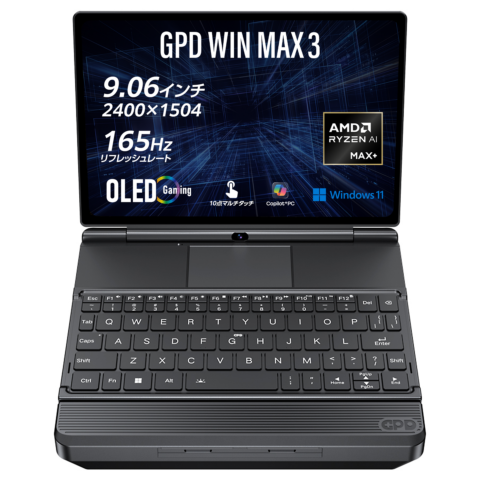

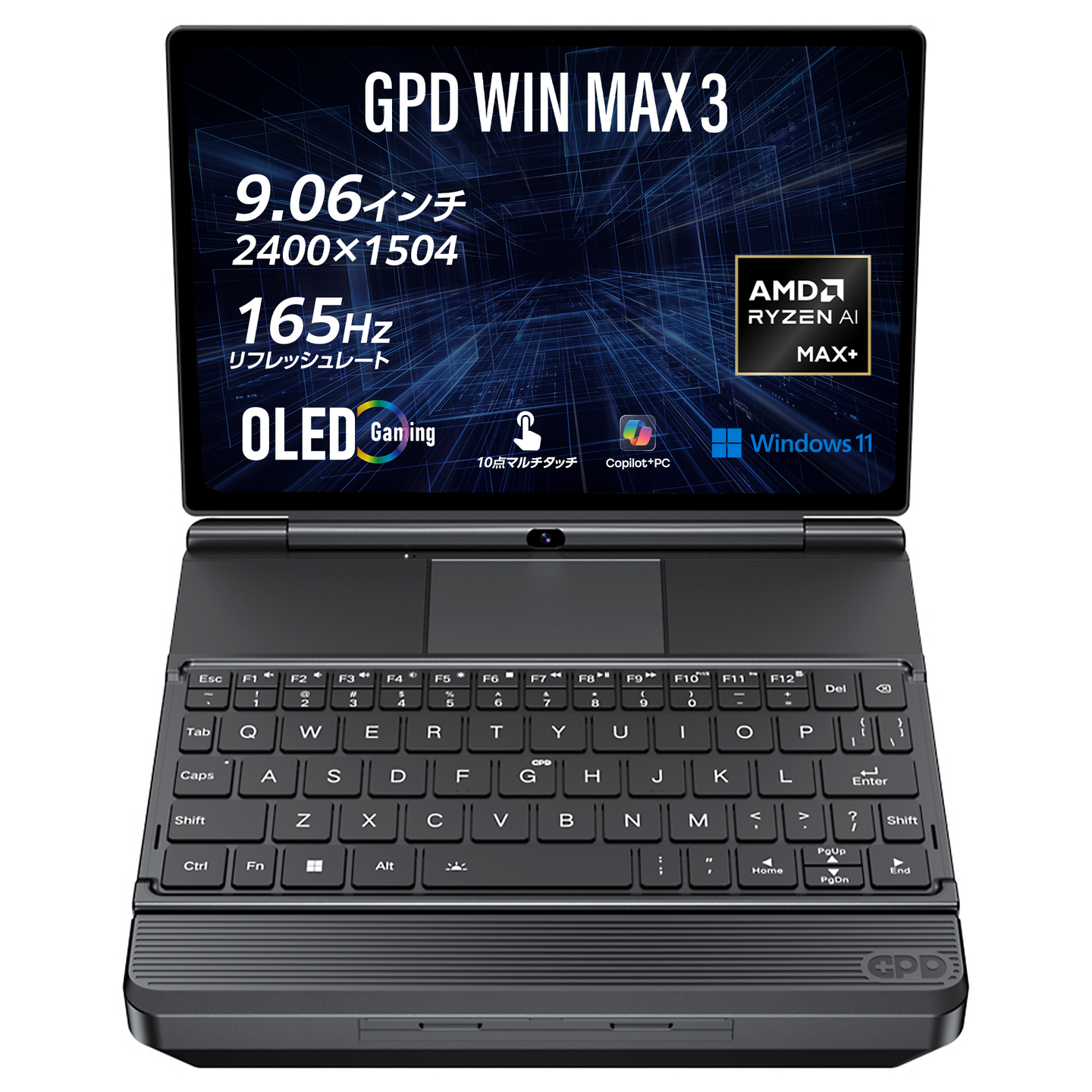
GPD Technology's latest handheld gaming PC, the GPD WIN Max 3, is coming to Japan. Tenku, the company handling official domestic sales, plans to release the device on December 25, with pre-orders opening on September 24. The standout feature is a modular front section that lets users swap between a battery module and a cooling fan module, aiming to combine long battery life on the go with stable high-load gaming performance at home.
Swapping Between Battery and Cooling
The GPD WIN Max 3 is the latest entry in the WIN Max series, which combines a game controller, keyboard, and trackpad into a single clamshell body. The front of the unit has a detachable module bay that can hold either a 97Wh battery module or a cooling fan module built with two fans.
The idea is to attach the battery module when out and about for extended runtime, then swap in the cooling fan module at home (while connected to AC power) for more stable thermals during demanding games. The battery module also doubles as a palm rest even when removed, and attaching only the cover plate with both modules removed gets the device down to its lightest configuration. Because the main unit still runs on AC power alone with the front module removed, it can also be used in a slim, minimal setup at a desk.
The controller section shows similar attention to detail. Both joysticks use capacitive sensing, and the triggers use Hall effect sensors to resist the stick drift that develops over time. The rear panel adds customizable L4 and R4 buttons along with a 6-axis gyro sensor, enabling motion controls in supported games. A magnetic joystick cover is included, and attaching it hides the controller elements to give the device a more conventional laptop-like appearance when portability matters most.
Display and Processor Configuration
The display is a 9.06-inch OLED panel at 2,400 x 1,504 resolution with a refresh rate of up to 165Hz, and it supports 10-point multi-touch. The processor lineup uses AMD's Ryzen AI Max+ series: the higher-end 395 offers 16 cores and 32 threads at up to 5.1GHz, while the 388 offers 8 cores and 16 threads at up to 5GHz. Both are paired with Radeon 8060S graphics (40 compute units), and the built-in NPU supports Windows 11's Copilot+ PC features.
Memory tops out at 128GB of LPDDR5x, with storage options up to 2TB via M.2 SSD, a configuration clearly aimed at users who want to run larger local language models on the device itself. Connectivity includes USB4, USB 3.2 Gen 2 Type-C, two USB 3.2 Gen 1 ports, HDMI 2.1, and a microSD Express slot, along with Wi-Fi 6E and Bluetooth 5.3. The chassis measures 207 x 147 x 34mm without a module attached and weighs 815g in that state, rising to 1,220g with the battery module installed.
Pricing and Release Timing
Pricing is set at 308,000 yen for the Ryzen AI Max+ 388 configuration with 32GB of memory and a 1TB SSD, 398,000 yen for the same chip with 64GB and 2TB, and 698,000 yen for the top-tier Ryzen AI Max+ 395 configuration with 128GB and 2TB. Pre-orders opened September 24 with a 3,000 yen discount for early buyers, and the device ships December 25 through sales channels including GPD Direct, the Highbeam official store, and Amazon.co.jp as an official Japan-market release.
Battery capacity and cooling performance have traditionally been at odds in handheld gaming PCs, with slimmer, lighter designs often sacrificing runtime or thermal headroom. The GPD WIN Max 3 tackles that tension with a physical solution rather than a purely software-based compromise, swapping the relevant hardware in and out as needed. How comfortable the experience is in practice will only become clear once units start reaching buyers, but the modular approach itself stands out as a notable idea in the niche handheld gaming PC market.
Summary
The GPD WIN Max 3 is a handheld gaming PC built around AMD's Ryzen AI Max+ chips, and its defining feature is a modular design that lets the battery and cooling fan be swapped in and out. It pairs a 9.06-inch, 165Hz OLED display with up to 128GB of memory, and comes in three configurations priced from 308,000 to 698,000 yen. The Japan release is set for December 25, with pre-orders already underway.