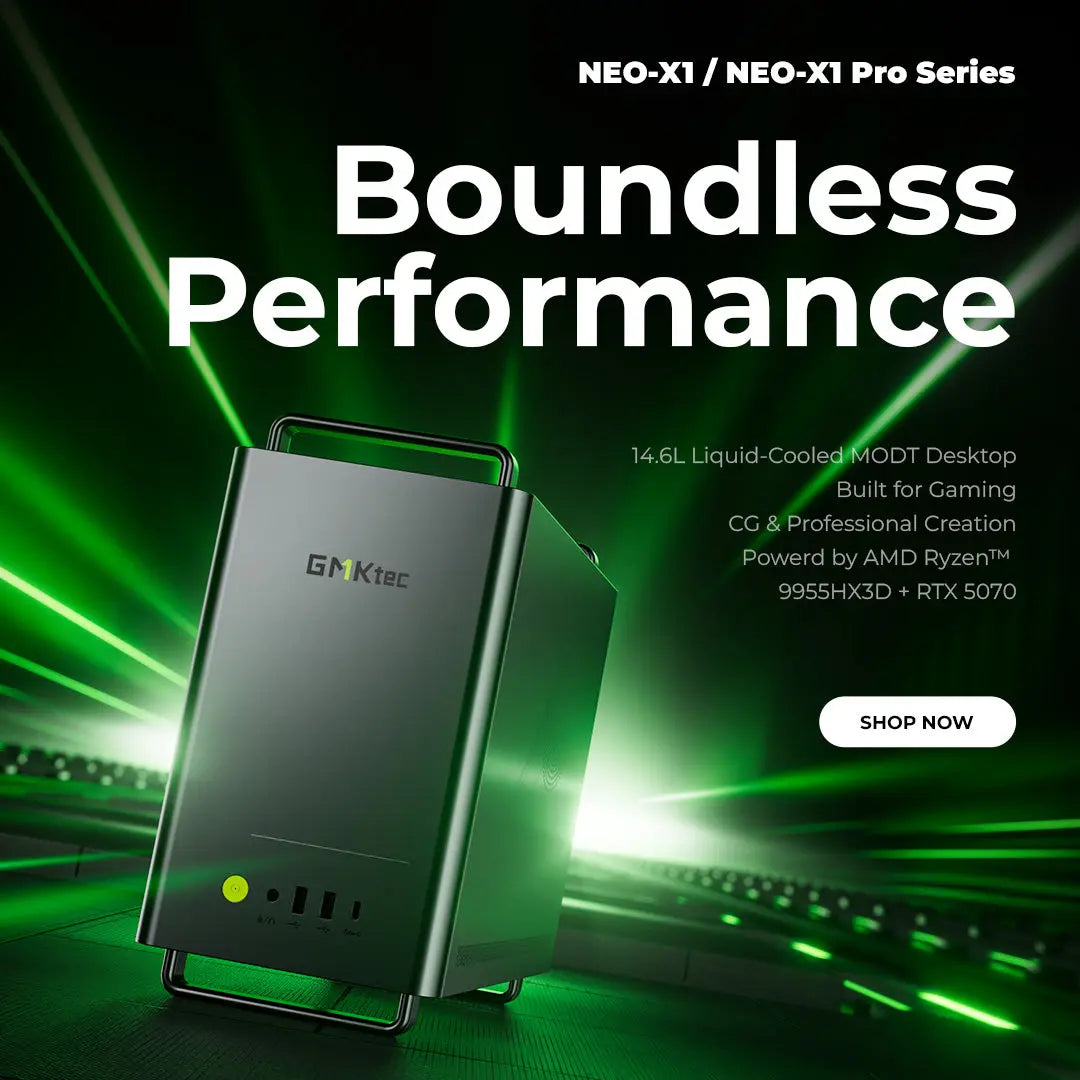
GMKtec is taking the NEO-X1 series worldwide, a desktop line built around high-performance laptop CPUs. The 14.6-liter metal chassis houses an all-in-one liquid cooler and a full desktop GeForce RTX card, and the higher-end NEO-X1 Pro pairs a Ryzen 9 9955HX3D with an RTX 5070. The series launched in China first and is now coming to overseas markets in the same form. Sales begin on August 17, with pricing from 2,099.99 USD.
MODT: a mobile CPU on a desktop board
The MODT tag in the product name refers to putting a mobile laptop processor on a desktop board. Because power draw and package size are both lower, the CPU area and its cooling can be made smaller, and the headroom that frees up goes to the graphics card and the power supply. The GPU is not a mobile part but a full desktop card, so the box shrinks without giving up rendering performance.
The chassis measures 14.6 liters, which GMKtec describes as 2.5 times smaller than a full tower. It is built from grey-green metal with a carrying handle running across the top. The power button and a set of ports sit on the front panel, reflecting a machine meant to live on the desk rather than under it.
Two configurations, split by 3D V-Cache and GPU class
Two SKUs are offered. The standard NEO-X1 combines a Ryzen 9 9955HX with a GeForce RTX 5060 Ti, 32 GB of memory and a 1 TB SSD for 2,099.99 USD (about 330,000 yen). The NEO-X1 Pro steps up to a Ryzen 9 9955HX3D and a GeForce RTX 5070 with 64 GB of memory and a 2 TB SSD for 2,899.99 USD (about 460,000 yen).
Both processors are 16-core, 32-thread Zen 5 parts built on TSMC's 4 nm process. The difference is 3D V-Cache: the 9955HX3D stacks an extra 64 MB of L3 on one CCD. Games that respond to cache capacity tend to show the gap most clearly, while workloads such as video encoding and rendering, where cache hit rates are low to begin with, rarely open up by as much as the price difference suggests. Factoring in the step from RTX 5060 Ti to RTX 5070, whether the 800 USD premium is worth it depends on the workload.
An AIO cooler holding 160 W, and tool-free storage
Cooling is handled by a triple-fan all-in-one liquid cooler, which GMKtec says can sustain 160 W on the CPU side. Power delivery uses a 13-phase design with three selectable operating profiles, and the power supply is a fully modular 850 W unit. For a 14.6-liter enclosure, both the cooling and the power side have been given real headroom.
Storage runs through two PCIe 5.0 M.2 slots supporting up to 16 TB in total. The 22110 form factor is supported, and drives can be swapped without tools. Memory is 32 GB of dual-channel DDR5-5600 in the base configuration. Expandability is usually the first casualty in a small-form-factor build, so this part deserves credit.
Wi-Fi 7, quad 8K output, and Windows 11 Pro
Networking covers both Wi-Fi 7 and 2.5-gigabit Ethernet. Video output supports up to four simultaneous displays at 8K, with ports on both the front and rear panels. The system ships with Windows 11 Pro preinstalled.
On the graphics side, both the RTX 5070 and the RTX 5060 Ti support DLSS 4.5, which fits the premise of running AAA titles out of a 14.6-liter box.
On sale August 17, with a 50 USD early-bird discount
Global sales start at 00:00 PST on August 17, which is 16:00 Japan time the same day. GMKtec is collecting email sign-ups on its website, and subscribers are offered a 50 USD (about 7,900 yen) early-bird discount. The prices above are those listed on the US store; the company also operates regional stores for Europe, the UK and Japan, among others.
※1 USD = 157 JPY (as of August 4, 2026)
Summary
The GMKtec NEO-X1 series is a small desktop that packs a laptop-class Ryzen 9 and a desktop GeForce RTX into a 14.6-liter metal chassis. The standard NEO-X1 pairs a Ryzen 9 9955HX with an RTX 5060 Ti at 2,099.99 USD, while the NEO-X1 Pro moves to a Ryzen 9 9955HX3D and an RTX 5070 at 2,899.99 USD. A triple-fan AIO cooler sustains 160 W on the CPU, and the system includes two PCIe 5.0 M.2 slots, Wi-Fi 7 and 2.5-gigabit Ethernet. The global launch is August 17, with a 50 USD early-bird discount for those who sign up in advance.