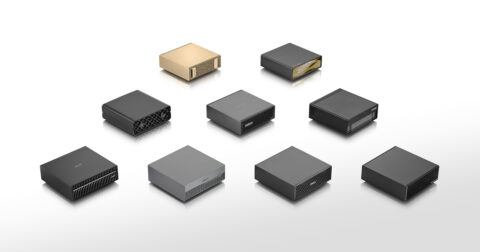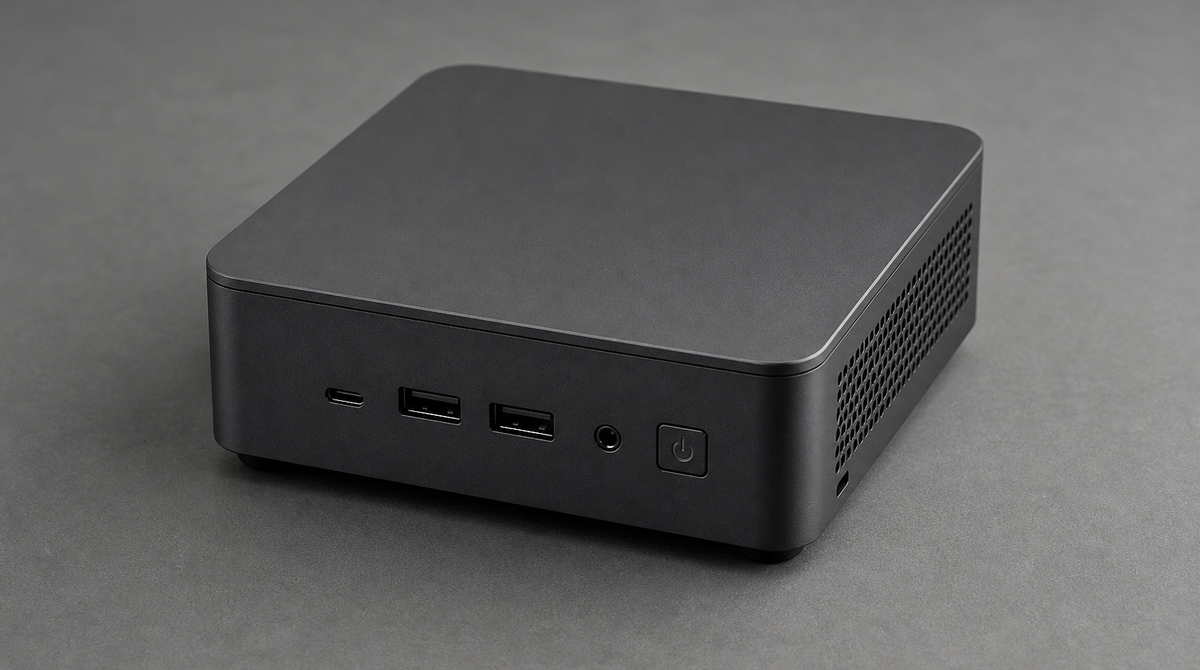
ASUS and Ventiva, a U.S. solid-state cooling startup, have formed a partnership to jointly explore next-generation thermal architectures for compact AI computing systems. Announced on June 1, 2026 at Computex 2026, the collaboration will evaluate whether Ventiva's "ionic cooling" technology — which moves air without any fans — can be applied to future ASUS NUC and Mini-PC designs. A demonstration unit integrating the technology into an ASUS NUC was also showcased at the venue.
What Is "Ionic Cooling," Which Moves Heat with Charged Air?
Ventiva is developing a cooling technology based on a principle called electrohydrodynamics (EHD). It generates airflow by moving ionized air molecules within an electric field, with no rotating parts such as motors or blades. Picture a minuscule plasma field pushing air particles along: because there are no mechanical moving parts, it produces no vibration, and its operating noise measures under 15 dBa in an anechoic chamber — a level that can fairly be called silent.
The module consists of a self-contained air blower device, a fin stack, and a vapor chamber or heat pipe, delivering cooling efficiency of up to 1.1 CFM per device. While typical blower fans are "top-in, side-out" devices that draw air from above and exhaust it sideways, Ventiva's module is a "side-in, side-out" design that requires no air gap for intake. As a result, the internal height can be kept as low as 5 mm, making it easier to fit into thin enclosures.
The Worsening Heat Problem in Compact AI PCs
Behind this partnership lies a fundamental tension: AI workload processing collides head-on with PC miniaturization. AI processing generates concentrated heat not only at the SoC but also in the memory and power-delivery circuitry placed close to it. Tackling these distributed heat sources with conventional fan-based cooling consumes significant board space, restricts component placement, and adds noise and vibration. The smaller and more powerful the chassis, the harder this contradiction becomes to absorb.
The strength of the ionic cooling module is that it is thin and lightweight and can be placed immediately adjacent to heat sources such as the SoC, memory, and power delivery. Because each thermal zone can be cooled independently and precisely, system designs become possible that resist performance degradation (thermal throttling) even under the kind of sustained high loads that AI processing demands.
Starting with Prototype Validation on a NUC Demo Unit
Through this collaboration, the two companies will identify the areas where ionic cooling can deliver the greatest impact within ASUS's next-generation AI system architectures. Christian Schlachte, Director of Product Management at Ventiva, said, "Thermal management has always been treated as a component-level decision. What we're seeing now is that it's becoming a platform architecture decision. How you cool a system determines what you can build," emphasizing the shift toward a "thermal first" design philosophy.
Alex Gilpin, who leads NUC Advanced Engineering at ASUS, commented, "Thermal architecture is becoming an increasingly important part of how next-generation compact AI systems are designed." The current phase of the effort centers on prototype development and technical evaluation, with the ASUS NUC demo unit exhibited at Computex 2026 positioned as the real-world platform for that validation.
Summary
The ASUS-Ventiva partnership is an effort to explore whether fanless, silent, vibration-free ionic cooling can be brought to compact AI PCs. With no rotating parts, up to 1.1 CFM per device, and a module as thin as 5 mm that can target heat sources at close range, the technology looks like a natural fit for high-density enclosures like the NUC. It is still at the prototype validation stage, but the prospect of a compact desktop freed from fan noise becoming reality makes this writer eager for the next update.