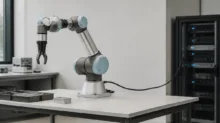
FANUC has developed a new product called the AI Welding Agent, which reads a part drawing and performs arc welding automatically. Built in collaboration with Google, it brings Gemini Enterprise, Google's enterprise generative AI, into an industrial robot. The system will be demonstrated at the International Welding Show at Tokyo Big Sight starting September 16, with shipments scheduled to begin at the end of December 2026.
Show it a drawing, get welding conditions and robot motion
At its core, the AI Welding Agent is a reader of engineering drawings. It takes in the design drawing of a part to be produced by arc welding, works out the material and the part being made, and then generates two things automatically: the welding conditions such as current and voltage, and the motion of the robot.
The phrase FANUC uses for this is zero setup, zero teaching. Conventional arc welding robots require two separate human steps, namely working out the welding parameters and teaching the robot its motion path. Both depend heavily on experience, and both have been the bottleneck in automating this process. The AI Welding Agent moves those two steps onto the AI side.
That does not mean operators are stuck with whatever the model produces. They can run the generated welding conditions and motion as they are, or fine-tune them before welding. Leaving room to inject shop-floor judgment afterward is a practical choice for real production use.
A tablet camera is all the hardware you need
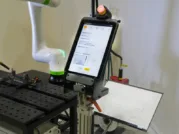
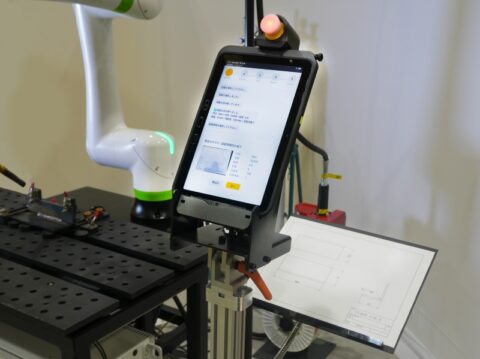
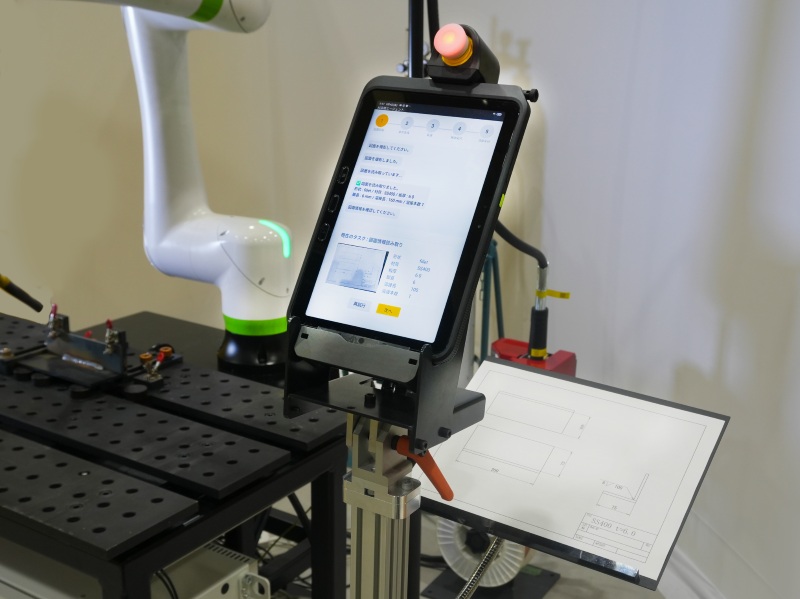
Drawings are captured using the camera built into the tablet-style teach pendant of FANUC's CRX collaborative robot. There is no need to bring a dedicated scanner or camera onto the floor; holding the drawing up to the pendant is enough to start the process. As a retrofit to an existing line, the barrier to entry is unusually low.
The contracting side has been simplified in the same spirit. Users of the CRX and the AI Welding Agent do not necessarily have to sign a separate corporate agreement with Google Cloud. The agent can be used on a subscription basis within the existing framework of their contract with FANUC, which removes one of the internal approval hurdles that typically slows cloud adoption in factories.
The feature also does not depend on any particular welding power source. Any power source connected to a FANUC robot will work. For plants that would rather not replace existing equipment, this may be the specification that matters most.
On security, the enterprise-grade protections of Gemini Enterprise apply directly. Part drawings and other data read by the agent are protected and are not diverted into AI training for other users. Drawings sit close to the core of a manufacturer's intellectual property, so without that guarantee the shop floor simply cannot move.
Why welding, then. Arc welding underpins automotive and truck components, construction materials and shipbuilding, and its importance is if anything growing. Yet skilled workers who can dial in welding parameters or teach a robot are in short supply in Japan and around the world. FANUC points to this as one contributor to long lead times for materials.
Seen this way, the AI Welding Agent is not about making robots faster. It addresses the problem that there are not enough people who can operate them. Being able to buy equipment but not staff it is a complaint heard well beyond welding, and this product aims AI squarely at that gap.
At the International Robot Exhibition in December 2025, FANUC showed its open platform support and a physical AI system. Physical AI describes robots that perceive their surroundings through sensors, judge for themselves and move according to the environment. This new product applies that approach to the specific process of arc welding, which fits with the company's account of strong interest following that exhibition.
Summary
The AI Welding Agent generates welding conditions and robot motion from a drawing alone, in a zero setup, zero teaching workflow. It runs off the camera in the CRX tablet pendant, works with any welding power source, and fits inside an existing FANUC contract, which together strip out a lot of the friction around adoption. Demonstrations begin at the International Welding Show on September 16, with shipments from the end of December 2026. It is worth watching as an early test of how practical an answer AI can offer to the shortage of skilled workers.