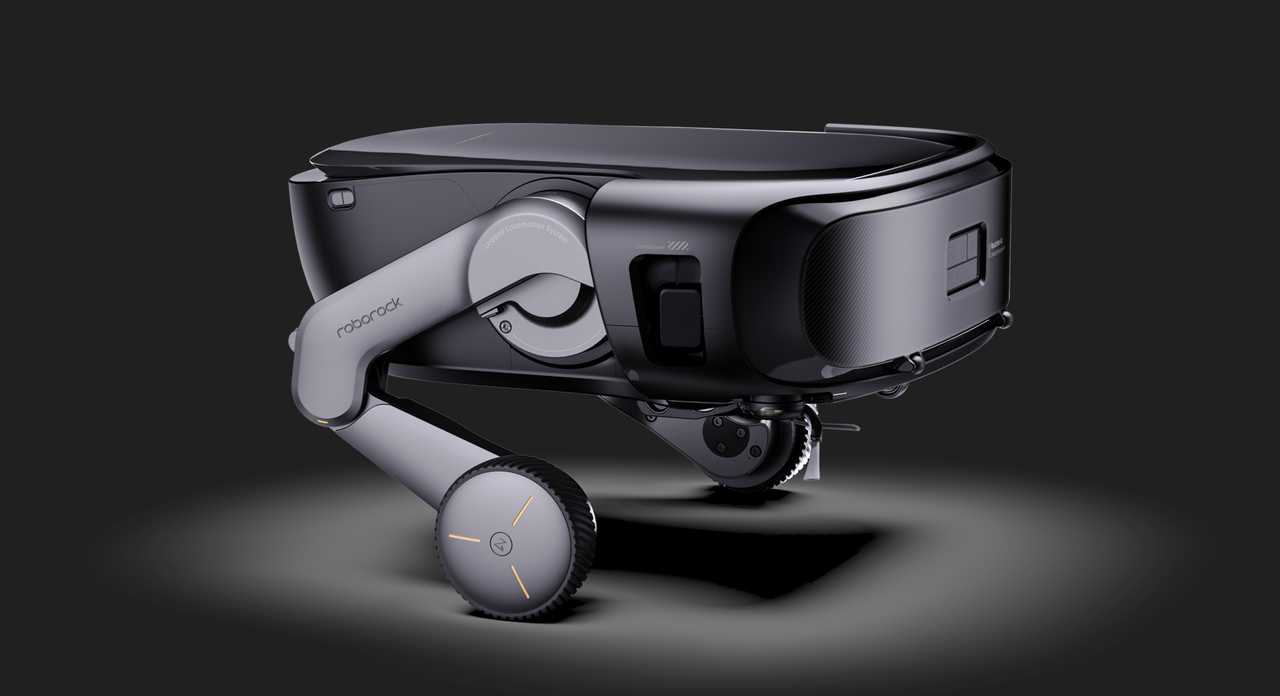
At IFA 2026 in Berlin, Roborock showed the Saros Rover, a cleaning robot built around wheel-legs, to a European audience for the first time. The company announced a 36,000 Pa flagship vacuum alongside it, plus its first pool-cleaning robot and a wire-free robotic lawn mower. Cleaning has moved from the living room floor to water and grass in a single show, which makes it a good moment to check how far the company's whole-home automation has actually come.
Lifting one leg at a time to climb stairs and clean each step
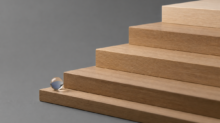
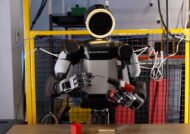
The Saros Rover abandons the usual arrangement of fixed wheels under a round chassis. Instead it carries two units that merge a wheel and a leg. Each leg extends and retracts independently, letting the robot hop slightly, stop abruptly, and change direction quickly while keeping the body level. Motion is handled by AI algorithms working with multiple motion sensors and 3D spatial information.
The target is the obstacle robot vacuums have never cleared: stairs. Roborock says the Rover can move between floors while cleaning each step as it goes, and not only on straight staircases. The list includes curved stairs, carpeted stairs with bullnose fronts, sloped floors, and doorways where several thresholds stack up. The idea is that a two-story house no longer needs two robots.
Pricing and release timing remain undecided. Roborock describes it as a real product in development, so for now it is a machine that moves on a show floor. The Rover first appeared at CES 2026 in January, and IFA was the first chance for European users to see it in person.
Flagship robots aim for 36,000 Pa and 8.8 cm thresholds
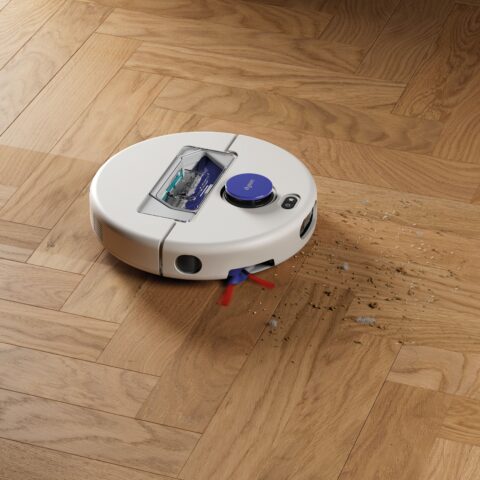
Products closer to purchase also moved forward. The Saros 20 Flow, which carries a roller-based mopping system, and the Qrevo Edge 3 Pro, which pushes on thinness, both claim 36,000 Pa of suction from a HyperForce motor.
Both ride on AdaptiLift Chassis 3.0, rated to cross double-layer thresholds up to 8.8 cm. Anyone who has watched a robot get stuck on a raised doorway or an entryway step will recognise why that figure matters in practice. A retractable sensor system called RetractSense also lets the Qrevo Edge 3 Pro slip under sofas and beds into gaps as low as 7.95 cm.
Climbing power and a low body normally pull against each other. Stowing the sensor tower and raising the wheels only when needed is how Roborock tries to have both.
On the mopping side, rollers that spin while being continuously rinsed have become the flagship approach. A conventional pad carries collected dirt back and forth across the floor, while a roller is washed as it turns, so residue is less likely to be spread again. That difference is what separates the two flagship models this year.
Cleaning moves into water and onto grass
The other notable shift at IFA was a set of products that left the house entirely.
The RockAqua P1 is Roborock's first pool-cleaning robot. It covers pool floors, walls, the waterline, and shallow platforms down to 15 cm. Suction is rated at 6,800 gallons per hour, or roughly 25,700 litres per hour. The debris basket holds 4 litres and filters in two stages, at 180 micrometres and 70 micrometres. Runtime reaches 3.5 hours, and recharging also takes 3.5 hours. A monocular camera avoids obstacles such as drain covers and steps, while dynamic dirt detection concentrates effort where debris collects. When a job ends the robot parks itself near the waterline, which makes retrieval less awkward.
The garden is handled by the RockNeo Q2 LiDAR, rated for lawns up to 800 square metres and free of both boundary wire and antennas. It combines Sentisphere LiDAR environmental perception with camera-based ReactiVision Fusion obstacle avoidance. A floating cutting deck follows the contours of the ground, and the PreciEdge module cuts to within 3 cm of the lawn edge.
Among wet-dry cleaners, Roborock showed the F25 Ultra Steam Gen 2, which pairs high-temperature steam with hot-water cleaning, and the five-in-one F25 Pro Turbo Combo, whose drive module detaches so the unit can work as a cordless vacuum.
Roborock by the numbers
Roborock claims the top position worldwide among robot vacuum brands for the first half of 2026 according to IDC. Its products sell in more than 170 countries and regions, and as of August 2026 the company says they are used in more than 30 million households. Headquarters are in Beijing, with local subsidiaries in six countries including Japan.
Quan Gang, President of Roborock, said the goal is to give time back to customers by automating everyday tasks, and that building smarter robots is the means rather than the goal. Every minute spent on housework, in his framing, is a minute taken from family and personal interests. He also touched on the partnership with Real Madrid, presenting a club with 15 UEFA Champions League titles and 36 league championships as a match for a company that refuses to rest on past results.
Summary
What Roborock presented at IFA is an attempt to cross three boundaries at once: thresholds, water, and grass. The models you can actually buy consolidate the fundamentals with 36,000 Pa and 8.8 cm threshold clearance, and the stair-climbing Saros Rover sits beyond them. Pool and garden robots will not resonate immediately with Japanese housing, but the broader move of autonomous cleaning away from floors will shape future lineups. When Roborock finally names a price and a date for the Saros Rover is the next thing worth watching.