A recorder's internal hard drive fills up, or it fails and takes your recordings with it. Panasonic's answer to that long-standing problem is the cloud. The five new Zen-Jido DIGA models announced on September 14, 2026 support Cloud Recording, which stores recorded programs on Microsoft OneDrive or Google Drive. They go on sale in late October 2026 at open pricing.
The cloud becomes a third place to offload recordings
Until now, when the internal hard drive ran out of space, the only options were dubbing to a Blu-ray disc or to a USB hard drive. The new series adds the cloud as a third destination. Two services are supported, Microsoft OneDrive and Google Drive, with up to 10TB of programs storable in the cloud.
What makes this more than a capacity workaround is what happens when hardware fails. Programs offloaded to the cloud survive a failure of the recorder's internal drive. For the first time, there is a practical insurance policy against the weak point that has always defined recorders, namely that your recordings share the fate of the box they live in. If a failure forces you to replace the unit, signing up for the cloud recording transfer service lets you carry those programs over to a new DIGA. The replacement model does need to support Cloud Recording as well.
Programs kept in the cloud behave much like those on the internal drive. They play back straight from the home screen or the recording list, and the Dokodemo DIGA smartphone app lets you watch them while you are out. Watching remotely requires creating a smartphone-transfer version of the program in the cloud in advance, and the viewing device must already be paired over the home network.
Five models, two of them with built-in 4K tuners
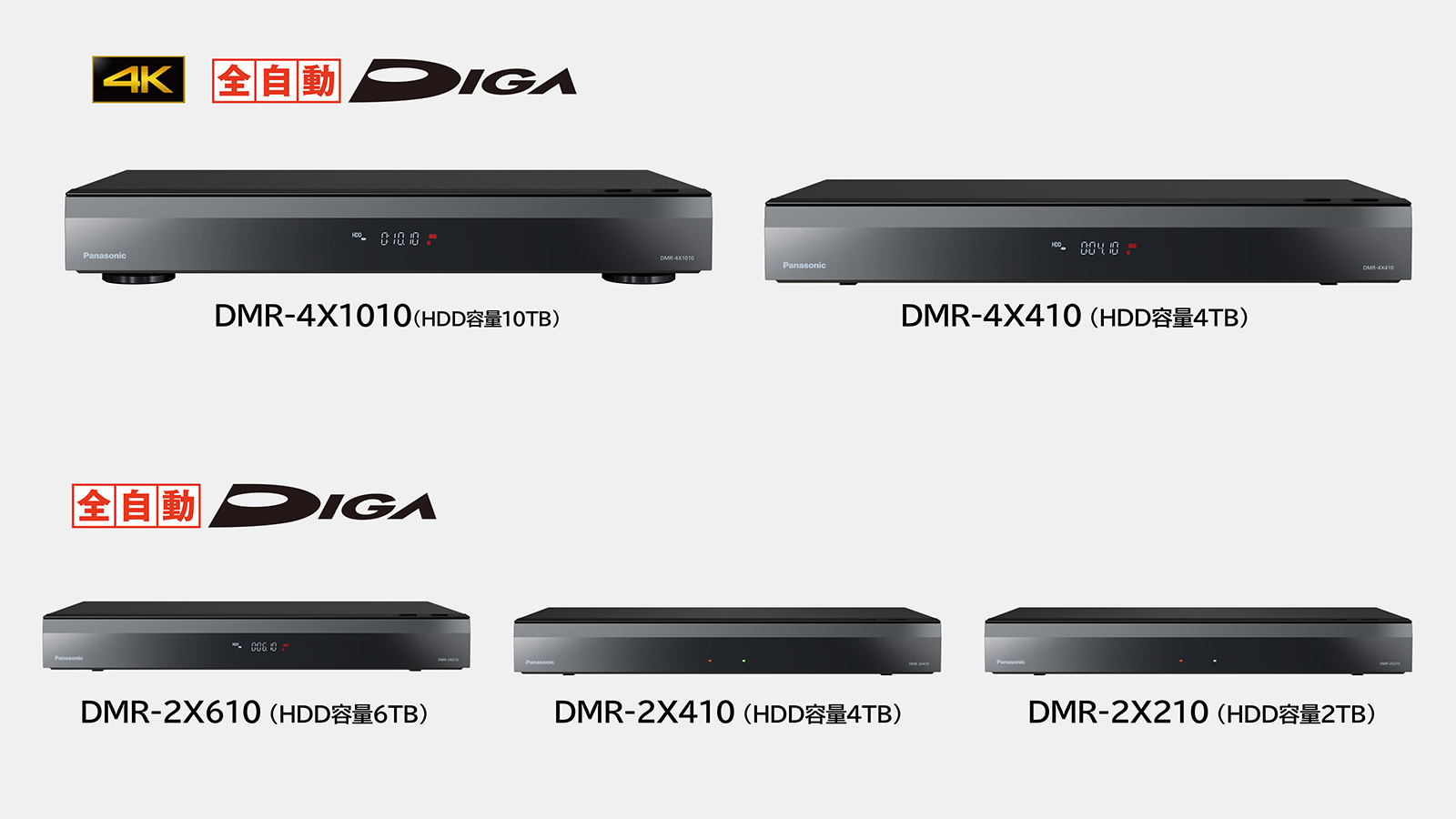
The lineup splits into two higher-end models with built-in 4K tuners and three without.
| Model | Hard drive capacity | Automatic recording guideline |
|---|---|---|
| DMR-4X10¹⁰ | 10TB (6TB for standard recording) | 8 channels for about 28 days |
| DMR-4X410 | 4TB | 4 channels for about 28 days |
| DMR-2X610 | 6TB (2TB for standard recording) | 10 channels for about 28 days |
| DMR-2X410 | 4TB | 6 channels for about 36 days |
| DMR-2X210 | 2TB | 6 channels for about 16 days |
Those durations all assume the 15x recording mode, and the figures for the 2X610, 2X410 and 2X210 include 2 additional channels. The balance between channel count and retention differs quite a bit from model to model, so the choice comes down to whether you want to cover many stations every day or keep a smaller set of channels around for longer.
The two models with built-in 4K tuners can also apply automatic recording to 4K satellite broadcasts. That setting is available only on an additional channel, is limited to 1 channel, and works only in 4K DR mode. Configuring an additional channel also reduces the hard drive area allocated to standard recording.
Conditions worth checking before you buy
Cloud Recording is convenient, but several prerequisites make it work. Setup requires the Dokodemo DIGA smartphone app, and you need an account with either OneDrive or Google Drive. Cloud services may charge a monthly fee depending on capacity, so the real calculation includes both your connection costs and your storage subscription.
The demands on your line are not trivial either. Panasonic recommends an FTTH fiber connection with an effective speed of 100Mbps or higher, and warns that saving and playback can suffer if the connection is unstable or too slow. Sending a large batch of programs at once may also slow down depending on your provider.
A few technical limits are worth noting. Even when you select the cloud as the recording destination, the program is first recorded to the internal hard drive and then transferred. Only programs can be stored; music and photo data are excluded. Panasonic also states plainly that service outages, changes to service terms, or the end of a service may make recording, dubbing or playback impossible, and that permanent storage is not guaranteed. When the backup destination sits outside the manufacturer's control, that is an honest caveat.
Editing features aimed at fan culture
The cloud is not the only addition. The new models support Playlist Editing, which collects your favorite scenes while leaving the original recording intact. Panasonic pitches it at pulling out the moments featuring a favorite performer, or sports highlights, and arranging them together. Because the source program stays untouched, it is a low-risk feature even for people whose editing attempts tend to go wrong.
A new Program Tag function also lets users tag song titles, performers and similar details inside a program and filter by them later. On a machine that keeps piling up recordings through automatic capture, more ways to find things is a practical improvement. Panasonic sees continued strong interest in recording even as streaming services expand, and frames the goal as evolving the recorder from a simple recording device into a platform for storing, managing and watching content.
Summary
On September 14, 2026, Panasonic announced 5 Zen-Jido DIGA models with Cloud Recording. The DMR-4X10¹⁰ and DMR-4X410 include built-in 4K tuners, while the DMR-2X610, DMR-2X410 and DMR-2X210 do not, and all five arrive in late October 2026 at open pricing. Up to 10TB of recorded programs can be stored on Microsoft OneDrive or Google Drive, which doubles as insurance against hardware failure. The prerequisites of a fiber line and a cloud subscription are real, but breaking the link between your recordings and a single box matters. Together with Playlist Editing and Program Tags, the way people live with their recorded libraries looks set to shift.