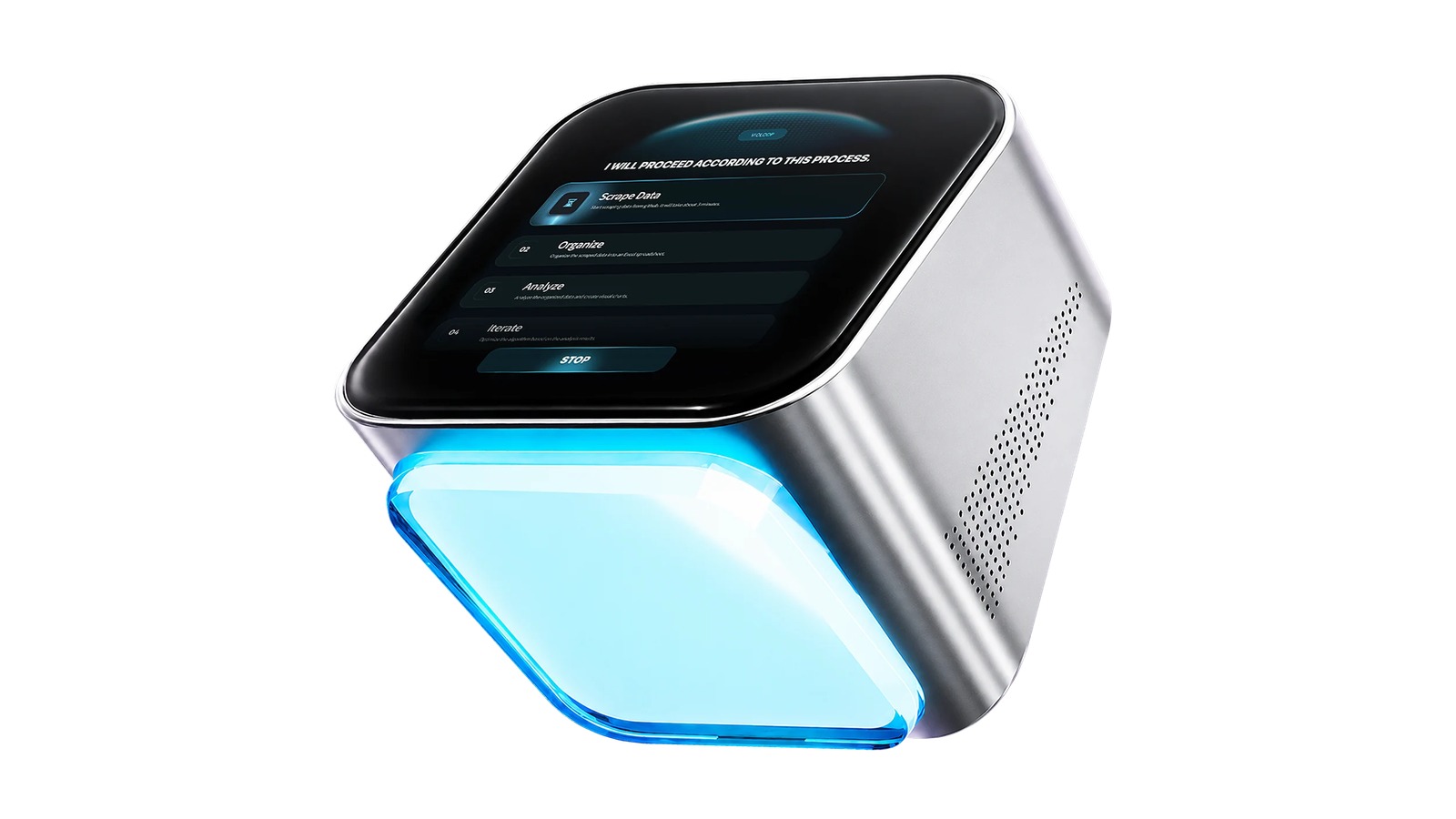
BVIO Technology has unveiled Violoop, a palm-sized AI device, at IFA 2026 in Berlin. Inserted between a PC and its monitor over HDMI and USB, it reads what is on screen inside the device and operates applications on the user's behalf by acting as a keyboard and mouse. It carries an 8B model and an AI accelerator on board, and the raw screen feed never leaves the device. The Kickstarter campaign opens on September 15, with shipping planned from October.
It Watches the Screen and Acts as a Keyboard
What sets Violoop apart from earlier AI agents is that nothing is installed on the PC. The PC's video output is routed through the device over HDMI, and the device captures that feed at 4K/30Hz over HDMI 2.0 for analysis. For control, it connects over USB and is recognized as a standard keyboard and mouse (USB-HID), sending commands to the PC in the same form a person's hands would.
No drivers or system changes are needed; as far as the PC is concerned, an ordinary input device is attached. That is why it works on Windows, macOS, and Linux alike, with support for up to two monitors. The unit itself has an AMOLED touchscreen for checking work in progress and pending approvals at a glance, and it also accepts voice instructions.
Usage is organized into three modes. The first is an instant mode that suggests the next action from the on-screen context, accepted with the Tab key. The second hands off long, multi-app tasks in one go; browsers, documents, spreadsheets, email, and internal systems with no API are all fair game as long as they appear on screen. The third is Away Mode: lock the PC screen, leave the desk, and the work continues, with a notification sent to the smartphone app whenever confirmation is needed.
BVIO cites an example in which an incoming customer order email triggers a single flow: looking up the customer's details, updating the CRM, having a model draft the reply, and placing it back in the email client. Execution paths are not uniform either. Where a script or API is available it is used directly, followed in order by keyboard shortcuts, accessibility handles, and finally GUI clicks, trying the fastest reliable method first. The company says training drew on more than 200 applications and over 10,000 real software screens.
An 8B Model On Board, Claimed to Be Faster Than a Mac mini M4
The hardware pairs Rockchip's octa-core RK3576 SoC with a 26 TOPS AI accelerator. Memory totals 13GB, made up of 8GB of LPDDR4X and 5GB of 3D-stacked DRAM, with 128GB of eMMC 5.1 storage. Wi-Fi covers 2.4GHz and 5GHz (802.11ac/ax), and Bluetooth 5.2 is included. The unit measures 90 x 92 x 80mm, weighs 450g, and runs on 12V.
On this hardware, an 8B Qwen model (4-bit quantized) runs entirely within the device. According to BVIO's measurements, with the same model and precision running under Ollama, a Mac mini M4 (16GB) generates 20 tokens per second while Violoop reaches 53 tokens per second, a 2.7x difference. Because quick questions and lookups are handled by this local model, the company says cloud token usage can be cut by up to 90 percent.
For work that needs a larger model, users bring their own API keys for services such as Claude, OpenAI, Gemini, and Codex. The device's routing logic decides the split: routine processing stays on the device, specialist work goes to a suitable model, and more powerful cloud services are called only when necessary. Even then, what goes to the cloud is a filtered text summary of the relevant context; the screen video itself is never streamed.
The Approval Button Is Wired to a Different Chip Than the AI
Where Violoop invests most is in making sure the AI cannot execute on its own. The USB-HID path that operates the PC is controlled by an STMicroelectronics STM32H563 microcontroller carved out as a dedicated security processor. The physical approval key on the unit is wired directly to that security-side chip, so neither the AI-side software nor any program on the PC can fake a press. It is a two-chip arrangement: the AI prepares, a separate chip decides.
When an action in Away Mode requires confirmation, the workflow pauses, an approval request is sent to the smartphone app, and nothing resumes until permission is granted. What the device learns about the user's steps, preferences, and app-to-app handoffs is stored on the device and, according to BVIO, is not used to train models unless the user enables that in settings.
699 USD at Retail, 399 USD for Early Kickstarter Backers
The Kickstarter campaign opens on September 15, 2026, with an expected retail price of 699 USD (about 108,000 yen). Early backers can pledge from 399 USD (about 62,000 yen), a discount of 300 USD (about 46,000 yen). Shipping is scheduled to begin in October 2026. The official site is also taking refundable 10 USD reservations, which the company says bring a further 30 USD off, to 369 USD (about 57,000 yen). Ahead of the announcement, BVIO raised a 20 million USD (about 3.1 billion yen) seed round.
※1 USD = 155 JPY (as of September 4, 2026)
Summary
Rather than putting AI inside the PC, Violoop places a second user outside it. Because it sees the screen over HDMI and moves the hands over USB, it is indifferent to OS and application, and even legacy software with no API falls within reach. The combination of an on-board 8B model and an approval button hard-wired to a chip separate from the AI is an angle no other AI agent product has taken, aiming for both speed and a safety-side brake. How well the screen recognition and cloud handoffs hold up in practice, though, is something that can only be judged once shipments begin in October.