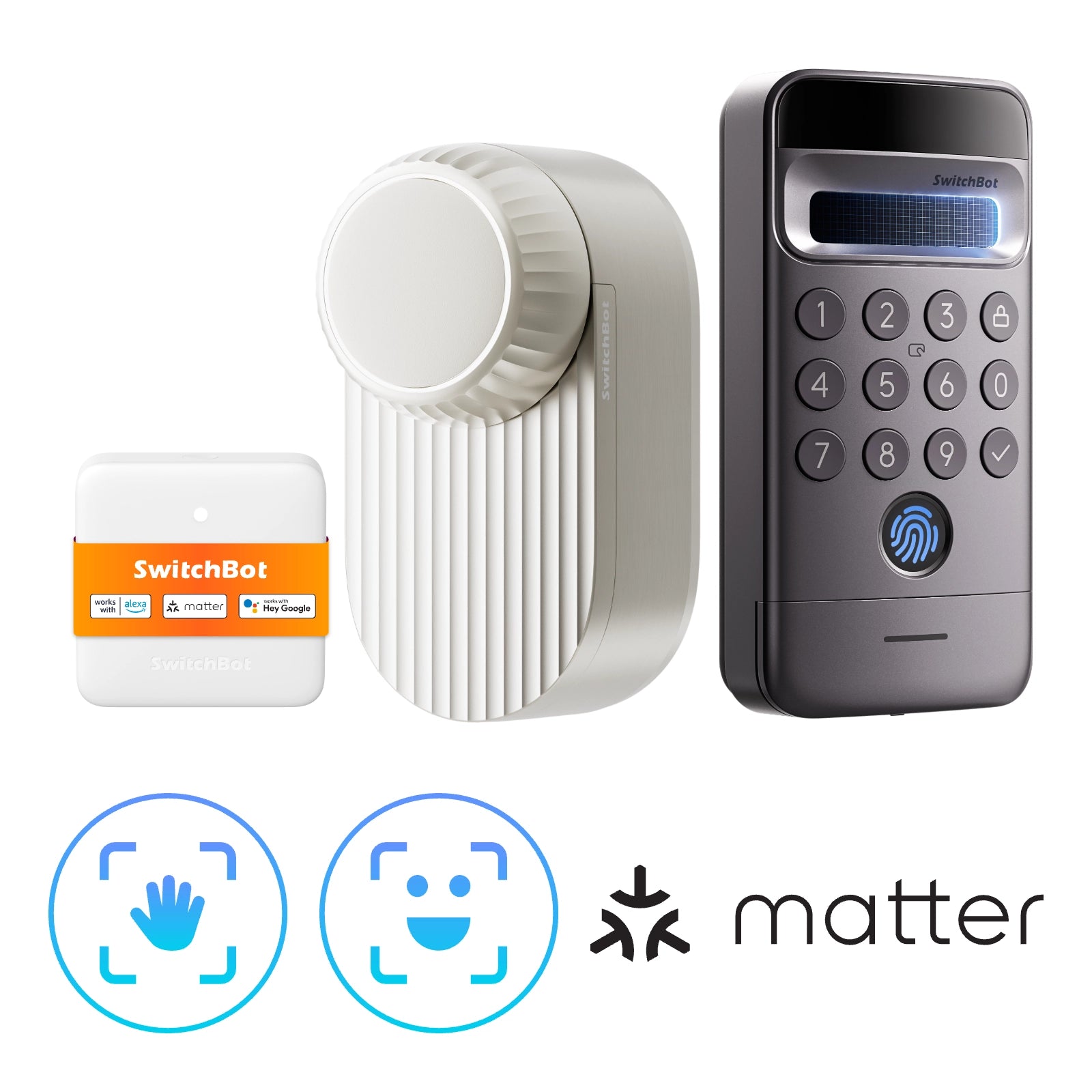
SwitchBot has announced a new smart lock, the SwitchBot Lock Ultra Max, timed to the opening of the IFA 2026 consumer electronics show in Berlin. It retrofits onto an existing lock without altering the outside appearance of the door. The Lock Ultra Max Vision Pro Combo, which pairs the lock with the Keypad Vision Pro exterior reader and a hub, is priced at 339.99 EUR (about 63,000 yen). Pre-orders opened on September 3 through SwitchBot's official European and UK stores.
A retrofit design that leaves the cylinder in place
The Lock Ultra Max mounts on the inside of the door and turns the existing thumb turn. No cylinder swap and no drilling are required, and it supports the lock formats common across Europe: EU profile, UK oval, Swiss round, and night latch. Separate adapters cover cases where the fit is not standard.
The body combines aluminum alloy with PC and ABS plastic, measures 122 by 62.6 by 66.8 mm, and weighs 391 g. A fluted cylindrical shell sits on a base ring with no visible gap, an attempt to make the unit look less like an add-on. Connectivity is Bluetooth 4.2 or later, and the operating range runs from -10 to 45 degrees Celsius.
A new motor: 1.1-second unlocking, 56.3 dBA in quiet mode
The drivetrain uses a brushless motor SwitchBot calls UltraDrive. It spins at up to 160 rpm, roughly 3 times the speed of the previous Lock Ultra, and Fast Mode completes an unlock in as little as 1.1 seconds.
Speed usually comes at the cost of noise, so a quiet mode brings operation down to 56.3 dBA. A Night Mode switches over automatically during set hours, which makes it practical to run quietly only in the early morning or late at night. The lock also adds Partially-Lock, which reduces the amount of rotation for faster everyday use, and an auto-lock that waits for a magnetic sensor to confirm the door is fully closed.
Face recognition, palm veins, and 19 ways to open the door
The Keypad Vision Pro mounted outside sharply expands the range of authentication methods. A household can use up to 19 different ways in, and the headline features are the two contactless options.
The first is 3D facial recognition. Infrared structured light reads the millimeter-level shape of a face, so SwitchBot says photos, images shown on a screen, and video cannot unlock the door. The recognition range is 0.6 to 0.9 meters, and the false recognition rate is stated as below 0.0001 percent. The system is designed to keep working across changes in appearance such as hats, sunglasses, or makeup.
The second is palm vein recognition. Near-infrared light reads the vein pattern inside the hand at a distance of 8 to 25 cm. It tends to work where fingerprints struggle, including wet, dirty, or dry hands, and SwitchBot positions it as easy for children and older family members. The scenario in mind is holding a hand up while carrying shopping bags or a child.
Beyond those, the lock supports fingerprints, passcodes, NFC cards, physical keys, voice control, Apple Watch, and the smartphone app.
Biometric data stays on the device, and power comes in three tiers
Biometric handling is designed to stay on the hardware rather than in the cloud. Face and palm vein data are converted into non-reversible feature sets, encrypted, and stored locally, with AES-128 used for communication. Users can delete the data at any time from the app, and it cannot be recovered afterward. When the device is online, SwitchBot says only MAC information, control commands, and lock execution status pass through its servers. The company also cites GDPR compliance and ISO/IEC 27001 and ISO/IEC 27701 certification for information security and privacy information management.
The worst failure mode for a door lock is a dead battery, so power is arranged in three tiers. The main 4,200 mAh rechargeable battery lasts up to 9 months in typical use. While it is removed for charging, or once it is drained, a CR123A cell takes over automatically for up to 95 days of standby or roughly 500 lock and unlock operations. If that backup drops too low to deliver enough power on its own, a built-in supercapacitor stores energy from the battery and works alongside it on the next unlock.
A Matter-enabled hub in the box
The bundled Hub Mini Matter Enabled provides remote control from outside the home and connects the Lock Ultra Max to Matter-based smart home setups. Apple Home and Home Assistant can check status and pull the lock into automations, which makes it easier to tie entry to occupancy detection or lighting rather than treating the lock as a standalone device. Event logs also show from anywhere whether the door is open, closed, or securely locked.
The Combo pairing the Lock Ultra Max, Keypad Vision Pro, and Hub Mini Matter Enabled costs 339.99 EUR (about 63,000 yen), or 339.99 GBP in the UK. A lock-only model is also planned at 189.99 EUR (about 35,000 yen), though its release date has not been set. The warranty runs 2 years, with an extra year included for early buyers.
Exchange rate (as of September 2026): 1 EUR = 185 JPY
Summary
The SwitchBot Lock Ultra Max keeps the retrofit format that requires no cylinder replacement while rebuilding the motor and the authentication layer. The main points are a brushless motor reaching 160 rpm for unlocking in as little as 1.1 seconds, a quiet mode at 56.3 dBA that balances speed against noise, 19 ways to open the door including 3D face and palm vein recognition, and a three-tier power system built from a rechargeable battery, a CR123A cell, and a supercapacitor. Keeping biometric data confined to the device is a sensible call for a product that sits on a front door. Pre-orders are running first in Europe and the UK, and no availability has been announced for Japan.