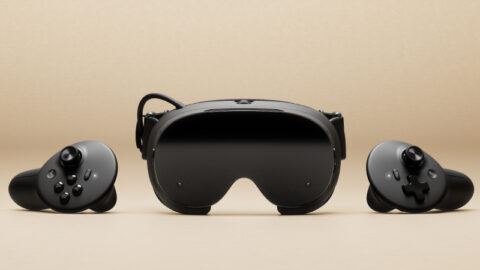
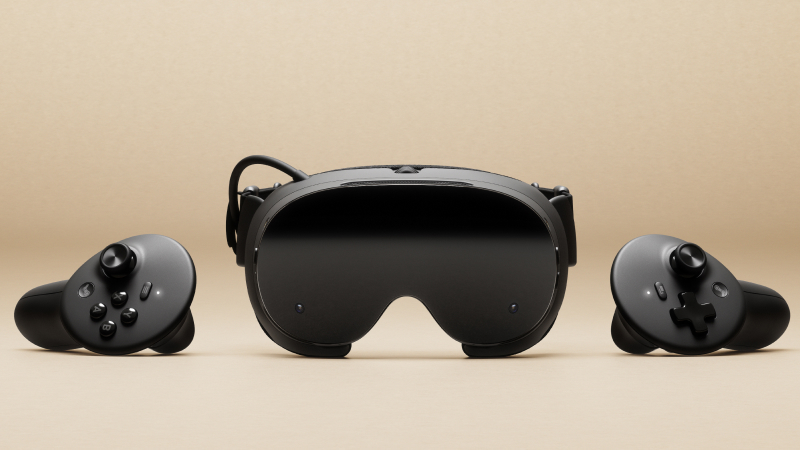
Valve's standalone VR headset, the Steam Frame, went on sale in Japan on September 15. KOMODO handles distribution in the country, and pricing is 199,980 yen for the 256GB model and 244,980 yen for the 1TB model, both tax included. Sales began the same day in Taiwan and Hong Kong. The launch arrived with almost no advance notice, and the 256GB model sold out shortly after listings went live.
Ten months from reveal to shelves, at roughly 200,000 yen
The Steam Frame first appeared as a product about 10 months ago, and a long stretch followed before anyone could actually buy one. In the United States the 256GB model is 1,059 USD (about 164,000 yen) and the 1TB model is 1,299 USD (about 201,000 yen), so the Japanese figures sit somewhat higher once consumption tax and local distribution are added.
※1 USD = 155 JPY (as of September 16, 2026)
This is not a cheap headset by VR standards. But as described below, the design lets a single unit carry an entire Steam library, so whether the price looks steep depends on whether you read it as the cost of a headset alone.
It runs without a PC, and it plays non-VR titles too
Inside is a Snapdragon 8 Gen 3 paired with 16GB of LPDDR5x memory, running SteamOS 3. In other words, games run on the device itself with no PC attached. Storage is UFS in 256GB or 1TB capacities, and there is a microSD card slot, so choosing the smaller model still leaves an escape route later.
The notable part is that support is not limited to VR titles. Valve says the headset can handle everything in a Steam library, meaning titles with no VR support can be played on a virtual big screen. Framed that way, an existing library becomes an asset rather than something left behind, which lowers the psychological barrier to adding a headset to the setup.
Two separate wireless paths, and high quality only where you are looking
The headset works on its own, but plugging the bundled wireless adapter into a PC also allows wireless streaming from that machine. The approach here is slightly unusual: the wireless link is split across two bands, one dedicated to video and audio transmission and the other reserved for ordinary Wi-Fi. The point is to keep streaming from fighting general network traffic for bandwidth. The headset supports Wi-Fi 7 and Bluetooth 5.3, while the wireless adapter uses Wi-Fi 6E.
The other headline feature is foveated streaming. Eye tracking picks up the direction of your gaze with low latency, and the highest quality pixels are assigned only to the area you are actually looking at. Human vision already resolves far less detail outside the center of the field, so dropping quality at the periphery tends to go unnoticed. Valve states that image quality and effective bandwidth improve by more than a factor of 10. The processing is meant to run without the user noticing it, and it works across everything in a Steam library.
Controllers run about 40 hours on a single AA battery
Input comes from the Steam Frame Controller, a separate unit for each hand. Alongside capacitive finger tracking, each controller carries a D-pad, A/B/X/Y buttons, a thumbstick, triggers and bumpers for non-VR games, which is a generous layout. The thumbsticks use magnetic sensing. Power comes from a single AA battery with roughly 40 hours of runtime, and avoiding a proprietary pack that degrades over time matters quietly over the years of owning a device. Each controller measures 126 by 73 by 87mm and weighs 130g with the battery installed.
The display is an LCD at 2,160 by 2,160 pixels per eye, covering refresh rates from 72Hz to 144Hz. Custom pancake lenses combine with glass and non-glass optical elements for a field of view of up to 110 degrees. Interpupillary distance spans 60mm to 70mm, and eyeglasses up to 140mm wide fit inside. Tracking is camera-based inside-out, so no external sensors are required. The headset measures 175 by 95 by 110mm and weighs 440g including the head strap, which Valve says was achieved while balancing weight between front and back.
Summary
The Steam Frame is a two-layer proposition: it runs Steam on its own with no PC required, and it can pull performance from a PC over a wireless link when that is what a game needs. Foveated streaming driven by eye tracking, controllers that last about 40 hours on an AA battery, and a microSD slot as a capacity safety valve all point to a device designed around sustained everyday use. Starting at 199,980 yen it is hardly a casual purchase, but the ability to bring an existing Steam library along means it never has to be treated as a VR-only machine.