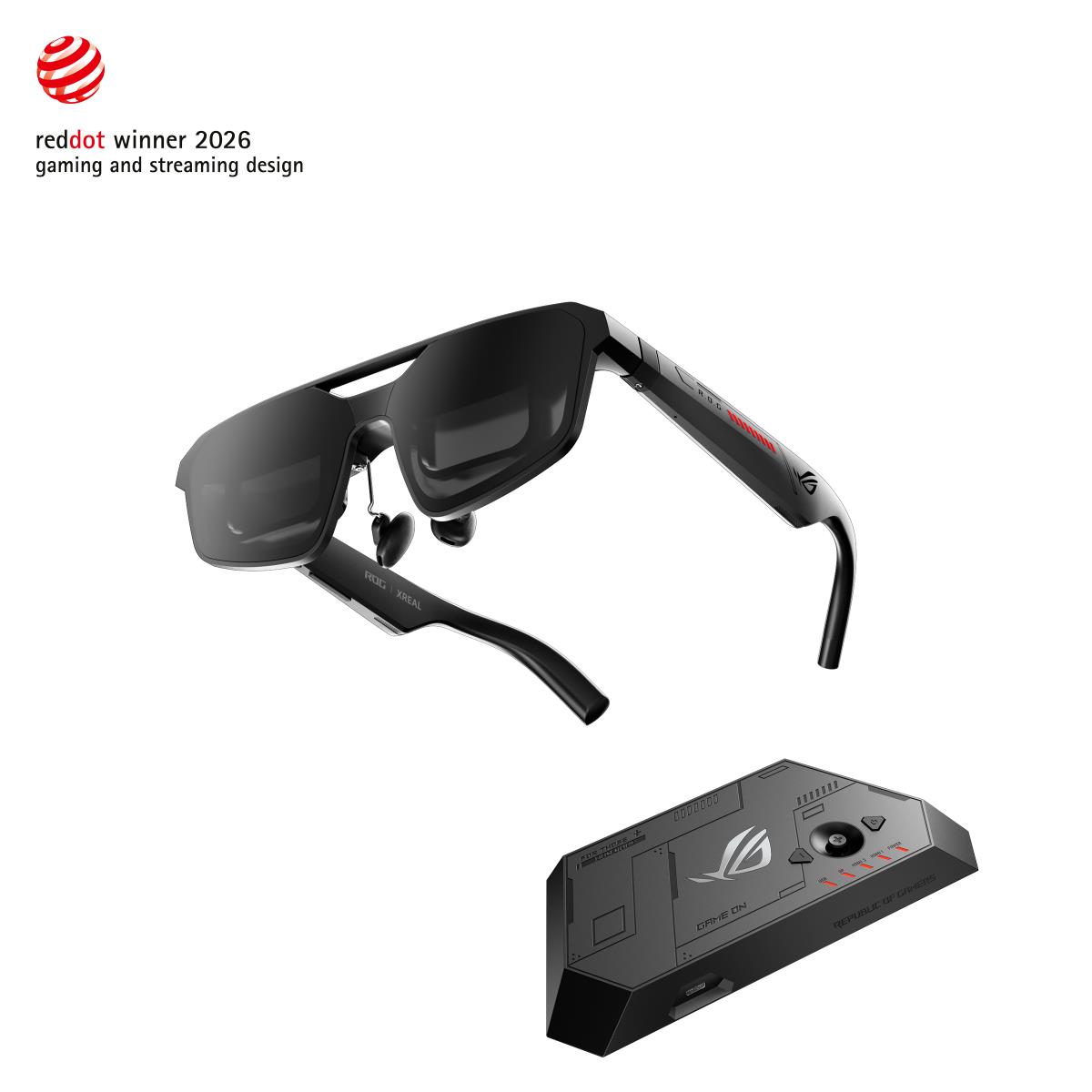
The ROG XREAL R1, co-developed by ASUS's ROG gaming brand and AR (augmented reality) glasses maker Xreal, is now available for pre-order overseas. It is a pair of AR glasses built squarely for gaming, projecting a virtual screen of up to 171 inches in front of your eyes. Unusually for the glasses form factor, it supports a 240Hz refresh rate, and it is priced at $849 (about 137,000 yen). In Japan, a mid-July launch has been announced.
A 171-Inch Screen in Front of Your Eyes, Built for Gaming
The ROG XREAL R1 is a pair of AR glasses that project an image onto the lenses, making a large screen appear to float within your field of view. It weighs about 91 grams, only slightly heavier than ordinary eyeglasses. The glasses have no built-in battery and instead draw power from the connected device, with power consumption under 3W for the glasses alone, or under 7.5W when used through the dedicated dock.
The image can appear as large as a 171-inch screen roughly 4 meters away. The field of view (FOV) is 57 degrees, said to cover 95 percent of the central area where your eyes focus, so the picture spreads across your vision. The displays use Micro-OLED (extremely small OLED panels) at Full HD (1920 x 1080) per eye, aiming for deep blacks and vivid color.
Gaming-Focused Hardware
The headline feature is the refresh rate, which indicates how smoothly the picture is redrawn. While typical AR glasses top out at 120Hz, the R1 claims to be the first commercially available AR glasses to support 240Hz. Its pixel response time is 0.01 milliseconds, which it says reduces motion blur even in fast-paced scenes. That said, the 240Hz mode is achieved through image scaling, and the company notes that text and other details may look slightly softer than at native resolution.
Stationary use is supported by the bundled ROG Control Dock. With two HDMI 2.0 ports and one DisplayPort 1.4, it lets you keep a PC and a game console connected at the same time and switch the video source with a single button. It also carries over features honed on ROG gaming monitors, including GamePlus, which overlays a crosshair, timer, or frame-rate counter on screen; seven GameVisual modes that optimize image quality for different game genres; and HDR tone mapping that takes an HDR signal and renders it cleanly.
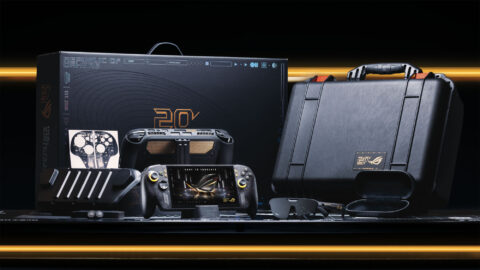
Integration with the ROG Ally handheld is especially deep: a single USB-C cable expands the 7-inch handheld into a 171-inch big screen. While connected, the Ally's own screen remains active as a control panel, letting you adjust brightness, screen size, dimming level, 3D display, and more without pausing the game.
Attention to Visuals and Fit
The R1's lenses incorporate electrochromic dimming, which changes tint by applying an electric current and offers three levels of adjustment. Whether in a bright cafe or a dark room, you can change the lens tint to maintain contrast. Thanks to the onboard X1 spatial processing chip, it supports 3DoF (a system that detects the tilt and direction of your head's movement), including an Anchor Mode that keeps the screen pinned to a fixed point in the air even as you move your head.
The audio is tuned by Bose, designed to make the direction of footsteps and ambient sounds easy to perceive. It uses a directional design to limit sound leakage, but headphones are recommended in quiet places or when full privacy is needed. Color reproduction covers 106 percent of sRGB, and peak brightness is 700 nits. The R1 also offers Instant 3D, which makes ordinary 2D video appear three-dimensional, and Instant Sphere, which lets you look around a full 360 degrees in step with your head movements.
For fit, it comes with M and L nose pads and temples whose angle can be adjusted. It ships in two sizes matched to interpupillary distance (IPD), said to cover 95 percent of users in the 57 to 75 mm range, and it supports the fitting of prescription lenses. Its optical design is built to ease eye strain and has earned TÜV Eye Comfort certification, with a recommendation to take a 10-minute break every 45 to 60 minutes.
Compatible Devices, Price, and Launch Timing
Connectivity is broad: any device that supports DisplayPort output over USB-C, such as the ROG Ally, the iPhone 15/16, and high-end Android phones, can connect directly. A PlayStation 5, an Xbox, or a desktop PC that only has video-output ports connects through the ROG Control Dock. The Nintendo Switch can also be used via the dock with external power, but because the Switch and smartphones are capped at 60Hz, whether you can take advantage of 240Hz depends on the connected device's capabilities. The USB-C cable is fixed at 1.2 meters to keep high-refresh-rate output stable.
The price is $849 (about 137,000 yen). Given that Xreal's higher-end One Pro sells for $649, this is an aggressive price reflecting the gaming-oriented features packed inside. In Japan, a mid-July launch has been announced, with the price said to be around 140,000 yen.
※1 USD = 161.5 JPY (as of June 24, 2026)
Summary
The ROG XREAL R1 is a gaming-focused pair of AR glasses born from a collaboration between ASUS's ROG and Xreal. At about 91 grams, it projects a 171-inch virtual screen and packs in gaming-first hardware: the first 240Hz display among commercial AR glasses, a 0.01-millisecond response time, source switching via the ROG Control Dock, and tight integration with the ROG Ally. At the same time, there are points worth checking before buying, such as the $849 price, the fact that the 240Hz mode relies on image scaling, and the lack of a built-in battery. With a mid-July launch expected in Japan, it will be worth watching how much support it gathers as a new option for big-screen gaming.