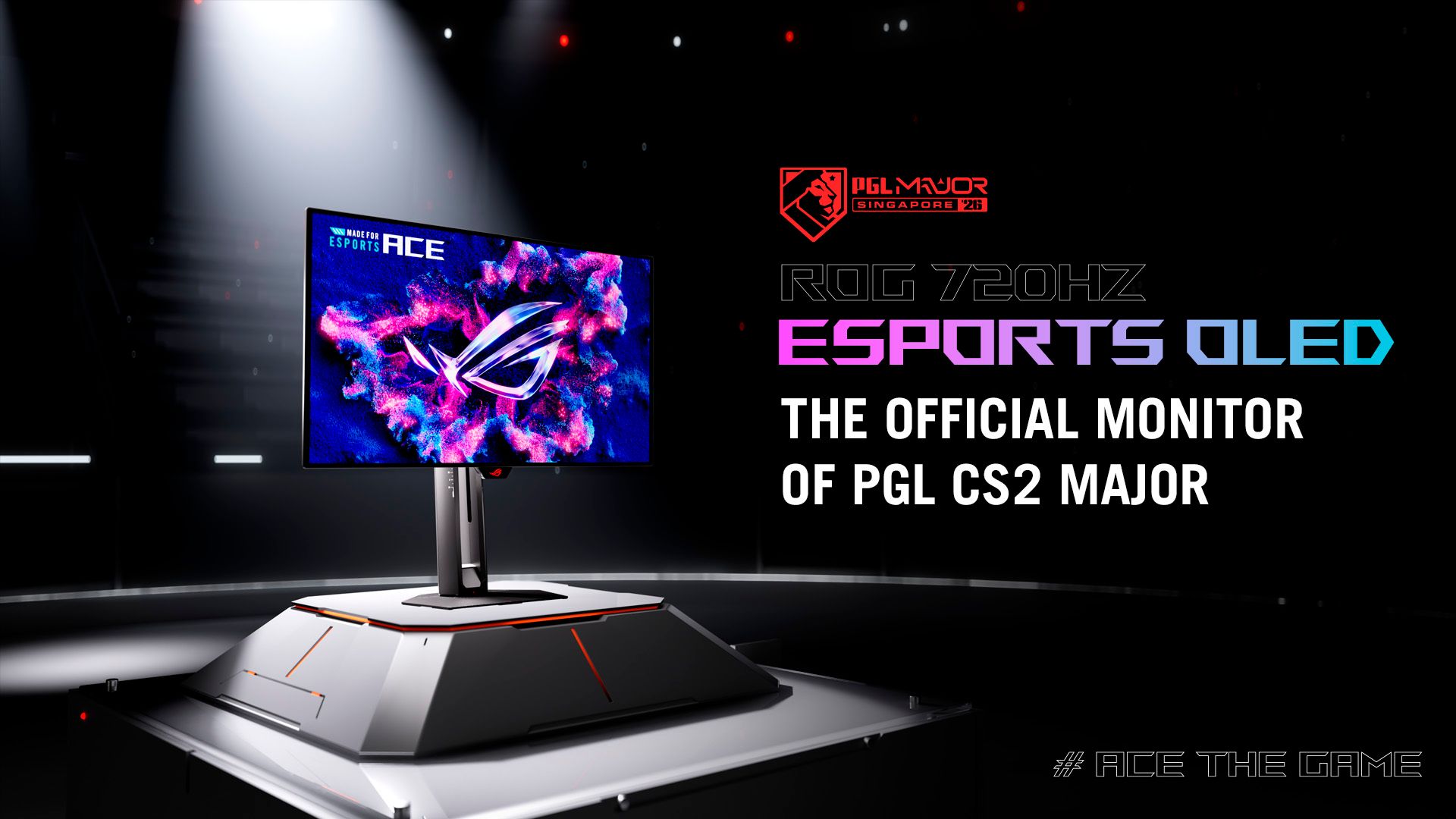
ASUS gaming brand ROG has announced the ROG Swift OLED PG259QWS Ace, a 24.5-inch OLED monitor running at a 720Hz refresh rate. Revealed alongside Gamescom 2026 in Germany, the company positions it as the fastest OLED monitor available today. It carries a 1,099 USD price tag (about 175,000 yen) and is scheduled to ship in early Q4 2026.
※1 USD = 159 JPY (as of August 26, 2026)
What 720Hz Actually Shortens
At 720Hz, a new frame arrives roughly every 1.4 milliseconds. Line that up against about 4.2 milliseconds at 240Hz and about 2.8 milliseconds at 360Hz, and what is being cut away becomes clear: the wait until the next image appears. In practice it shows up in how quickly the screen tells you an opponent has stepped out from cover.
Refresh rate alone is not enough, though. If pixels switch slowly, ghosting remains. The PG259QWS Ace uses a TrueBlack Glossy Tandem WOLED panel with a 0.02ms response time, a 1920 x 1080 resolution, and peak brightness of 1,700 nits. The aim is to keep the deep blacks OLED is known for while holding edge definition under the harsh lighting of an arena stage.
Color coverage is generous for a competitive display as well, with 99.5 percent DCI-P3, true 10-bit color, and Delta E under 2. The reason 24.5 inches remains the standard size in competitive play is that it lets a player take in the whole screen without moving their eyes. The 720Hz figure grabs attention, but the product's intent points somewhere far more practical.
The ROG Esports OLED Series Grows to Four Models
Three monitors were newly revealed at Gamescom: the 720Hz PG259QWS Ace, the ROG Strix OLED XG259QDPG Ace with a 560Hz RGB QD-OLED panel, and the 360Hz ROG Strix OLED XG259QDNS Ace. Adding the 540Hz ROG Strix OLED XG259QWPG Ace shown earlier at Computex 2026 brings the series, all built around 24.5-inch panels, to four models.
| Model | Panel | Refresh rate | Response time | Brightness |
|---|---|---|---|---|
| ROG Swift OLED PG259QWS Ace | TrueBlack Glossy Tandem WOLED | 720Hz | 0.02ms | 1,700 nits |
| ROG Strix OLED XG259QWPG Ace | TrueBlack Glossy Tandem WOLED | 540Hz | 0.02ms | 1,700 nits |
| ROG Strix OLED XG259QDPG Ace | RGB QD-OLED (anti-glare + BlackShield film) | 560Hz | 0.03ms | 1,800 nits |
| ROG Strix OLED XG259QDNS Ace | RGB QD-OLED (anti-glare + BlackShield film) | 360Hz | 0.03ms | 1,800 nits |
For the two QD-OLED models, ASUS says the BlackShield film and low-reflection anti-glare coating raise perceived black levels by up to 40 percent and increase panel hardness by 2.5 times. That directly addresses the weak spot of running an OLED panel in a room where reflections are a problem. On connectivity, the XG259QDPG Ace offers one DisplayPort 1.4 (DSC), two HDMI 2.1, and three USB 3.2 Gen 2 Type-A ports, while the XG259QDNS Ace provides DisplayPort 1.4 (DSC) and HDMI 2.1.
Carrying Your Setup Around as Numbers
The most interesting work on the Ace series arguably sits in the stand rather than the panel. Every model has measurement scales engraved on tilt (-5 to +33 degrees), swivel (plus or minus 45 degrees), and height adjustment (0 to 155mm). Memorize your preferred angle and height as numbers, and you can reproduce the same posture at a different venue on a different unit.
The flagship PG259QWS Ace pushes this a step further. A built-in Position Sensor measures tilt, height, and swivel angle and displays them on screen, so a player can dial back into a familiar setup by matching figures instead of reaching for a tape measure. On top of that, Pro Setting to Share in the ASUS DisplayWidget Center app lets players export image settings, import them onto another unit, or share them with teammates. Being able to align how a picture looks across QD-OLED and WOLED panels fits neatly with a lineup that now spans four models.
Every model also includes a Quick OSD menu for touching key settings right before a match and three Esports Color modes tuned to different FPS scenarios. ROG says it gathered direct feedback from PGL and top professional players during development, and judging by the feature list, from stand markings through to the Position Sensor, that claim looks well founded.
Burn-in Protection Backed by Warranty
Another quietly consequential detail is the use of gallium nitride field-effect transistors (GaNFET) in the power design. The goal is heat suppression more than raw efficiency, reducing thermal stress on the panel to extend OLED lifespan. It ships as OLED Care Pro, combined with a Neo Proximity sensor that detects when someone is nearby, and the PG259QWS Ace comes with a 3-year burn-in warranty.
Burn-in and aging still sit near the top of the list of reasons buyers hesitate over an OLED monitor. High refresh rate panels tend to run under tougher conditions, so tackling heat dissipation first and then stating a warranty period is a sensible order of operations.
The First Major Played on OLED
The PG259QWS Ace will serve as the official monitor of PGL CS2 Major Singapore 2026, running from November 24 to December 13, 2026. It is the first Counter-Strike Major held in Southeast Asia, and also the first Major with OLED monitors on the main stage.
PGL CEO Silviu Stroie commented that a stage this historic deserved a display to match, and that ROG delivered it. Vincent Chiou, who heads the display business at ASUS, described it as the moment competitive Counter-Strike moves to OLED. In competitive monitors, tournament adoption doubles as proof of reliability, and ROG is also marking its 20th anniversary as a brand at this year's Gamescom.
Pricing has been disclosed for two models: 1,099 USD for the PG259QWS Ace and 699 USD (about 111,000 yen) for the XG259QWPG Ace shown earlier at Computex. Both are set to reach the market in early Q4 2026. Availability and pricing in Japan have not been announced.
Summary
The headline is 720Hz, but the substance reads as a methodical checklist for competitive use: a Tandem WOLED panel with a 0.02ms response time, a Position Sensor that turns setup into reproducible numbers, and OLED Care Pro backed by a 3-year warranty. At 1,099 USD the price is steep for a 24.5-inch display, yet this is the kind of product judged with its billing as the official monitor of the first OLED Major attached. What Japanese pricing and timing look like will be the next thing worth watching.