Check Point Software Technologies' Japanese unit announced on November 16, 2026, in a Japanese-language press release, the October 2026 cyber threat figures compiled by its threat intelligence arm, Check Point Research (CPR). Organizations in Japan faced an average of 2,000 attacks per week, an increase of 82% from a year earlier. The figures are based on a Check Point Research blog post published on November 11 (U.S. time).
Japan's Growth Rate Is More Than Double the Global Average
Globally, the average organization faced 2,550 attacks per week. That was down 9% from September but up 32% year over year. In Japan, the weekly figure fell from 2,319 in September, yet the 82% year-over-year increase far outpaced the global rate.
The company attributes the trend to AI-powered attack tools that now work regardless of language, saying Japan is increasingly becoming a target of opportunistic cybercrime that casts a wide net.
By region, Africa saw the most attacks at 3,834 per week, followed by Latin America at 3,483 and Asia-Pacific (APAC) at 3,436. Europe posted the steepest increase, up 39% year over year.
Education Tops the List While Agriculture Surges 93%
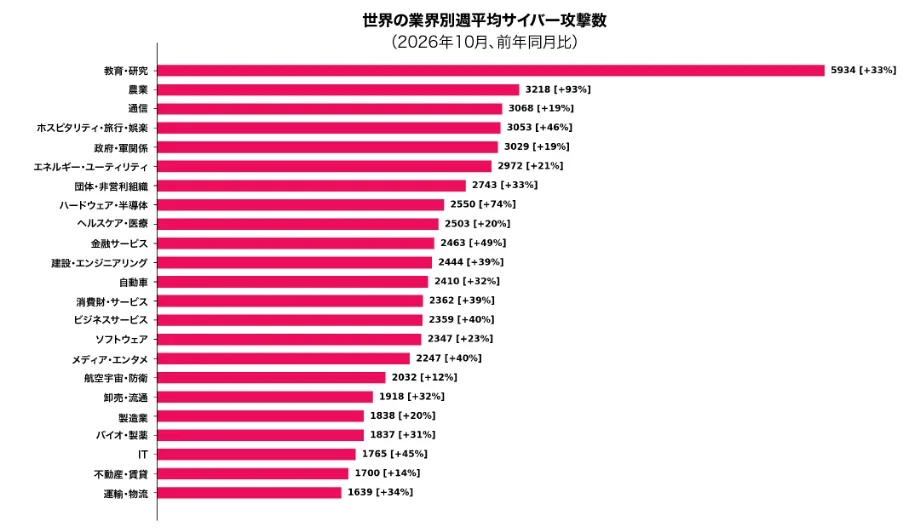
Education and research was the most targeted sector, with an average of 5,934 attacks per week. Agriculture ranked second at 3,218, but its 93% growth stood out among the top sectors. Every sector covered in the report saw a double-digit year-over-year increase.
| Sector | Weekly attacks per organization | Year-over-year change |
|---|---|---|
| Education & Research | 5,934 | +33% |
| Agriculture | 3,218 | +93% |
| Communications | 3,068 | +19% |
The chart released by the company also shows hardware and semiconductors up a sharp 74%.
High-Risk GenAI Prompts Rose for a Third Straight Month
About 1 in 35 prompts (2.9%) sent to generative AI tools in enterprises was rated as carrying a high risk of sensitive data leakage. The share rose for the third consecutive month, from 2.3% in August and 2.5% in September, and affected 90% of organizations using GenAI tools. Prompts that potentially contained sensitive information made up 12% of the total.
Each user sent an average of 91 prompts per month, and organizations used an average of seven GenAI tools. Measured by the share of affected organizations, the most common types of data at risk were financial information at 71%, followed by legal and regulatory information and network and IT infrastructure data at 70% each.
Publicly Reported Ransomware Cases Hit a Monthly Record
Extortion groups publicly reported 1,063 ransomware victims, up 35% year over year and the highest monthly total on record, according to the company. By industry, business services accounted for 31.5% of victims, and by country, the United States accounted for 44.3%.
The most active groups were The Gentlemen at 13% and Qilin at 12%, with n0n taking third place at 8%. n0n, a data theft and extortion group that relies heavily on AI tools, jumped from 2% in September.
Meanwhile, the share of malicious emails fell from 1 in 91 (1.10%) in September to 1 in 128 (0.78%) in October. Links were found in 79% of malicious emails.
Our Take
Japan's 82% increase stands out sharply against the 32% global average. The Japanese language may have served as something of a barrier to attackers in the past, but AI-driven text generation and translation appear to be eroding that protection.
That said, Japan's weekly average of 2,000 attacks is still below the global average of 2,550, so it would be premature to judge the situation by growth rates alone. Even so, the rise in sensitive data entered into GenAI tools and the emergence of an AI-reliant extortion group in the top ranks in the same month should not be overlooked. Organizations may need to review their internal GenAI usage rules and their defenses against outside attacks together rather than separately.
Summary
Check Point's October 2026 data shows attacks on organizations in Japan rose 82% year over year, far outpacing the global average. The findings are relevant to corporate security teams and to organizations that use generative AI at work. The company publishes its threat landscape figures monthly, and upcoming reports should show whether Japan's increase continues.