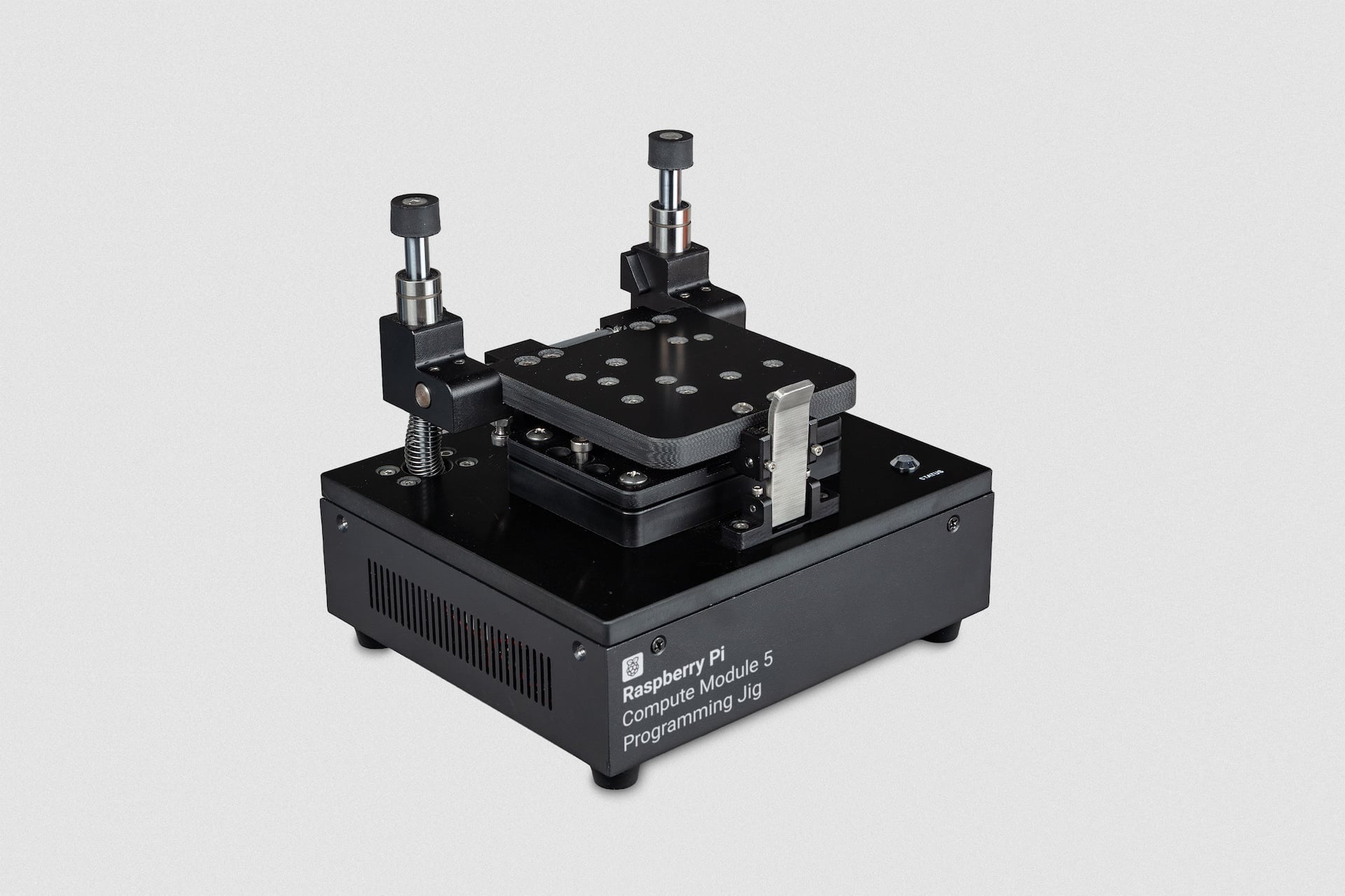
Raspberry Pi has released a dedicated provisioning device for the Compute Module 5, called the Raspberry Pi Compute Module 5 Programming Jig. Drop a module into the bay, close the clamp, and the jig handles everything from installing the operating system to applying secure boot and disk encryption settings. It costs 600 USD (about 95,000 yen) and can be ordered now through Raspberry Pi's global network of Approved Resellers.
※1 USD = 159 JPY (as of August 25, 2026)
Building one is a different problem from building a thousand
The Compute Module 5 packages the internals of the Raspberry Pi 5 onto a board designed to be embedded in other products. More manufacturers are adopting it as the brain of their own hardware, but a new wall appears the moment a prototype starts working. After the hardware, the software, the documentation, and the sales channel are all sorted out, the same device has to be produced hundreds or thousands of times at identical quality.
One of the quieter costs in that process is flashing an OS and applying initial settings to every single module. Connect a cable by hand, type the commands, then check visually that the write completed. Even at a few minutes per board, a run of 1,000 boards turns into days of labour. This jig exists to hand that repetitive work over to a machine.
Insert, close, done
The workflow is almost anticlimactically simple. Once the jig's software is configured and the ports you need are connected, all that remains is to slot the Compute Module 5 into the module bay and close the clamp. Nothing else is required from the operator, and a status LED signals when programming has finished.
A design that asks nothing of the operator's judgement is valuable on a production line in its own right. Staff who have not memorised a procedure manual can still produce the same result, and there is less room for human error such as a missed write or a mismatched configuration.
The rear ports, and a trick that uses two Ethernet connections
The back of the unit carries a minimal set of ports. There is one Ethernet connection for the jig itself and a separate one for the Compute Module 5 being programmed, plus a USB port for manually updating the jig's software. Two activity LEDs, one for the jig and one for the module, make it possible to tell which device is doing what.
Raspberry Pi notes that connecting the JIG ETH and DUT ETH ports to the same network speeds things up further. It is an instruction worth remembering when laying out a production line, since the faster option is to converge the two ports onto one network rather than keeping them strictly separate.
Built on rpi-image-gen and rpi-sb-provisioner
The jig's software was not written from scratch. It is built on rpi-image-gen, Raspberry Pi's OS construction tool, and rpi-sb-provisioner, its automated provisioning software. Together these handle secure boot implementation, full disk encryption, and bare operating system installation.
Because the jig's own OS is assembled from Raspberry Pi OS components, existing customisation scripts and functions can be reused directly. The recently released Raspberry Pi Imager v2.0.11 also promotes Compute Module writing to public availability, and it can be used to tailor the jig's OS to requirements such as Wi-Fi, security, and user settings. Ongoing improvements to Raspberry Pi OS, Raspberry Pi Connect, and rpi-sb-provisioner flow through to the jig as well, which is a practical advantage.
Where the 600 USD price sits
At 600 USD this is clearly expensive as a hobby purchase. The intended buyer, though, is not a hobbyist but a business shipping products with a Compute Module 5 inside. Factoring in the time saved, plus the certainty of enabling secure boot and full disk encryption through the same procedure every time, the figure is defensible as an investment.
With a single programming head, very high volume operations will likely run several units side by side. Even so, designing and building a custom jig and then maintaining its software is enough work that buying an officially supported one often comes out ahead. Setup instructions are on Raspberry Pi's documentation pages, and rpi-image-gen and rpi-sb-provisioner are listed on its software sources page.
Summary
The Raspberry Pi Compute Module 5 Programming Jig is an official production tool that writes an OS and security configuration to a module as soon as it is inserted and clamped shut. It runs on rpi-image-gen and rpi-sb-provisioner, automating secure boot and disk encryption along the way. The price is 600 USD, and it is available to order through Approved Resellers. If a Compute Module 5 product is on the roadmap, it is worth evaluating before the production process is finalised.