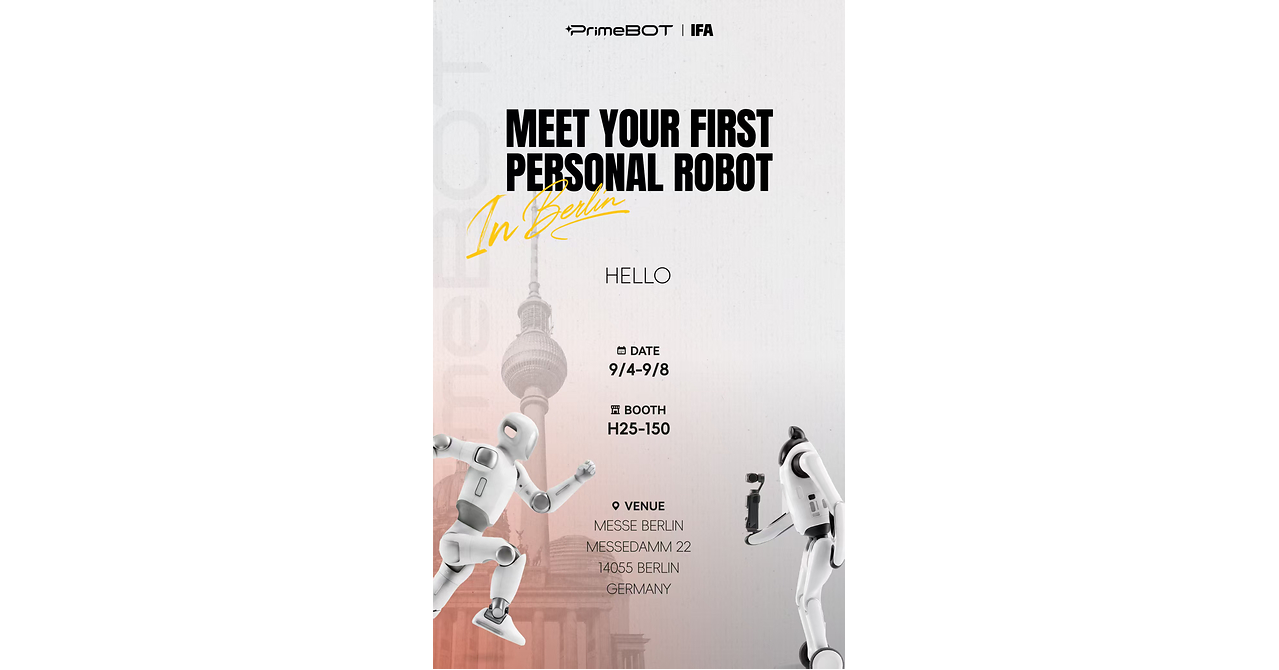
Chinese robotics company PrimeBOT is bringing two new consumer personal robots to IFA 2026 in Berlin. The PrimeBOT T1 switches on its own between a humanoid stance and a quadrupedal one, while the PrimeBOT Q1 packs 22 degrees of freedom into an 88 cm frame and can perform martial arts movements. Both run live demos at Booth H25-150 for the duration of the show, and both were previewed a day early at the ShowStoppers press event on September 3.
The T1 Rearranges Itself Mid-Route
What defines the T1 is its ability to move between humanoid and quadrupedal modes. A humanoid form struggles with steps and rough ground, while a permanently four-legged machine loses the eye-level presence that makes interaction feel natural. Being able to swap between the two is a practical compromise aimed at letting a single unit work indoors and outdoors without a handoff. PrimeBOT describes the T1 as the first personal robot built this way.
The camera side is unusually developed. The T1 recognises its user, follows them, films autonomously, and carries more than 15 templates for professional camera movement. Instead of setting up a tripod or gimbal and framing a shot, the idea is that the robot moves around a subject that will not stay still.
Education is the other axis. PrimeBOT says the interaction design was tuned so children grow comfortable with giving instructions to AI, thinking in prompts, and splitting work between a person and a machine. The robot is meant to be treated less as something you operate and more as something you brief.
The Q1 Fits 22 Degrees of Freedom Into 88 cm
The Q1 stands 88 cm tall with 22 degrees of freedom across its joints. It supports more than 10 martial arts movements, which means the design accounts for shifting weight and coordinating the whole body rather than simply standing and walking. More range of motion makes both control and chassis engineering harder, and the Q1 leans into that trade.
Close-range safety is part of the specification. At 88 cm the robot sits low enough for an adult to look down at and close enough to meet a child at eye level, a height that assumes people will be standing right next to it. The faster and stronger a robot moves, the more its behaviour near people has to be deliberately restrained.
Customisation is the Q1's other selling point. Appearance, voice, personality, behaviour, and even future applications can be reworked by owners and developers. Combined with a programmable design and multimodal interaction, it is positioned as a product whose contents are meant to grow after purchase.
No Pricing or Release Date Yet
The announcement covers the product concept and the show schedule only. Pricing, release dates, and target markets have not been disclosed. IFA 2026 runs from September 4 to 8 in Berlin, where PrimeBOT is demonstrating both machines at Booth H25-150. How polished and how stable they actually are will come down to what visitors report from the floor.
PrimeBOT positions itself as an embodied intelligence company, combining robotics, advanced materials, motion systems, human-robot interaction, and open development platforms to connect AI with the physical world. Personal robots have long split into two camps: products close to toys, and research hardware an order of magnitude more expensive. Whether the T1 and Q1 land somewhere in between depends on a price that has not been announced.
Summary
The T1 and Q1 that PrimeBOT showed at IFA 2026 compete on how they are meant to be used rather than on a spec sheet. The T1 covers indoor and outdoor use with a single body by switching between two and four legs, with filming and education as its stated purposes. The Q1 fits 22 degrees of freedom into an 88 cm body and leads with martial arts motion and customisation. With no price and no release date, whether either works as a product for the home depends on what comes next.