
FriendlyELEC has released the NanoPi R28S, a single-board computer that packs two Gigabit Ethernet ports and Wi-Fi 6 onto a 45mm square PCB. The bare board costs 20 USD (about 3,100 yen), and the bundle with a CNC-machined metal case comes to 29 USD (about 4,600 yen). Rather than a general-purpose mini PC, this is a board built for a narrower job: serving as the base for compact routers and other network appliances.
A 45mm Square and 14 Grams Are Part of the Spec
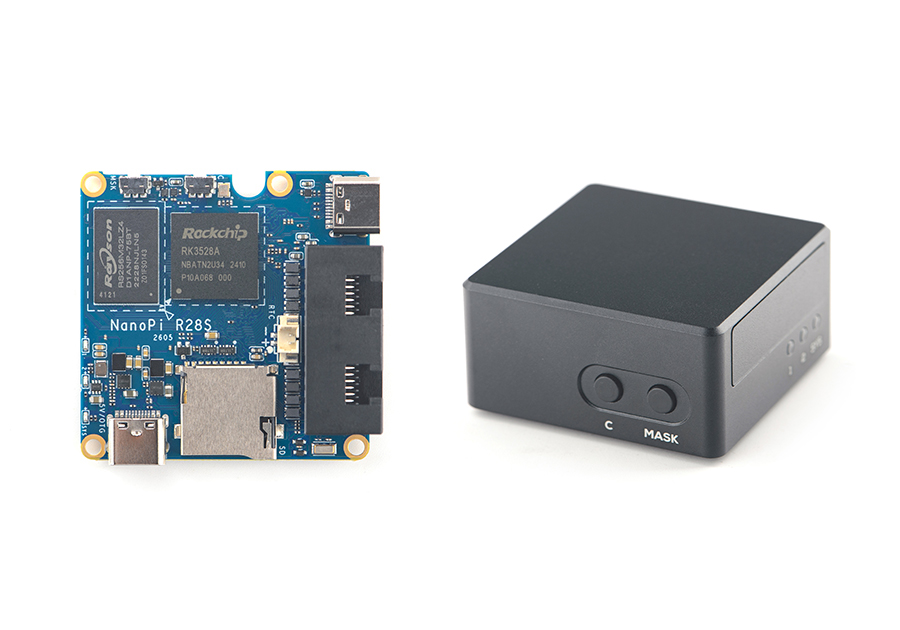
The bare board measures 45 x 45 x 1.2mm and weighs 14g. Into an area noticeably smaller than a business card, FriendlyELEC has fitted two Gigabit Ethernet ports, two USB Type-C ports, and a microSD slot. The PCB uses 8 layers, which is what it takes to route two wired LAN paths through that footprint.
Adding the optional CNC-machined aluminum case brings the dimensions to 49.5 x 49.5 x 24mm and the weight to 77.5g. The user C button and the MASK button for eMMC flashing are exposed on the side of the case, so firmware operations remain possible with the board installed.
Two Wired Ports Plus Wi-Fi 6 and Bluetooth 5.3
The two Gigabit Ethernet ports are implemented with separate controllers, a Realtek RTL8211F and an RTL8111H. On the wireless side, a Wi-Fi 6 and Bluetooth 5.3 module sits on the board itself.
Having two wired ports means the WAN and LAN sides can be physically separated. On a board with only one port, using it as a router or firewall requires either adding a USB Ethernet adapter or splitting traffic logically with VLANs. The R28S ships with two physical ports, so neither detour is necessary. Add Wi-Fi 6 to that, and it also works as a compact wireless router.
No Video Output and No GPIO Header
The SoC is a Rockchip RK3528A with four ARM Cortex-A53 cores running at up to 1.8GHz, paired with an ARM Mali-450 GPU. Video decoding covers H.265 and H.264 at 4K 60fps.
That said, the official specification table lists no video output, and no HDMI connector is visible in the product photos. The decode figures are on paper, but there is no port to send that video out of. A GPIO header for wiring up sensors and actuators is likewise absent from both the official specification table and the product photos.
Expansion is therefore limited to microSD, an eMMC module, and USB Type-C data transfer. There are two USB Type-C ports: one doubles as the eMMC flashing interface and the 5V power input, while the other is dedicated to a UART debug console. A separate debug port is generous at this price, and it means recovery is possible even after breaking the network configuration on a board with no display output.
Memory is 1GB of LPDDR4. That is clearly not enough for desktop use, but it is a realistic figure for workloads such as routers and gateways where the set of resident processes is small. Storage supports an eMMC module, and microSD cards up to 128GB can be used.
The board also carries a 2-pin battery connector (1.27/1.25mm pitch) for the low-power HYM8563TS RTC chip, so the clock survives a power loss. That matters for any appliance that needs meaningful log timestamps. There is one red system LED and two green user LEDs, plus the user C button and the MASK button for eMMC flashing. Power is DC 5V/2A, and the rated operating temperature range is 0 to 70 degrees Celsius.
Key Specifications
| Item | Details |
|---|---|
| SoC | Rockchip RK3528A (4 x ARM Cortex-A53, up to 1.8GHz) |
| GPU | ARM Mali-450 |
| Video decode | 4K H.265/H.264 60fps |
| Memory | 1GB LPDDR4 |
| Storage | eMMC module support, 1 x microSD slot (up to 128GB) |
| Wired LAN | 2 x Gigabit Ethernet (RTL8211F / RTL8111H) |
| Wireless | Wi-Fi 6, Bluetooth 5.3 |
| USB | USB Type-C 2.0 (eMMC flashing / 5V power input), USB Type-C (UART debug) |
| LED | 1 x system (red), 2 x user (green) |
| Buttons | User/C button, MASK button |
| RTC | 2-pin battery connector for HYM8563TS |
| Power | DC 5V/2A |
| Operating temperature | 0 to 70 degrees Celsius |
| PCB | 8 layers |
| Dimensions | 45 x 45 x 1.2mm (bare) / 49.5 x 49.5 x 24mm (with case) |
| Weight | 14g (bare) / 77.5g (with case) |
Seven Supported Operating Systems, from FriendlyWrt to Proxmox VE
FriendlyELEC lists seven supported operating systems: Alpine Linux 3.23, Buildroot (Weston/Wayland), Debian 13 Core, FriendlyWrt 25.12, OpenMediaVault 8.0.6, Proxmox VE 8.2.7, and Ubuntu 24.04 Core. The kernel is Linux 6.1 LTS and the bootloader is U-Boot 2017.09.
FriendlyWrt is FriendlyELEC's own build of OpenWrt, the router-oriented distribution, tuned for the company's boards. It is the most natural fit for the R28S, treating the two wired ports and Wi-Fi 6 as router interfaces from the start. Seeing OpenMediaVault for NAS duty and Proxmox VE for virtualization on the list is ambitious given the 1GB memory ceiling, but they remain options for light shared storage or a small test virtualization environment.
FriendlyELEC notes that firmware is updated on an ongoing basis and that the actual versions should be confirmed on its wiki.
Priced from 20 USD, with Import Duties on the Buyer
On FriendlyELEC's own store, the 1GB RAM bare board is 20 USD (about 3,100 yen). The metal case bundle adds 9 USD (about 1,400 yen) for a total of 29 USD (about 4,600 yen). The listing showed the board in stock at the time of writing. The store also states explicitly that the buyer is responsible for any import duties.
*1 USD = 157 JPY (as of August 4, 2026)
Twenty dollars is a low bar for a single-board computer. That price, though, is the result of cutting video output, GPIO, and memory capacity. Anyone looking for one board to repurpose freely will not be served here. For a clearly defined goal, such as building a home router or lining up several experimental network appliances, the trade-off pays off.
Summary
The NanoPi R28S is a 20 USD single-board computer that fits a Rockchip RK3528A, two Gigabit Ethernet ports, Wi-Fi 6, and Bluetooth 5.3 onto a 45 x 45mm 8-layer PCB. In place of video output and a GPIO header, it offers a dedicated UART debug port and an RTC battery connector, with support for seven operating systems centered on FriendlyWrt. At 29 USD even with the metal case, it is a board to pick as the foundation for a compact network appliance rather than as a general-purpose computer.