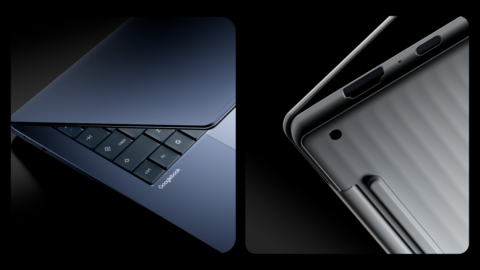
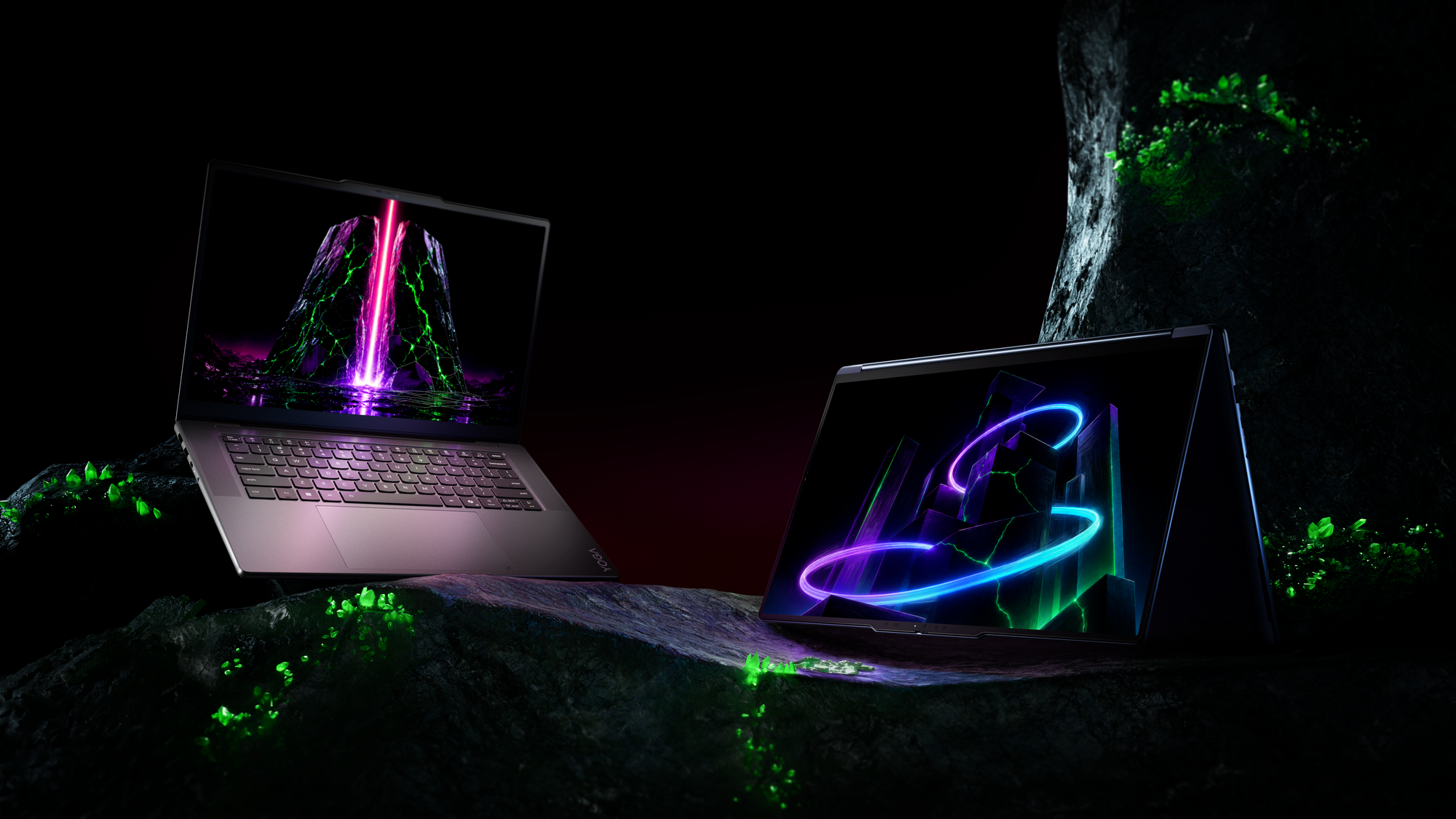
Lenovo has announced two consumer laptops built on NVIDIA RTX Spark: the Yoga Pro 9n (15-inch) and the Yoga 9n 2-in-1 (16-inch). Both carry 9400 MT/s unified memory, up to 128GB on the Pro 9n and up to 64GB on the 2-in-1, so AI work can stay on the machine instead of going to the cloud. The 2-in-1 adds an input method rarely seen elsewhere: you can write with a pen on either the OLED display or the touchpad. The two were shown on September 3 at Lenovo's own event during IFA 2026 in Berlin.
A Yoga with a Grace CPU inside
The first thing worth noting is that these two machines are a different lineage from previous Yoga models. The processor is neither Intel nor AMD but NVIDIA RTX Spark, pairing a Grace CPU with up to 20 cores and a Blackwell-generation RTX GPU with up to 6,144 cores, both sharing the same pool of memory.
The Yoga Pro 9n takes up to 128GB of 9400 MT/s LPDDR5X, while the Yoga 9n 2-in-1 tops out at 64GB. Both use a 256-bit, 16-channel configuration. Because the CPU and GPU share memory, there is no need to shuttle data between system memory and VRAM when loading a large model. The size of the models you can run locally is governed by total memory rather than VRAM capacity.
Lenovo positions the machines for AI development, video editing, 3D rendering, and software development, and says the platform accelerates tools such as Adobe Premiere Pro and ComfyUI along with local models including FLUX and LTX. Sitting on the RTX platform also means games run. Using the same machine for professional work and RTX-enabled titles is a new pitch for the Yoga line.
Write on the screen, or on the touchpad
Of the two, the Yoga 9n 2-in-1 has the more distinctive character. A 360-degree hinge lets it switch between Laptop, Tablet, Tent, Stand, and Canvas modes. That much is familiar from earlier Yoga models. What is new is what Lenovo calls the dual-surface pen experience.
You can write directly on the 16-inch PureSight Pro OLED display, or on the haptic Force Pad, choosing whichever suits the task. Drawing an illustration while watching the screen favors the former; scrubbing through a timeline in fine increments favors the latter, since your hand never has to leave the deck.
The matching Yoga Pen Gen 2 supports AES 3.0, tilt detection, palm rejection, and customizable buttons. One caveat: the Force Pad only accepts AES 1.0. The pen's full specification does not carry across to both surfaces. The magnetic pen case doubles as a stand.
The display runs at 2880 by 1800 with a variable refresh rate from 30 to 120 Hz, 1,100 nits peak brightness, 100 percent coverage of both sRGB and P3, and a Delta E below 1. Audio comes from six speakers, with two tweeters built into the rotating soundbar so they stay front-firing in every mode. The chassis measures 360 by 243.1 by 17.5 mm and weighs 1.94 kg. The 99.9 Wh battery is rated for up to 3 hours of use from a 15-minute charge.
The Pro 9n: a 165 Hz 15.3-inch panel, cooling under 22 dB
The Yoga Pro 9n is the performance-led option. Its 15.3-inch PureSight Pro OLED runs at 2560 by 1600 with a variable refresh rate from 48 to 165 Hz, and its Delta E is below 0.5, tighter than the 2-in-1.
It measures 16.7 mm at its thinnest point and starts at 1.65 kg. Two SSD slots allow up to 4TB of total storage. The battery is 92.5 Wh and the power adapter is rated at 140W. Ports include HDMI 2.1 with 8K/60Hz output, two USB4 ports, two USB-A ports, and a UHS-II SD card slot. Since the 2-in-1's SD slot is only UHS-I, anyone ingesting photos and video every day will prefer the Pro 9n.
Cooling is handled by what Lenovo calls X Power, with an 80W TDP on the Pro 9n and 70W on the 2-in-1. Both are rated at under 22 dB. Each machine has a 9.2MP IR camera. The Pro 9n comes in Thunder Grey and the 2-in-1 in Cosmic Blue, one color each.
Two tablets arrive in September with prices attached
Lenovo also announced two pen-first Android tablets, the Yoga Tab Plus Gen 2 and the Yoga Tab Gen 2. The higher-end Plus Gen 2 has a 13-inch 4K (3840 by 2560) panel in a 3:2 aspect ratio, runs on Snapdragon 8 Elite, and weighs 605 g. The Yoga Tab Gen 2 has an 11.1-inch 4K panel, uses MediaTek's Dimensity 9500s, and weighs 480 g. Both reach 144 Hz and 1,100 nits peak brightness.
The Tab Pen Pro 2 supports 8,192 pressure levels, with gestures assigned to clicking the pen tail to draw, squeezing to select, and flipping to erase. Both tablets ship with Android 17 and are covered by 7 OS upgrades through Android 24 and up to 7 years of security updates through 2033.
The Yoga Tab Plus Gen 2 starts at 849 euros including tax (about 154,000 yen), and the Yoga Tab Gen 2 at 649 euros including tax (about 117,000 yen). Both are expected from September 2026.
Exchange rate: 1 EUR = 181 JPY (as of September 5, 2026)
The Yoga Pro 9n and Yoga 9n 2-in-1, meanwhile, have neither pricing nor availability attached. Lenovo says both will be announced later, and Japanese availability is undecided.
Summary
The Yoga Pro 9n and Yoga 9n 2-in-1 bring RTX Spark, a Grace CPU paired with a Blackwell GPU, into Lenovo's consumer Yoga line. The Pro 9n leads with up to 128GB of unified memory and a 165 Hz 15.3-inch OLED panel; the 2-in-1 offers up to 64GB along with dual-surface pen input across both the display and the Force Pad. The two tablets announced alongside them arrive in September at 649 and 849 euros, but the laptops still have blanks where price and date should be. With local-AI PCs now lining up from several vendors, where the Yoga machines land on price is the next thing to watch.