
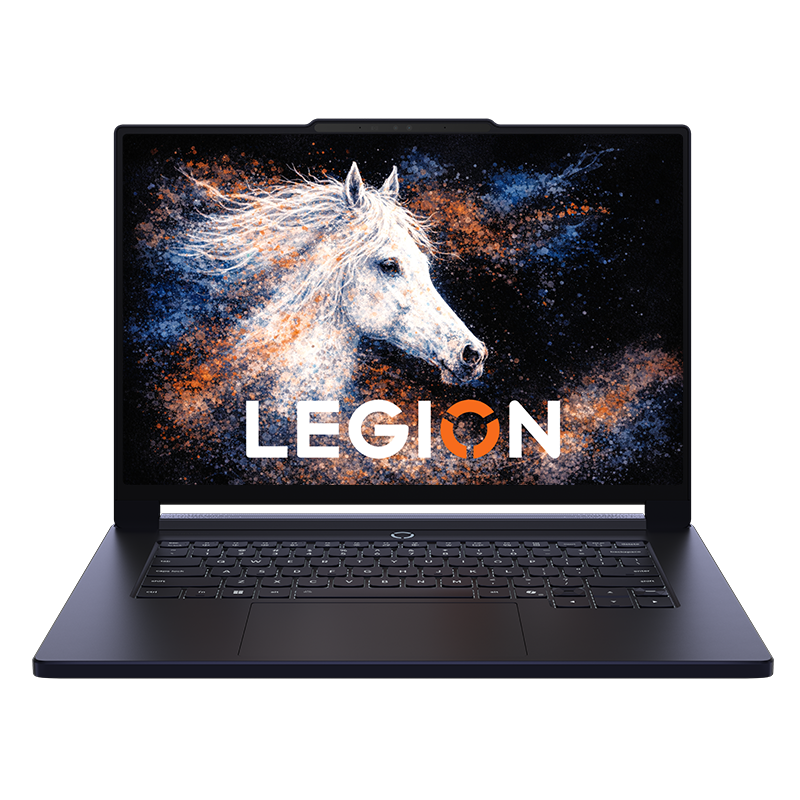
Lenovo has released the 2026 edition of its Legion R9000X gaming laptop in China. Its defining trait is that it carries no discrete graphics card at all: both processing and graphics are handled by AMD's latest mobile chip, the Ryzen AI Max+ 392, paired with its built-in Radeon 8060S GPU. That approach lets Lenovo fit a 15.3-inch OLED display into a body just 15.5mm thick and 1.55kg light. The price is 20,999 yuan (about 500,000 yen).
*1 CNY = about 23.9 JPY (as of early July 2026)
A thin gaming laptop with no discrete GPU
What sets the 2026 Legion R9000X apart from a typical gaming laptop is the complete absence of a separate graphics card. By consolidating both computing and rendering into a single AMD chip, Lenovo keeps the chassis to a slim 15.5mm and the weight to 1.55kg, which is light for a gaming machine. The company says this configuration still delivers graphics performance close to that of a discrete GPU.
At the core: Ryzen AI Max+ 392 and Radeon 8060S
The heart of the machine is AMD's Ryzen AI Max+ 392. It is built on a 4nm process and uses the latest Zen 5 architecture, with 12 cores and 24 threads and a maximum boost clock of 5.0GHz.
Graphics are handled by the Radeon 8060S integrated into that same chip. It is based on the newest RDNA 3.5 architecture and packs 40 compute units (CUs). Because the CPU and GPU share memory in a unified-memory design, a large share of the installed memory can be assigned to graphics, with some reports putting the ceiling at 48GB. The idea is to use this shared-memory design to make up for the lack of a discrete GPU.
A 15.3-inch OLED tuned for color accuracy
The display is a 15.3-inch OLED panel with a 2560 x 1600 resolution and a 165Hz refresh rate. It holds VESA DisplayHDR True Black 1000 certification, which indicates its level of contrast performance, and covers 100% of the DCI-P3 color space used in video production. Each unit is factory color-calibrated by X-Rite, with a Delta E color-deviation value below 1 and a 0.3ms response time. It is a specification suited not just to games but also to photo and video editing.
Memory, ports, and cooling
The laptop comes standard with 64GB of LPDDR5X memory (running at 8000MT/s) and a 1TB PCIe 4.0 SSD. A spare M.2 slot is also provided, so storage can be added later.
For connectivity, it offers two 40Gbps USB4 ports, one 10Gbps USB-C port, and two 10Gbps USB-A ports, along with HDMI, an SD 4.0 card reader, and a 3.5mm audio jack. The USB-C ports support DisplayPort 2.1, enabling 8K output at 60Hz or 4K at 240Hz. Wireless connectivity is handled by Wi-Fi 7.
Beyond that, the machine carries a quad-speaker system, a 5-megapixel webcam with a privacy shutter and Windows Hello support, and a keyboard with 1.5mm of key travel. Cooling is provided by a second-generation "QianKun" system, which can draw up to 120W in total at its highest performance setting. Charging supports 180W fast charging over USB-C, as well as standard 100W USB Power Delivery.
Price and availability
The 2026 Legion R9000X launched in China at 20,999 yuan (about 500,000 yen). There is no word yet on availability in other regions, including Japan. Alongside it, Lenovo has also introduced the Legion LM50S, a portable Wi-Fi router with 4G LTE and Wi-Fi 6 support and up to 12 hours of battery life.
Summary
By dropping the discrete GPU and leaving both processing and rendering to the Ryzen AI Max+ 392 and its integrated Radeon 8060S, the 2026 Legion R9000X achieves a slim 15.5mm, 1.55kg build that is rare for a gaming laptop. Combined with a color-accurate 15.3-inch OLED, 64GB of memory, USB4, and Wi-Fi 7, it balances portability with performance. It is a China-market model for now, but its design, which chases slimness using only an integrated GPU, is worth watching as a sign of where gaming laptops may be heading.