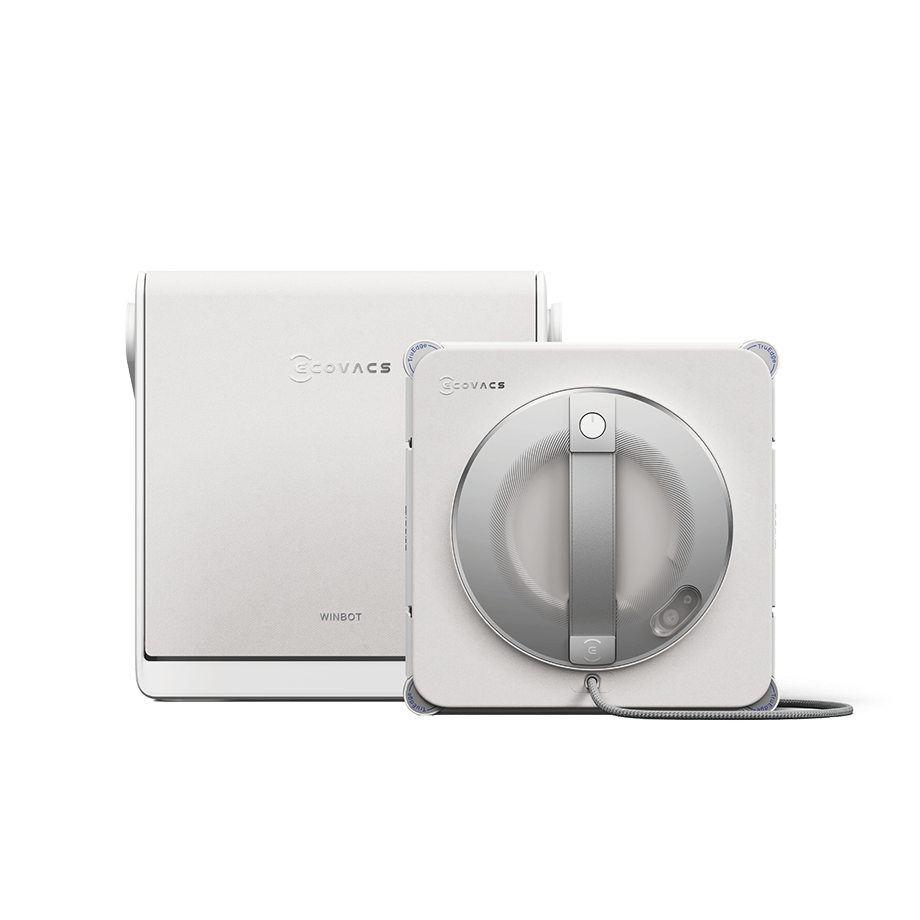
ECOVACS Japan released two window-cleaning robots on August 21: the WINBOT W2S PRO OMNI and the WINBOT W2S PRO. Pricing is 99,800 yen for the OMNI and 69,800 yen for the standard model, both including tax. The headline feature is a new edge-cleaning system called TruEdge 2.0, and the question worth asking is whether it finally hands off the strip of glass right against the window frame, a spot most owners still wipe by hand.
An Answer to the Edge Problem
Window robots have long handled the middle of a pane cleanly. The few millimeters where glass meets frame were the holdout, and since grime tends to collect exactly there, leaving that band untouched undercuts the whole result.
TruEdge 2.0 targets that band. A radial edge-lock structure arranges brushes in eight directions around the body, so the brush reaches the very edge of the glass no matter which way the unit is traveling. The pad uses a high-density felt brush aimed at lifting stubborn deposits such as rain spotting and built-up dust.
Working closer to the frame raises the risk of snagging. To counter that, an edge-detection system reads the frame on two axes, inside and outside, and a dynamic lift-and-run mechanism raises and lowers the side brush automatically as conditions change, reducing the chance the robot climbs onto the frame and stalls. Frame detection relies on a photocoupler with a response time of 0.007 seconds. Because the robot recognizes an edge even without a frame present, it can also be used on frameless windows and bathroom mirrors.
Wet First, Wipe Second
The cleaning sequence has been reworked as well. Three nozzles spray a fine mist across a wide angle to form a water film on the glass, loosening dirt before the pad passes over it. That leaves fewer streaks than dry scrubbing and keeps runoff in check.
The water tank holds 120 ml, roughly double the capacity of the earlier W1 PRO and W2 PRO. Coverage grows by about 25 percent as a result, allowing up to 75 square meters of continuous cleaning per fill. For a living room lined with full-height windows, being called back to refill less often matters in practice.
Route planning is handled by the WIN-SLAM 4.0 navigation system. Six modes are available: spot, split, edge, thorough, intensive and fast cleaning, switchable remotely through the ECOVACS HOME app. Operating noise is rated at 66 dB, held down by four sound-suppression techniques including airflow control and acoustic damping material.
What the Station Changes
The only difference between the two models is whether the OMNI station is included, but that single difference shapes how the robot can be used.
The W2S PRO OMNI carries a large lithium battery inside its station and runs for up to 110 minutes on a full charge. Freed from the location of a wall outlet, it can be carried out to balconies and exterior glass where power is hard to reach. The W2S PRO, by contrast, has to stay plugged in throughout operation, with a 6.8-meter power cable made up of a 5-meter composite cable and 1.8 meters of DC cable.
Cable handling also favors the OMNI. It uses a 2-in-1 composite cable that combines the safety rope and power cord, with automatic retraction built into the station. Cutting the setup and pack-away fuss matters for a chore that is easy to postpone. The station carries a control panel with a display, putting automatic retraction and cleaning-mode selection on a single button.
Three Layers of Fall Protection
Since exterior windows on upper floors are in scope, the safety design sits at the center of the specification. The unit grips the glass with up to 10,000 Pa of suction and includes several hardware-based fall-prevention features, among them automatic air-pressure compensation and a floating cleaning-pad plate. Even when the battery runs low, it stays attached for about 30 minutes.
The W2S PRO ships with a 5.5-meter safety rope secured by a carabiner. On the W2S PRO OMNI the station itself serves as the anchor: its 5 kg mass acts as a counterweight, and it grips the floor with up to 800 N so the station cannot fall along with the robot. A 1-meter safety rope and carabiner are included as well.
Key Specifications
| Item | Detail |
|---|---|
| Release date | August 21, 2026 |
| Price (incl. tax) | W2S PRO OMNI 99,800 yen / W2S PRO 69,800 yen |
| Body size | 272 x 272 x 76 mm |
| Weight | Approx. 2.1 kg |
| Maximum suction | 10,000 Pa |
| Water tank | 120 ml |
| Maximum cleaning area | Approx. 75 square meters |
| Runtime | Up to 110 minutes (OMNI only) |
| Supported window size | 30 x 40 cm minimum to 8 x 2.5 m maximum |
| Operating noise | 66 dB |
| Navigation | WIN-SLAM 4.0 |
Summary
The WINBOT W2S PRO series goes after the few millimeters at the edge that window robots had left behind, using TruEdge 2.0 to close the gap. Doubling the water tank widens what a single fill can cover, so homes with large, continuous glazing stand to gain the most. The station-equipped OMNI costs 30,000 yen more, but between cutting the cord for exterior glass and adding automatic cable retraction, the reason for the gap is easy to see.