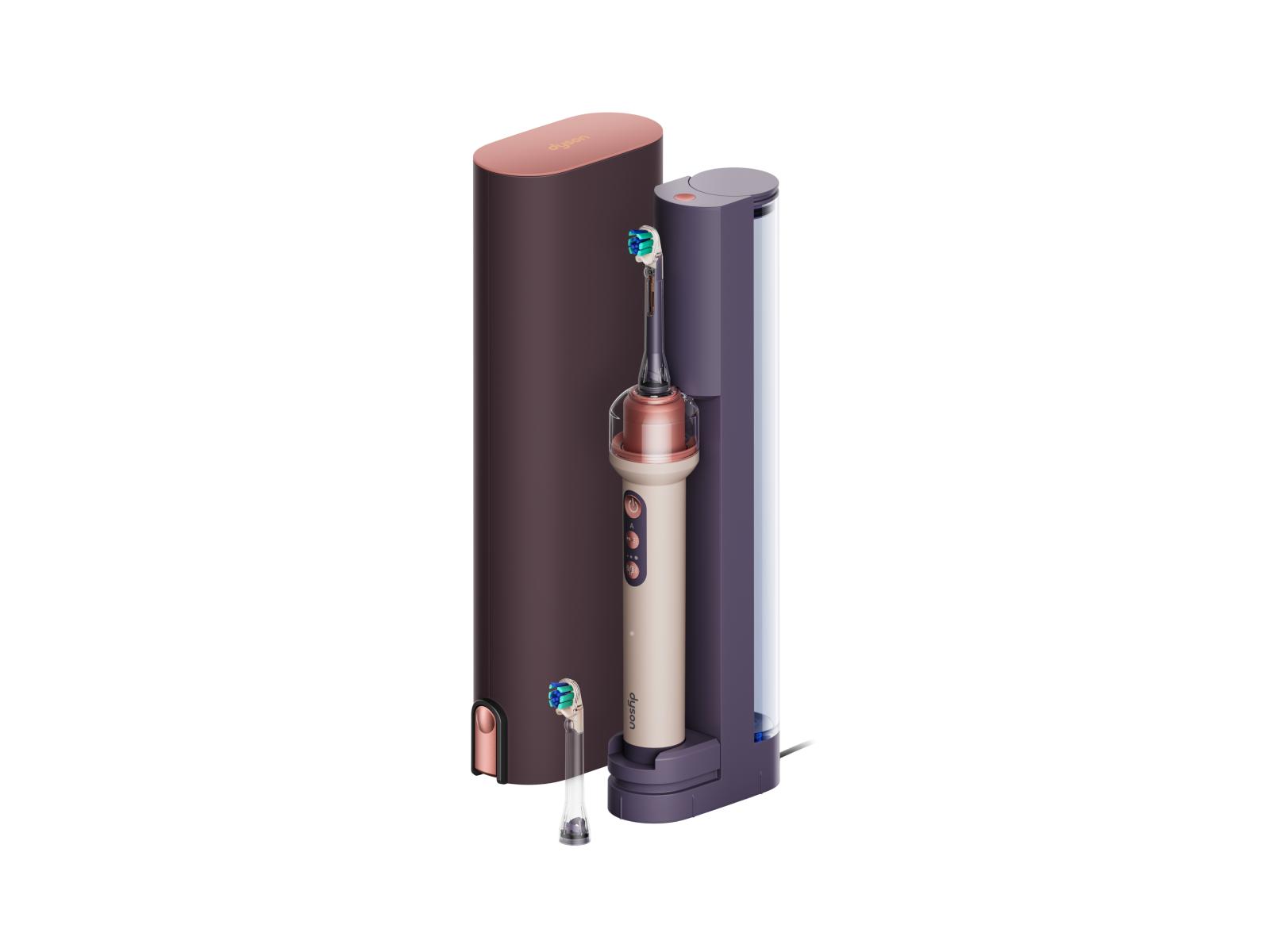
Dyson has entered the electric toothbrush category. The Dyson CameraJet toothbrush with flosser houses a 100k pixel macro lens camera at the base of the brush head, uses the footage to find the gaps between teeth, and fires mouth rinse straight at them. The idea is to fold brushing and flossing into a single device. It is already on sale in Japan at 79,800 yen including tax.
Seeing the gap first, then aiming
At the heart of the product is a system Dyson calls Gap Optical Targeting. A 1 mm camera sitting below the brush head captures 28 images per second, and a machine learning algorithm searches those frames for interdental gaps. A dome-shaped target lens widens the camera's field of view and a stroboscopic light illuminates the inside of the mouth, a combination built to make image recognition work in genuinely poor conditions.
Once a gap is found, a diaphragm pump pushes liquid out in as little as a tenth of a second. What comes out is a conical jet rather than the needle-shaped stream used by typical water flossers. Dyson developed a proxy plaque in collaboration with the National University of Singapore and used it to test jet geometry. A needle-shaped stream can punch through plaque at a single point without dislodging it, whereas a cone sweeps it away across a wider surface. Because the coverage comes from area rather than pressure, the jet also lands more gently on gums and enamel.
The tank holds a modest 12.5 ml, but its anti-gravity design uses flexible silicone that expands to minimize air pockets, so the device can jet at any angle. That matters for spots like the back of the molars, which are hard to reach without twisting your wrist.
The fundamentals as a toothbrush
The camera gets the attention, but the brush itself is carefully built too. The head uses a dual-bristle structure that combines two bristle stiffnesses: softer outer bristles work along the gumline while slightly firmer inner bristles tackle surface stains. The motor oscillates 245 times per second and includes control designed to prevent the stalling that happens when you press too hard. Dyson says the toothbrush removes up to 69 percent more plaque than market leading electric toothbrushes. That figure comes from a lab test in brush-only Daily clean mode against premium competitors priced above 200 USD (about 32,000 yen).
※1 USD = 160 JPY
There are three cleaning modes: auto-jet and brush together, auto-jet only, and brush only. Brushing intensity can be set to Sensitive, Daily clean or Deep clean. Each brush head carries an RFID tag that tracks wear and signals when it is time for a replacement.
Watching your own mouth on a phone
The camera is not only there to aim the jet. Connect the device to the MyDyson app over 2.4 GHz Wi-Fi and you can watch live footage while you brush. It puts the view a dentist gets from an intraoral camera into your own hands. There is also coverage mapping that shows missed areas like a map, plus reports on your cleaning history.
A camera pointed inside your mouth naturally raises privacy questions. Dyson says the footage streams directly to the app in real time and is never stored on the device or in the cloud, and that neither Dyson nor third parties can access it. A white LED indicates when the camera is active, and it switches off when not in use.
Constraints in use, and how to buy it in Japan
There are caveats. Because the camera needs a clear view to find gaps, Dyson recommends SLS-free gel or non-foaming toothpaste and a clear, low-foaming mouth rinse. Use something that foams heavily and the camera's view gets blocked. Dyson's own toothpaste and mouth rinse are listed as not yet available in Japan as of September 2026.
As for hardware, the handle weighs 230 g, charges over USB-C, and runs for 10 days on a full charge. The included dock refills the tank at the press of a button and also handles storage and charging. A case for the dock is included, along with a sleep mode that keeps the battery from draining while traveling. The IPX7 rating means it can be used in the shower.
It comes in Ceramic Pink and Ceramic Ultra Blue. In the United States it costs 499.99 USD (about 80,000 yen), and in Japan the official Dyson online store sells it for 79,800 yen including tax. Note that electric toothbrushes and related products are excluded from the 30-day full refund guarantee for hygiene reasons, and returns are limited to unopened, unused items.
Summary
The Dyson CameraJet is an electric toothbrush that detects interdental gaps with a camera and machine learning, then cleans them with a conical jet. Combining brushing and flossing in one handle, and letting you check the inside of your mouth in an app while you brush, is what makes it new. At 79,800 yen it sits at the very high end for an electric toothbrush, but with an integrated flosser and a design that hands the flossing habit over to the machine, the reasoning behind the product is easy to follow.