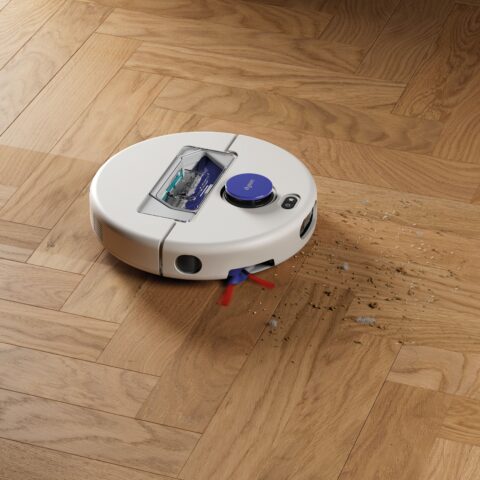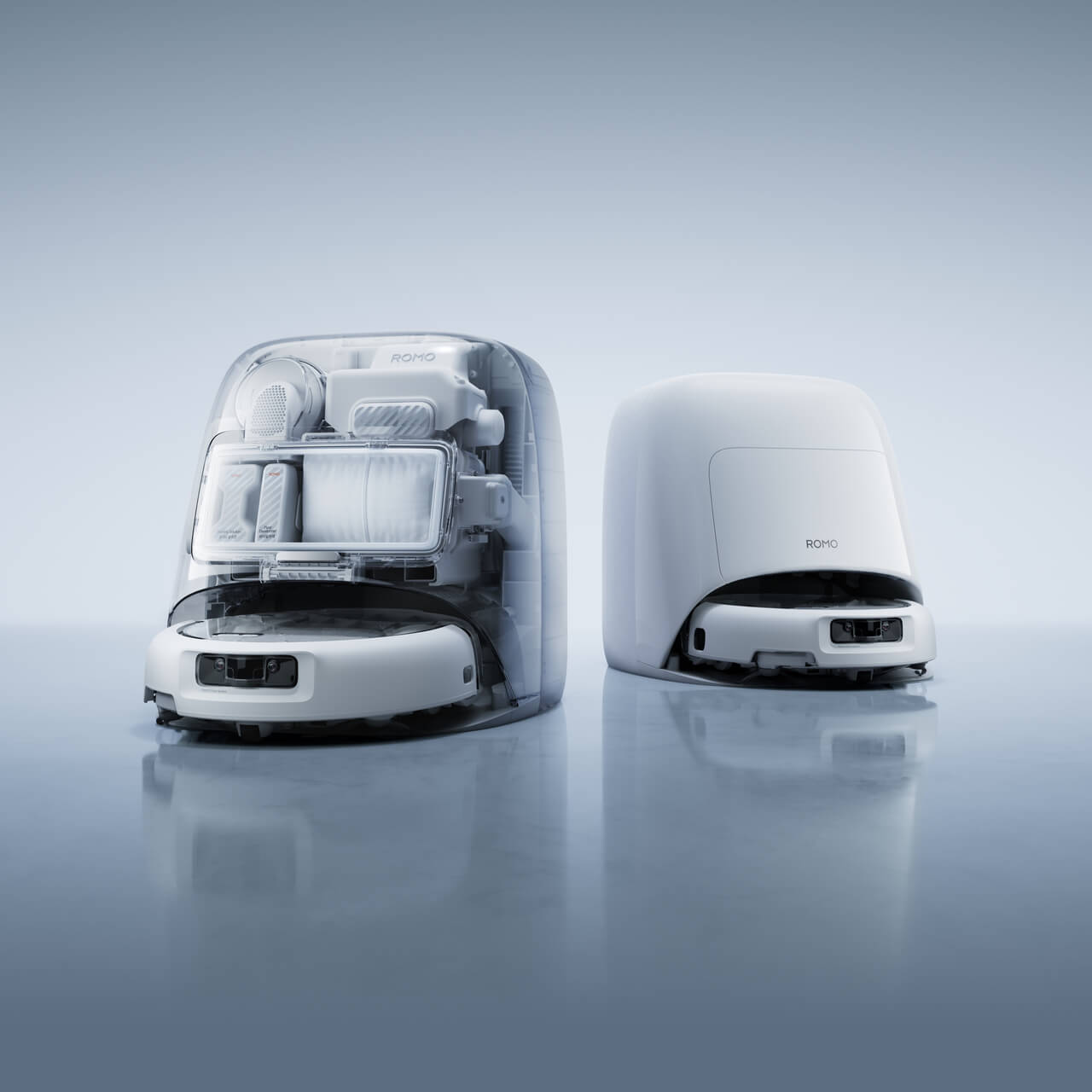
DJI has announced the second generation of its robot vacuum line, the ROMO 2 series, for global markets. The lineup consists of two models, the higher-end ROMO P2 and the standard ROMO A2, and carries over millimeter-level obstacle sensing built on the ranging technology DJI developed for its aircraft, a LiDAR-guided arm with a 123-degree swing, and 36,000 Pa of suction. Starting in the fourth quarter of 2026, the machines will also support a Local Data Mode that cuts the app's internet connection. In Europe, the P2 is priced at 1,299 EUR (about 235,000 yen).
Drone Technology Brought Straight into the Home
The ROMO line started from a simple idea: take the ranging and avoidance technology DJI built for aircraft and put it to work inside the house. For the ROMO 2, that perception system has been rebuilt from the ground up, and DJI calls the result Millimeter-Level Obstacle Detection 2.0.
The sensor package combines a forward-facing 3D ToF LiDAR, two high-performance fisheye image sensors, and a side-mounted 3D ToF LiDAR. Beyond thin objects like cables, the system is meant to handle the transparent and reflective surfaces that robot vacuums have traditionally struggled with, including glass and mirrors. DJI says the robot can infer from situations it has already recognized, allowing it to react to obstacles it has never encountered before.
For dim spaces, the robot has a built-in light that reveals dust on the floor. It covers an illuminated area of 2,000 square centimeters, aimed at reducing what gets missed under furniture or around beds where light rarely reaches.
A 123-Degree Arm and 36,000 Pa of Suction
The cleaning hardware has been reworked as well. The mopping arm is LiDAR-guided and swings across a wide 123-degree arc. It reaches 7.8 cm farther than the previous generation, letting it work under sofas and cabinets and around wall edges and table legs, the spots that usually end up half-cleaned.
Rated suction is 36,000 Pa. That figure tends to take on a life of its own in marketing, but the ROMO 2 backs it with structure: on carpet, a pressure plate lowers to form a near-seal against the floor so the suction is concentrated deep into the fibers. To fight tangles, a design called DualSweep deliberately overlaps the coverage of the side brushes and the roller brush.
The robot legs return for climbing obstacles. The ROMO 2 can clear single steps up to 4 cm and double steps up to 8.5 cm, so ordinary thresholds between rooms are not a stopping point.
Noise is another area DJI highlights. By reworking the materials, the company says noise energy has been cut by as much as 85 percent. In practice, the robot runs at roughly 54 dBA in the combined vacuum and mop mode, and the base station registers about 40 dBA while drying.
The base station handles high-temperature, high-pressure self-cleaning, washing the mop pads with 80-degree Celsius water. DJI says this enables up to 365 days of maintenance-free operation. As a runtime guide, in vacuum-only mode with suction set to quiet, the robot runs for about 3 hours and covers roughly 178 square meters with around 12 percent of the battery left. A 30-minute charge restores about 18 Wh, good for roughly 36 minutes in the combined vacuum and mop mode.
Local Data Mode Cuts the Connection
The part of this announcement DJI puts front and center is how footage from inside the home is handled. Starting in the fourth quarter of 2026, the ROMO 2 will support Local Data Mode, a feature that originated on DJI drones.
When it is enabled, the internet connection of the DJI Home app itself is severed. Photos or videos captured by the robot vacuum never reach external servers. Users can also disable the cameras and microphone outright, and any personal data shared with DJI can be deleted.
Once a camera-equipped device is moving around your home, the question of where the footage goes is unavoidable. Making a cloud-off switch a standard feature is a clear point of difference against competitors in the same price bracket. One practical caveat: the ROMO 2 series is not water resistant, so both the robot and its base station need to be kept away from liquids.
Pricing and the Difference Between the P2 and A2
Only European pricing has been disclosed so far. The flagship DJI ROMO P2 costs 1,299 EUR (about 235,000 yen) and the standard DJI ROMO A2 costs 1,199 EUR (about 217,000 yen), available directly from DJI or through retail partners. The official German store is applying a launch discount that brings the P2 to 1,059 EUR (about 192,000 yen) and the A2 to 1,049 EUR (about 190,000 yen).
※1 EUR = 181 JPY (as of September 5, 2026)
The two models are largely identical inside. Obstacle detection, 36,000 Pa suction, the 123-degree arm, the 8.5 cm climbing ability, and the 80-degree self-cleaning are all shared. The split comes at the base station: the P2 uses a translucent housing and supports a floor odor remover, while the A2 has a white housing with a UV lamp for the dust bag. Both dry the robot's own dust bin. Four cleaning modes are offered, vacuum and mop, vacuum only, mop only, and vacuum then mop, with custom schedules available in the app.
As for Japan, neither a release date nor a price has been indicated at the time of writing. The Japanese DJI store still lists only the first-generation ROMO models, so when the ROMO 2 arrives there remains an open question.
Summary
The ROMO 2 is the second generation of DJI's effort to move the ranging and avoidance technology it built for aircraft into a household robot. Alongside the cleaning upgrades of a 123-degree arm and 36,000 Pa of suction, the biggest change in this generation is that a mode which cuts the connection and keeps footage off external servers is now a standard option. A Japanese launch is undecided, but as more home robots ship with cameras, this kind of setting is likely to become a standard criterion when choosing one.