
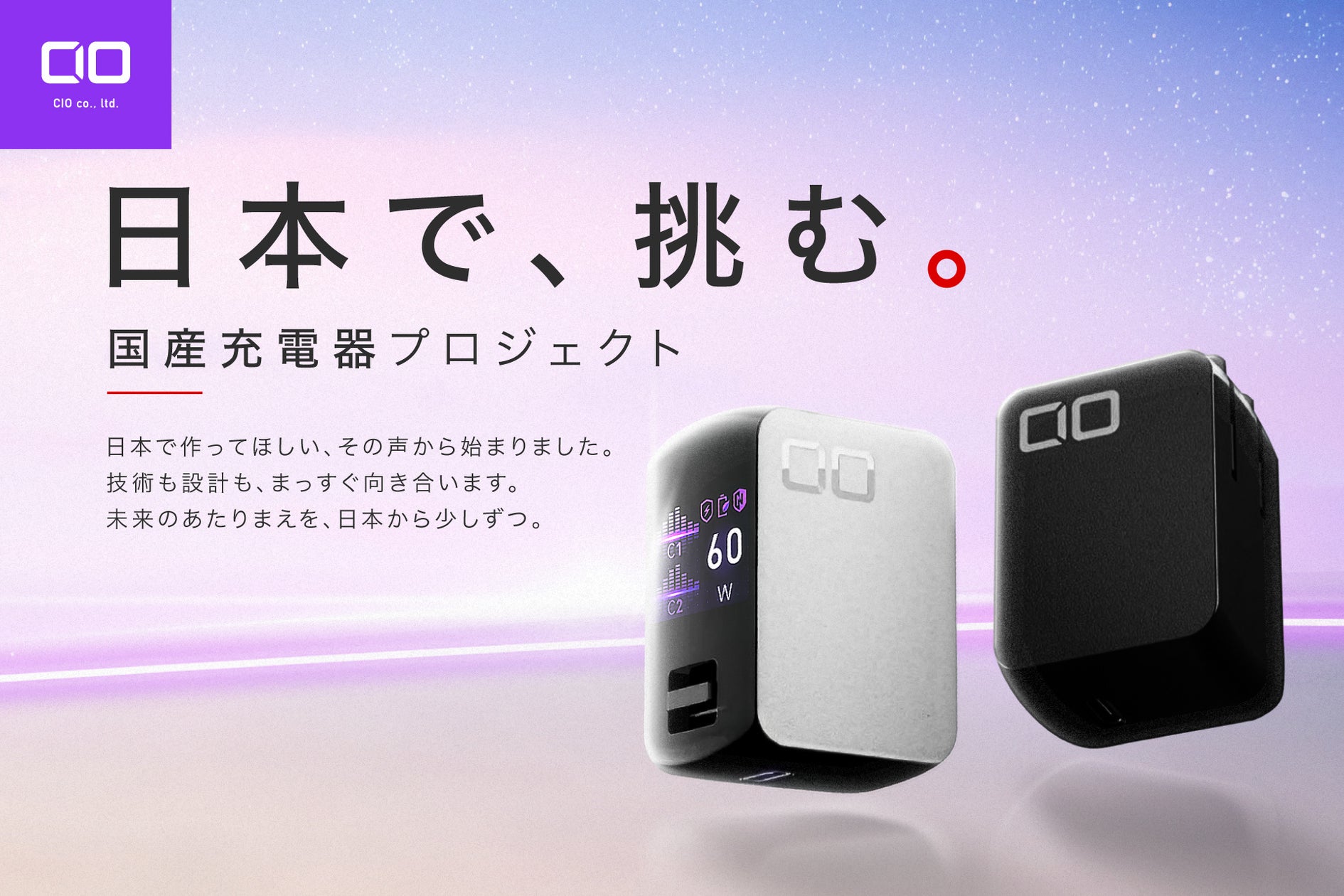
CIO, a Japanese company known for chargers and power banks, opened its first Japan-made charger project, the NovaPort DUO III 65W2C, on the crowdfunding service Makuake on September 10, 2026[1]. The charger delivers up to 65W across two USB-C ports and adds four output modes, a TFT display, and control through a dedicated app. The planned retail price is 8,880 yen, with Makuake early-bird tiers starting at 7,180 yen[1].
Breaking made-in-Japan into three challenges
CIO is headquartered in Moriguchi, Osaka, and was founded in 2017. The company is now in its tenth year, and it launched the domestic charger project to mark that milestone[1].
The project sets out three challenges: manufacturing through a Japanese factory, solid thermal design that sustains output, and using parts from Japanese manufacturers wherever possible[1].
Production is handled by Asahi Denshi in Date City, Fukushima Prefecture. CIO explains that building chargers in Japan is not a matter of transplanting the production steps it used in China, and that it had to assemble the process step by step with the domestic factory while checking differences in equipment and areas of expertise. The company also frames this as an effort to keep manufacturing in Japan rather than a one-time exercise[1].
The share of Japanese-made components started at 0 percent in April 2026, when the project began. After reviewing the bill of materials and working through replacements, that figure reached 23 percent in May 2026 and 53.3 percent of the 210 total components as of September[1]. The concept itself dates back to July 2025, and the project passed through factory selection, parts replacement, prototyping, and design revisions before reaching Makuake[1].
One point worth noting is that CIO states in its own press release that not every step is completed in Japan and that not all components are Japanese-made. The company says the product clears the bar required to call itself domestic, but that this differs from the common image of 100 percent domestic production[1].
Four output modes built around heat
Ichiken, a YouTuber who covers electrical and electronic engineering, joined the project to work on the circuit and thermal design. CIO says it brought in the perspective of an outside engineer who has spent years taking products apart, and that they reviewed circuits, components, and thermal behavior together during development[1].
Small, high-output chargers run into heat as a constraint. Rather than chasing peak wattage alone, CIO made sustained output under continuous use one of the themes for this product[1]. That thinking shows up as four selectable output modes.
Full Power uses the 65W maximum and targets situations where a laptop or similar device needs steady power. Safety Power monitors the internal temperature and switches output to hold heat down. Power Save charges more gently to reduce strain on a smartphone battery, aimed at overnight use and other unhurried moments. Custom lets the user allocate output manually, which matters when a laptop and a pair of earphones are connected at the same time[1].
On the safety side, NovaSafety2.0 continuously monitors temperature and controls heat automatically. Power allocation is handled by CIO's own NovaIntelligence technology, which supports up to 65W on a single port and distributes power according to the connected devices when both ports are in use[1].
A TFT display and app control that show charging state
The body carries a TFT display that makes charging status visible in a way most chargers do not. Users can show total output, per-port information, several readouts at once, or turn the display off when it is not needed[1].
Settings can also be changed from a dedicated app rather than only on the unit itself, which helps when the charger sits somewhere out of reach[1].
The physical design gets attention as well. The USB-C ports sit on the underside of the body, so cables run naturally downward when the charger is plugged into a wall outlet. That keeps cable weight and pulling force off the plug and makes the charger less likely to come loose. The power plug has an insulating cap, and the display and control areas use a construction designed for durability[1].
Pricing and project period
The charger comes in black and white. The planned retail price is 8,880 yen, and Makuake offers several reward tiers[1].
The Makuake Special tier, limited to 500 units, is 7,180 yen including tax at 19.1 percent off. A second tier limited to 1,000 units is 7,280 yen including tax at 17.3 percent off, and another 1,000-unit tier is 7,380 yen including tax at 16.9 percent off[1]. Two-unit bundles and a reward that lists the backer's name are also available[2].
The project runs from September 10 to November 29, 2026, with rewards scheduled to ship in December 2026[2]. Crowdfunding on Makuake is a way to back a project rather than an ordinary retail purchase, and CIO states plainly that the product is not finished yet[1].
Summary
On paper, a 65W dual-port charger competes in a crowded category. What stands out here is that CIO published the process itself in numbers and dates, from setting up domestic production to raising the share of Japanese-made components from 0 to 53.3 percent. Shipping standard modes that hold heat down, and bringing an outside engineer into the design, also point away from a pure race for peak wattage. Mass production and delivery are planned for December 2026, so how far these stated challenges translate into a finished product will depend on what arrives in backers' hands.
Source: https://prtimes.jp/main/html/rd/p/000000695.000043212.html