
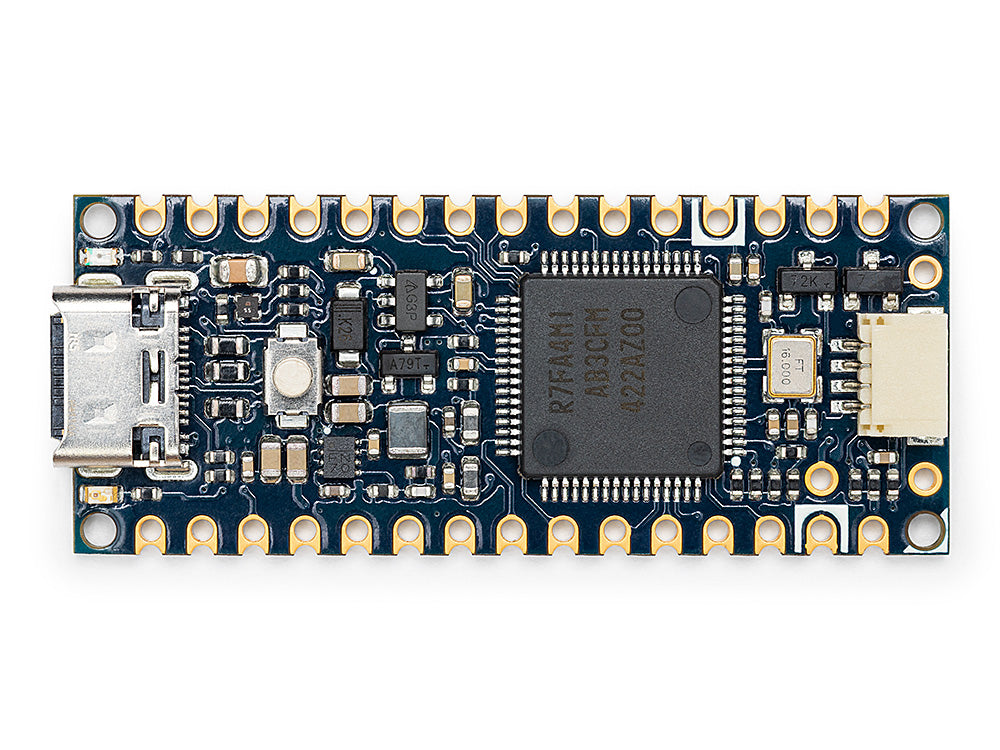
The Arduino Nano R4, the new generation of the Arduino Nano series, is now widely available in Japan, including at Akizuki Denshi Tsusho. It carries the same Renesas Electronics RA4M1 microcontroller used in the UNO R4, comes with dramatically expanded memory, and adds a USB Type-C port and a Qwiic connector on a thoroughly modernized board. This article walks through what has evolved from the classic Nano and the caveats worth knowing before you buy.
From 8-Bit to 32-Bit: A New Microcontroller and Far More Memory
The biggest change is the microcontroller itself. In place of the 8-bit ATmega328P found on the classic Nano (R3 generation), the Nano R4 adopts the Renesas Electronics RA4M1 (R7FA4M1AB3CFM), a 32-bit microcontroller. Its Arm Cortex-M4 core runs at 48 MHz and includes a floating-point unit (FPU), delivering a dramatic leap in computing performance over the 8-bit generation[2].
The memory gains are just as striking. Flash memory grows 8x from 32 kB to 256 kB, SRAM expands 16x from 2 kB to 32 kB, and an 8 kB EEPROM is available for data storage[2]. Large libraries and big arrays — image or audio buffers, for example — can now be handled with room to spare.
The RA4M1 is the same microcontroller used in the Arduino UNO R4 series. The operating voltage also stays at 5 V, the same as the classic Nano, so code written for the UNO R4 and existing Nano accessories and circuits designed around 5 V remain easy to reuse[2].
USB Type-C and Qwiic On Board, With Castellated Edges
The physical design has changed substantially as well. The USB port moves from the old Mini-B to USB Type-C, making cables easier to source and share with smartphones. A 3.3 V Qwiic connector is newly added at the bottom edge of the board, letting you attach off-the-shelf Qwiic sensors and Arduino's own Modulino series without any soldering[2].
The board keeps the roughly 18 mm x 45 mm Nano footprint while mounting all components on one side and using castellated (edge through-hole) pins. You can solder pin headers for breadboard prototyping, or reflow-solder the board directly onto a custom PCB like a surface-mount module — one board covers everything from prototyping to small-scale production[2]. The power input (VIN) accepts a wide 6-21 V range, so it can be dropped into 12 V systems without a separate step-down circuit[2].
Note that the model sold at Akizuki Denshi for 2,620 yen (tax included, sales code 131210) ships with pin headers included but not soldered. If you would rather avoid soldering, a version with pre-installed headers (sales code 131211, 2,860 yen) is also available[1].
DAC, Op-Amp, and CAN Added — but Mind the 8 mA Limit and the Price
New features include a 12-bit DAC (digital-to-analog converter) attached to the A0 pin, an operational amplifier accessible on pins A1-A3, and CAN communication that works with an external transceiver. The ADC has been upgraded to up to 14-bit resolution, and a real-time clock (RTC) with battery backup (VBATT pin) is built in[2]. Generating and amplifying analog signals, or experimenting with the CAN bus used in automotive systems — tasks that previously required external circuitry — can now be tackled with the board alone.
One thing to watch, however, is the output current of the I/O pins. The RA4M1's GPIOs can handle a maximum of 8 mA per pin, down from the roughly 20 mA guideline of the previous 8-bit generation. Wiring current-hungry parts such as LEDs or relays directly to a pin is risky; driving them through a transistor or MOSFET as a current amplifier is the way to go[2]. The official datasheet explicitly warns against connecting devices that draw more than 8 mA directly.
Price deserves a mention too. In Japan, Switch Science began selling the board on July 24, 2025, and Akizuki Denshi followed on July 25 of the same year[1][3]. At Akizuki, the price was revised from 2,480 yen to 2,620 yen in December 2025[1]. Considering that Nano-compatible boards with the ATmega328P can be had for a few hundred yen, there is no denying the price is on the high side. For jobs an 8-bit board can handle, the clones win on value; the Nano R4 earns its keep where you need the computing power, the memory, and the newly added analog features — or where the quality and supply stability of a genuine board matter.
The Nano R4 is also available on Amazon.co.jp.
![Arduino Nano R4 [ABX00142] - ヘッダー非搭載(ルーズピン付属)、コンパクトルネサス RA4M1マイクロコントローラーボード、Qwiicコネクタ、プログラム可能なRGB LED、Arduino IDE対応](https://m.media-amazon.com/images/I/61PMSktRUZL._AC_SL1000_.jpg)
Amazon.co.jp でチェック
Arduino Nano R4 [ABX00142] - ヘッダー非搭載(ルーズピン付属)、コンパクトルネサス RA4M1マイクロコントローラーボード、Qwiicコネクタ、プログラム可能なRGB LED、Arduino IDE対応
Summary
With its move to 32-bit, the jump to 256 kB flash and 32 kB SRAM, a modern board design featuring USB Type-C, Qwiic, and castellated edges, plus the addition of a DAC, op-amp, and CAN, the Arduino Nano R4 amounts to a true superset of the classic Nano. At the same time, the I/O pin output current drops to 8 mA, and designing peripheral circuits with 8-bit-era instincts can lead to unexpected trouble. It is pricey next to clones costing a few hundred yen, but for projects where computing power and memory pay off, it looks like a strong candidate.
Source: https://akizukidenshi.com/catalog/g/g131210/
Source: https://docs.arduino.cc/resources/datasheets/ABX00142-datasheet.pdf
Source: https://prtimes.jp/main/html/rd/p/000000209.000064534.html