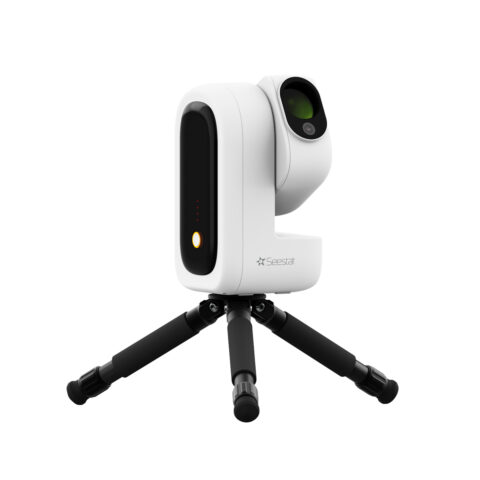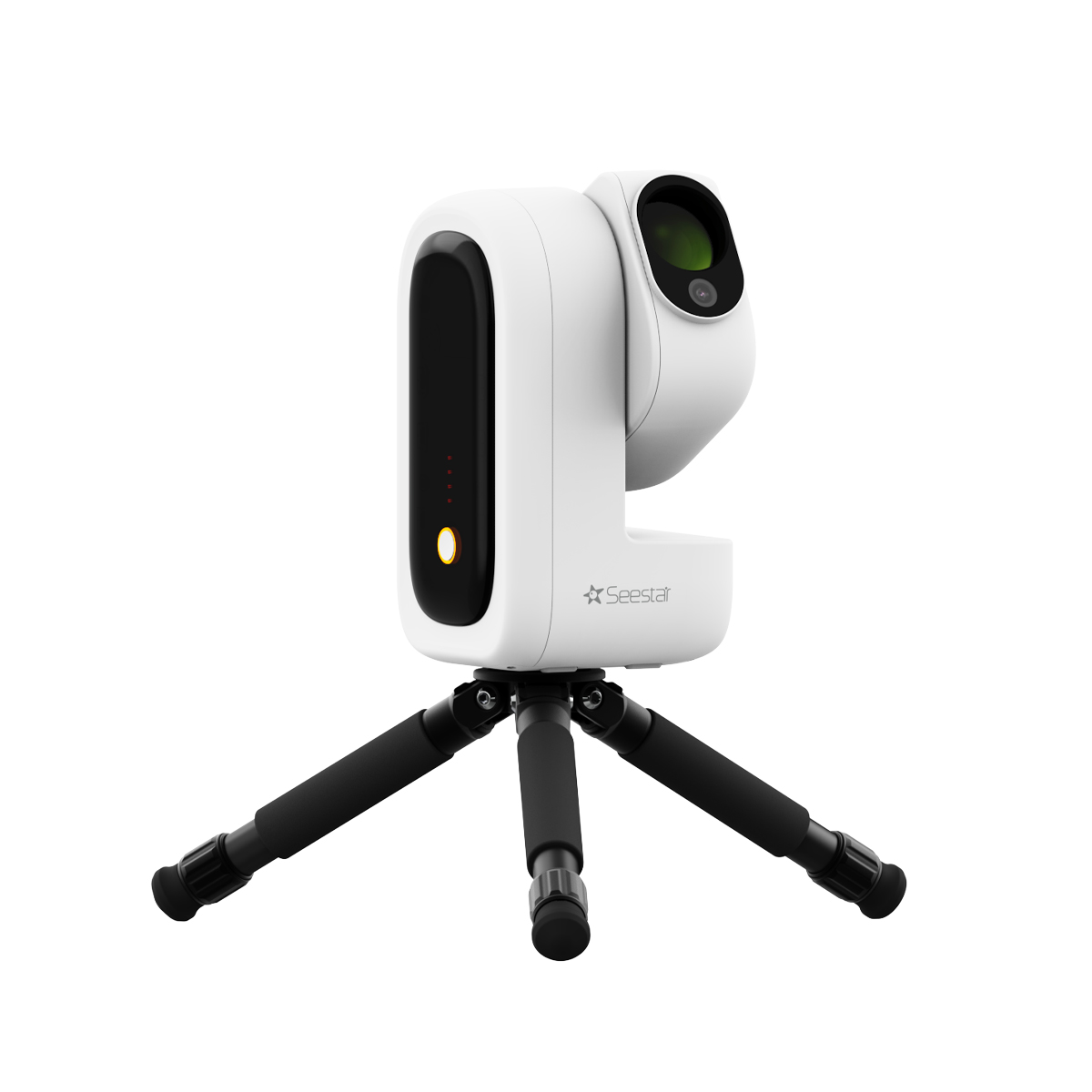
ZWO has announced the Seestar S50 Pro, the newest model in its line of all-in-one smart telescopes. The 50mm aperture carries over, but the imaging sensor moves up to 4K and a 63-degree wide-angle camera has been added. The introductory preorder price is 899 USD (about 144,000 yen), and shipping started on September 1. It is a generational step that pushes the original goal of lowering the barrier to astrophotography further, on both the optical and the power side.
A Two-Camera Setup Built Around a 4K Sensor
The imaging sensor is the biggest change. The original S50 captured 1080x1920, roughly 2.1 megapixels. The S50 Pro uses a 1/1.2-inch CMOS and shoots 2160x3840, roughly 8.3 megapixels, in 4K. Focal length stretches slightly from 250mm to 260mm, and the optics are a four-element apochromatic design that suppresses chromatic aberration.
The larger sensor also widens the frame. Field of view grows from 1.46 degrees to 2.8 degrees, enough to fit large targets such as the Andromeda Galaxy or the North America Nebula that the original could not frame in a single shot. In astrophotography, where you place the subject in the frame is the heart of composition, so this difference matters a great deal in practice.
The original was a single-lens instrument, while the S50 Pro adds a 63-degree wide-angle camera. The telephoto side goes after individual deep-sky objects, and the wide side covers Milky Way panoramas, star trails, and time-lapses. Being able to switch between telephoto and wide on one body is a real advantage for anyone trying to carry less gear.
Better Tracking and a Bigger Battery
Equatorial mode itself is not new. ZWO added it to the original S50 and the S30 through a software update in 2025, allowing 60-second exposures with a compatible wedge. What is new on the S50 Pro is a precision drive system that ZWO describes as having near-zero backlash. The company says it improves pointing accuracy, tracking stability, and resistance to wind. In long exposures, even slight play in the gear train shows up directly as smeared stars, so reworking this part is a sensible improvement.
Power has been reinforced as well. The battery grows from 6,000 mAh to 10,000 mAh, and live stacking time under typical conditions extends from about 6 hours to as much as 9 hours. For anyone shooting from sunset toward dawn, that gap decides whether an external power source is needed. Storage doubles from 64 GB to 128 GB, and NFC-based Bluetooth pairing has been added for phone setup. A swappable filter set is included in the kit.
The Same Seestar App Drives It
The S50 Pro runs on the same app as the rest of the Seestar line. After pairing with a phone, you pick a target from the in-app catalog, and go-to, focusing, tracking, and live stacking (combining multiple frames to reduce noise) all proceed automatically by default. Settings such as exposure length can be adjusted manually, and raw frames can be exported for processing in external software. The app also includes background extraction, noise reduction, and star removal.
As for where it sits in the lineup, the S50 Pro is essentially the S30 Pro from this January scaled up in aperture. The optics, the 8.3-megapixel sensors on both cameras, the 63-degree wide field, and the 128 GB of storage are shared with the S30 Pro. The differences are the 30mm versus 50mm aperture and the battery capacity. Choose the S50 Pro to reach fainter targets, or the S30 Pro if portability comes first.
Summary
The Seestar S50 Pro fills in the field-of-view and resolution gaps that were the original S50's weak points, through the move to a 4K sensor and the addition of a 63-degree wide-angle camera. Quieter but practical gains stack on top: a near-zero-backlash drive, a 10,000 mAh battery, and 128 GB of storage. The preorder price is 899 USD, rising to 999 USD (about 160,000 yen) after September 15.
※1 USD = 160 JPY (as of September 2, 2026)