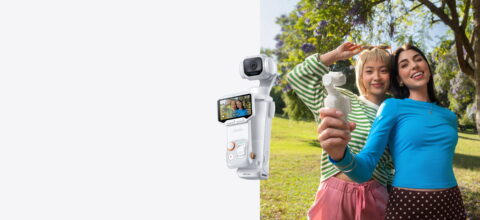
Gimbal maker Hohem has shown Eyepic at IFA 2026, a pocket gimbal camera whose camera unit detaches so it can be worn. Held in the hand it works as a 3-axis stabiliser; taken off the arm it clips to a cap or hangs from a lanyard. Its headline trick is recording vertical video at full 4K resolution rather than cropping it. Hohem expects the camera to reach the market in the first quarter of 2027.
Moving between handheld and hands-free with one device
Hohem treats Eyepic as the starting point of its move from stabilisers alone into imaging hardware more broadly. The base form is a 3-axis gimbal with a grip, but the camera unit at the top comes away entirely.
Once detached, the camera can be worn using a hat clip or a lanyard. Hohem points to family outings, travel, cycling and dog walks, the situations where both hands are already busy. The unit also attaches magnetically to suitable metal surfaces, and it is waterproof to 10 metres, so underwater and splash-level shooting stay on the table.
When the camera comes off, the gimbal arm retracts and locks. The remaining grip becomes a remote: its 2.51-inch touchscreen shows a 1080p live preview and allows setting changes from up to 10 metres away, so the person being filmed can still check the framing.
Vertical 4K captured by physical rotation, not by cropping
The second pillar is how Eyepic handles vertical video. Most cameras shoot horizontally and crop a tall region out of the frame, which costs resolution.
On Eyepic, rotating the touchscreen with one hand physically reorients the camera to match. In vertical mode it records at up to 2160 by 3840 at 60 fps, delivering native vertical 4K rather than a trimmed horizontal frame. The rotation behaviour is adjustable from the menu.
The idea is that footage destined for TikTok, Instagram Reels or YouTube Shorts already arrives in its final shape. The reframing work and the quality loss that normally happen in editing are dealt with before the shot is taken.
Smartphone gimbals and a wireless microphone shown alongside
Two smartphone gimbals and a wireless microphone system sat next to Eyepic on the IFA 2026 stand.
The iSteady V4 Ultra pairs a detachable touchscreen remote with live preview and Frame-to-Track subject selection, letting the user pick a subject to follow from the screen. It also supports native Apple DockKit tracking, which works in the iPhone Camera app and compatible apps. The iSteady X4 likewise supports DockKit tracking, and adds an integrated touch-control panel and a 360-degree infinite pan axis suited to panoramas.
Mic 2, the wireless microphone, pairs one receiver with up to four transmitters, aimed at interviews, panels and other multi-person recording. Each transmitter weighs 7.7 grams, records at 48 kHz and 24-bit, and applies adaptive AI noise cancellation. Wireless range is quoted at up to 300 metres.
Release is still some way off, and pricing is open
It is worth stressing that everything shown is at the preview stage. Final specifications, configurations, pricing and on-sale dates are all to be confirmed closer to launch, and the only timing figure attached to Eyepic is the loosely defined first quarter of 2027. Nothing has been said about availability in Japan.
Hohem was founded in 2014 and brought on-device AI tracking to a smartphone gimbal in 2021. The company now claims more than 5 million users across over 70 countries. Whether the mechanical know-how built up in stabilisers carries over into building a camera itself is the question that will decide how Eyepic is judged.
The stand is in Hall 20 at Messe Berlin, booth H20-123, running from 4 to 8 September.
Summary
Hohem Eyepic is a pocket-sized 2-in-1 that works as a handheld 3-axis gimbal and converts into a wearable camera when the head is detached. Rotating the touchscreen physically turns the camera, allowing 2160 by 3840 vertical video at 60 fps without cropping. It is waterproof to 10 metres and the grip doubles as a remote at a distance. Pricing and an exact release date remain unannounced, so a real verdict will have to wait until 2027.