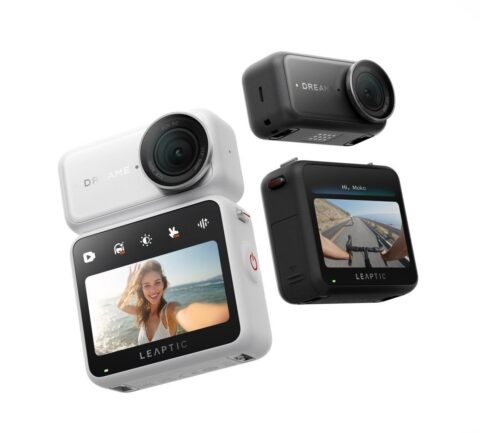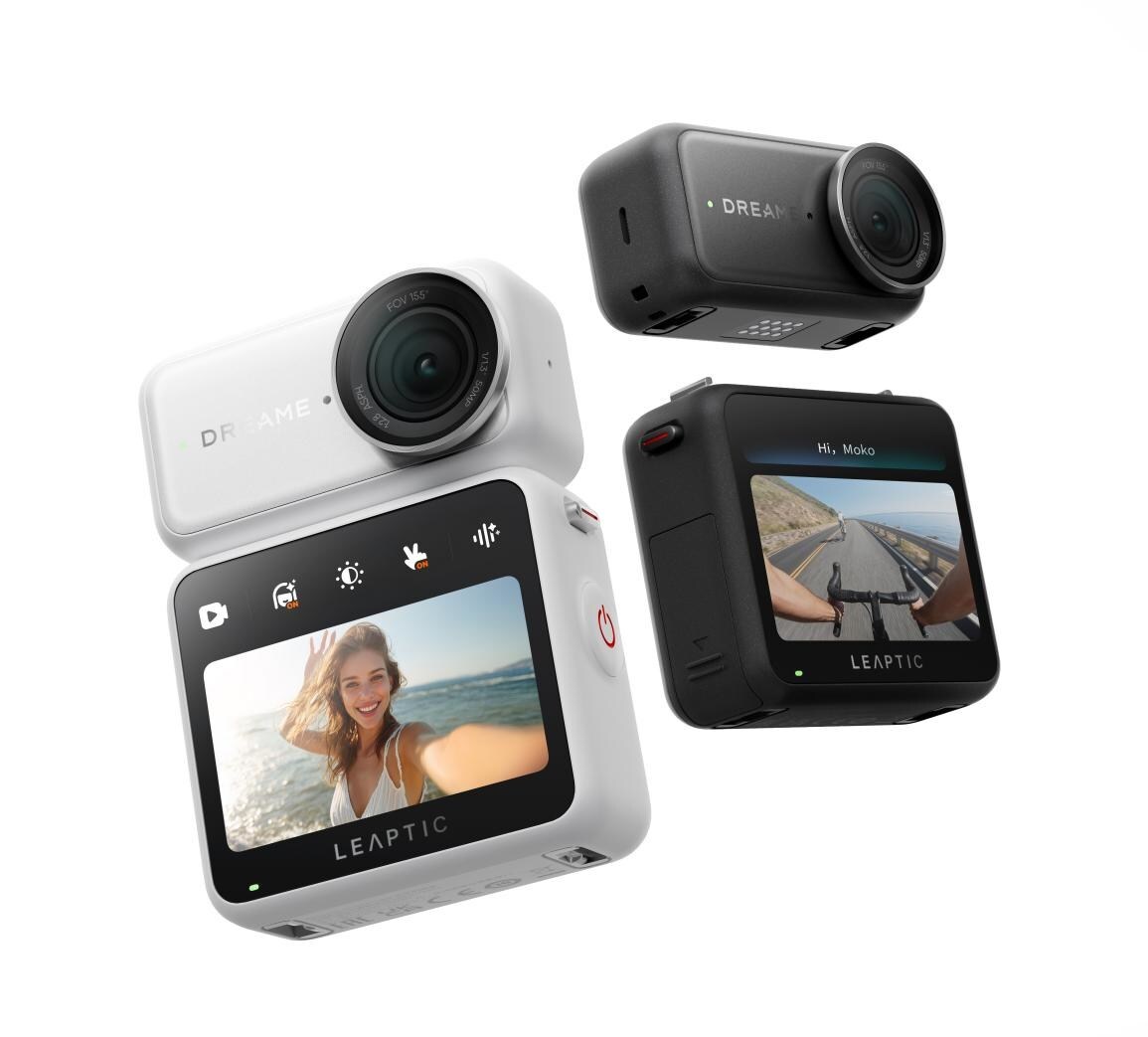
Dreame, a company best known for robot vacuums, has stepped onto unfamiliar ground. The LEAPTIC Cube, shown at IFA 2026 in Berlin, is the company's first action camera. A 55.9-gram body shoots 8K video at 30fps, and the camera section detaches from its base. It goes on sale in Europe in mid-October at 399 euros (about 72,000 yen).
A vacuum maker steps into GoPro, DJI and Insta360 territory
Dreame is a Chinese smart-appliance maker that has built its name on products such as robot vacuums that climb stairs. Its plan to enter the camera market was first shown at CES 2026 earlier this year. IFA 2026 is the follow-up, the point at which pricing and availability were locked in.
The competition is clear. The thumb-sized action camera segment is led by Insta360's Go series and DJI's Osmo Nano, with GoPro holding ground through its mainline products. A latecomer entering the same arena has to beat the field somewhere. Dreame chose a straightforward frontal approach: sensor size and processing silicon.
A 1/1.3-inch sensor and a 48 TOPS chip
The LEAPTIC Cube carries a 1/1.3-inch CMOS sensor, which is on the large side for a compact action camera in this class. Dynamic range reaches up to 13.5 stops, and stills go up to 50 megapixels. The lens is f/2.8 with a 155-degree field of view, and the camera supports 10-bit color depth and P-Log recording, which points to color grading in post.
Video modes include 8K at 30fps, 4K HDR at 60fps and 4K slow motion at 120fps. There is also a dedicated 4K night mode, turning the sensor's size directly into low-light headroom. Stabilization is handled by a system called GyroSteady, and the camera is waterproof to 10 meters.
Processing runs on a Qualcomm chip rated at 48 TOPS of AI performance. That compute is spent on capture-side work: scene recognition, subject tracking, natural-looking portrait correction and audio noise processing. According to Dreame, scene analysis uses a multimodal language model that adjusts settings both during capture and in post-processing.
The camera pops off and shoots from 30 meters away
The most striking part of this product is its modular structure. The imaging section is a standalone cube that attaches magnetically to a base housing a 2.27-inch touchscreen and a battery. It can face forward or backward while docked, or be detached entirely to be worn on the body or moved to a different mount.
Once detached, the camera unit runs over a wireless link called ProSync at distances of up to 30 meters from the base, transmitting video for up to 90 minutes. That lets you frame a shot on the screen in your hand while the camera itself sits somewhere out of reach. For anyone currently doing something similar with a tripod and a smartphone, it removes a piece of gear.
The control options are reasonably complete. A voice assistant called Hi, Moko handles power, starting a recording and switching modes by voice. It is said to understand intent even when phrasing is loose, which is aimed at situations where your hands are full. Gesture control is supported as well.
Storage and power
Internal storage comes in 64GB and 128GB versions, and microSD cards up to 1TB are supported. Since 8K and 10-bit P-Log eat capacity quickly, working from internal storage alone is not realistic, and a card will be part of the setup.
Battery life is rated at 110 minutes, extending to 210 minutes with the optional Magnetic Battery Cube. Charging reaches 80 percent in 19 minutes, and Wi-Fi 6 plus USB 3.1 put transfers to a host machine on the faster side. The body carries an anti-smudge coating called CrystalShield.
How to read the price
European sales start in mid-October from 399 euros (about 72,000 yen). *1 EUR = 181 JPY (as of September 4, 2026)
Measured against going rates for compact action cameras, this is not a budget play. That said, few current models combine a 1/1.3-inch sensor, 8K capture and a camera section that detaches and operates on its own in a single package. On paper, the specifications hold up against the incumbents.
Action cameras, however, are judged in the field rather than on a spec sheet. How well the stabilization actually works, how long 8K recording lasts before heat intervenes, how stable the app is, and what repair support looks like when something breaks. None of that can be assessed until units are in circulation. Whether the manufacturing muscle Dreame built with vacuums carries over to imaging hardware is also an open question. Japanese availability and pricing have not been announced.
Summary
Dreame showed its first action camera, the LEAPTIC Cube, at IFA 2026 and will release it in Europe in mid-October from 399 euros (about 72,000 yen). A 55.9-gram body houses a 1/1.3-inch sensor, shooting 8K at 30fps and 50-megapixel stills. Its defining features are a modular design in which the camera separates from the base and shoots from up to 30 meters away, and capture-side AI processing driven by a 48 TOPS chip. A real verdict will have to wait until the hardware reaches the market.