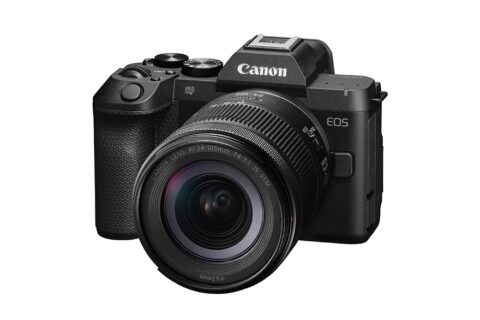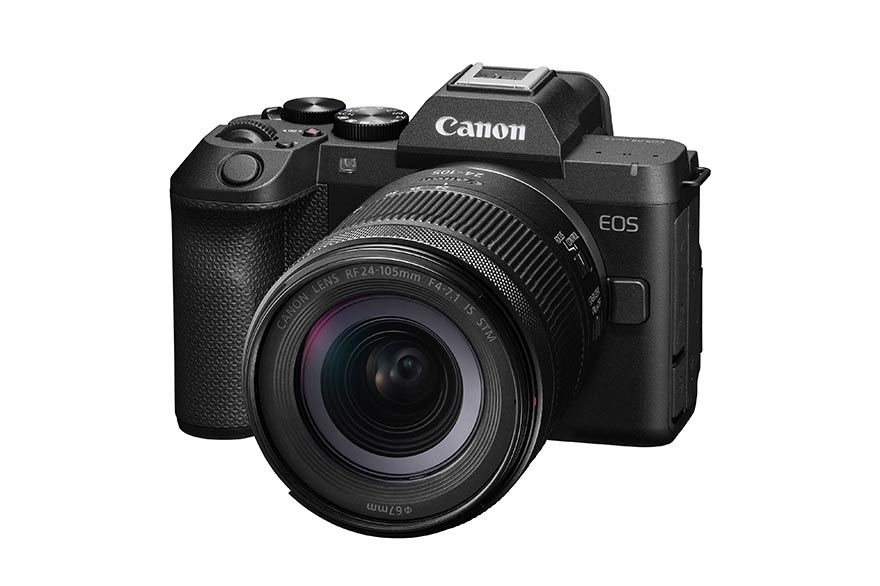
Canon will release the EOS R8 Mark II, a compact and lightweight full-frame mirrorless camera, on October 29, 2026. It keeps the portability of the original EOS R8 from April 2023 while switching to a straight-edged body design, and it adds two things the first model never had: in-body image stabilization and a multi-controller. The result is a small camera that handles much like Canon's higher-end bodies.
From curves to straight lines
The exterior is what stands out first. Earlier EOS bodies were built around soft, curved surfaces, but the EOS R8 Mark II moves to a simple, modern shape based on straight lines and arcs. The top plate and front surfaces are noticeably flatter, and side by side the two generations barely look related.
The positioning has not changed, though. This is still a small, light body for a full-frame camera. Canon carried over the original EOS R8 idea of pairing full-frame image quality with easy portability, and simply gave it a contemporary look.
In-body stabilization and a multi-controller
The biggest internal change is the new 5-axis in-body image stabilization unit, which the EOS R8 did not have. Paired with an RF lens that has optical stabilization, coordinated control delivers up to 7.5 stops of correction at the center of the frame and up to 7.0 stops at the periphery. Those figures follow the CIPA 2024 standard, measured with the RF24-105mm F2.8 L IS USM Z at 105mm using the electronic shutter.
Publishing a separate figure for the edges of the frame is useful in practice, especially for video at wider focal lengths where corners tend to drift.
On the control side, Canon added a multi-controller for moving AF points quickly, another part missing from the EOS R8. Canon says handling is now comparable to the EOS R6 Mark III released in November 2025, so buying the smaller body no longer means giving up operability.
40 fps bursts and an AF system that remembers people
The sensor is a full-frame CMOS chip with roughly 24.2 effective megapixels, paired with the DIGIC X processor. Standard sensitivity reaches ISO 102400 for stills.
With the electronic shutter, continuous shooting runs at up to about 40 frames per second with AF and AE tracking, which is plenty for fast-moving subjects. Canon does note that rolling shutter distortion can appear depending on the subject and conditions, the usual caveat for electronic shutter shooting.
Autofocus uses Dual Pixel CMOS AF II, designed to hold accuracy and tracking even during high-speed bursts. On top of that, a registered-person priority function detects and follows specific people you have registered in advance. Canon rates its performance as equivalent to the EOS R3 from November 2021. The camera stores up to 10 people internally and can save up to 10 registration files to a card, so in practice you can carry data for as many as 100 people. Think school sports days or recitals, where you need to pick one person out of a crowd.
Oversampled 4K/60p video
For video, the camera reads the sensor at 6K and downsamples to 4K, recording 4K/60p with no crop. Full HD goes up to about 180p for high-frame-rate capture, which makes clean slow motion possible.
Canon Log 3 is supported, covering up to 14 stops of dynamic range. For anyone who wants to grade footage properly afterward, that is one more option available in a small body.
Color filters expand to 16, including film looks
Canon also expanded the creative tools. The color filter function, available for both stills and video, gains NegativeFilmtone and PositiveFilmtone, which reproduce the character of film, bringing the total to 16. Filter strength is adjustable across 11 steps, so you can dial the effect back and use it as a subtle base.
Color settings for handheld night scene mode were expanded as well, with 5 tonal options to choose from. Note that the filter type, color, and strength chosen at capture cannot be changed afterward, and the night-scene color settings apply only to JPEG shooting.
Price and accessories
Pricing is open, and the release date is October 29, 2026. As a guide, the body alone is listed around 275,000 yen, the RF45mm F1.2 STM lens kit at 317,900 yen, and the RF24-105mm IS STM lens kit at 324,500 yen.
Canon also detailed accessories launching alongside the camera, including the EG-E2 extension grip for a more secure hold, the EL-5 (Ver.2) Speedlite, and the HG-1000TBR tripod grip. The company is also moving ahead with plastic-free packaging, so the changes reach beyond the product itself.
Summary
The EOS R8 Mark II keeps the small, light character of the original while filling in its two practical gaps: in-body stabilization and a multi-controller. Roughly 40 fps bursts, registered-person priority AF, and oversampled 4K/60p make it a well-rounded body whether you come at it from stills or video. For anyone who wants a full-frame camera light enough to carry every day, October 29 is a date worth watching.