
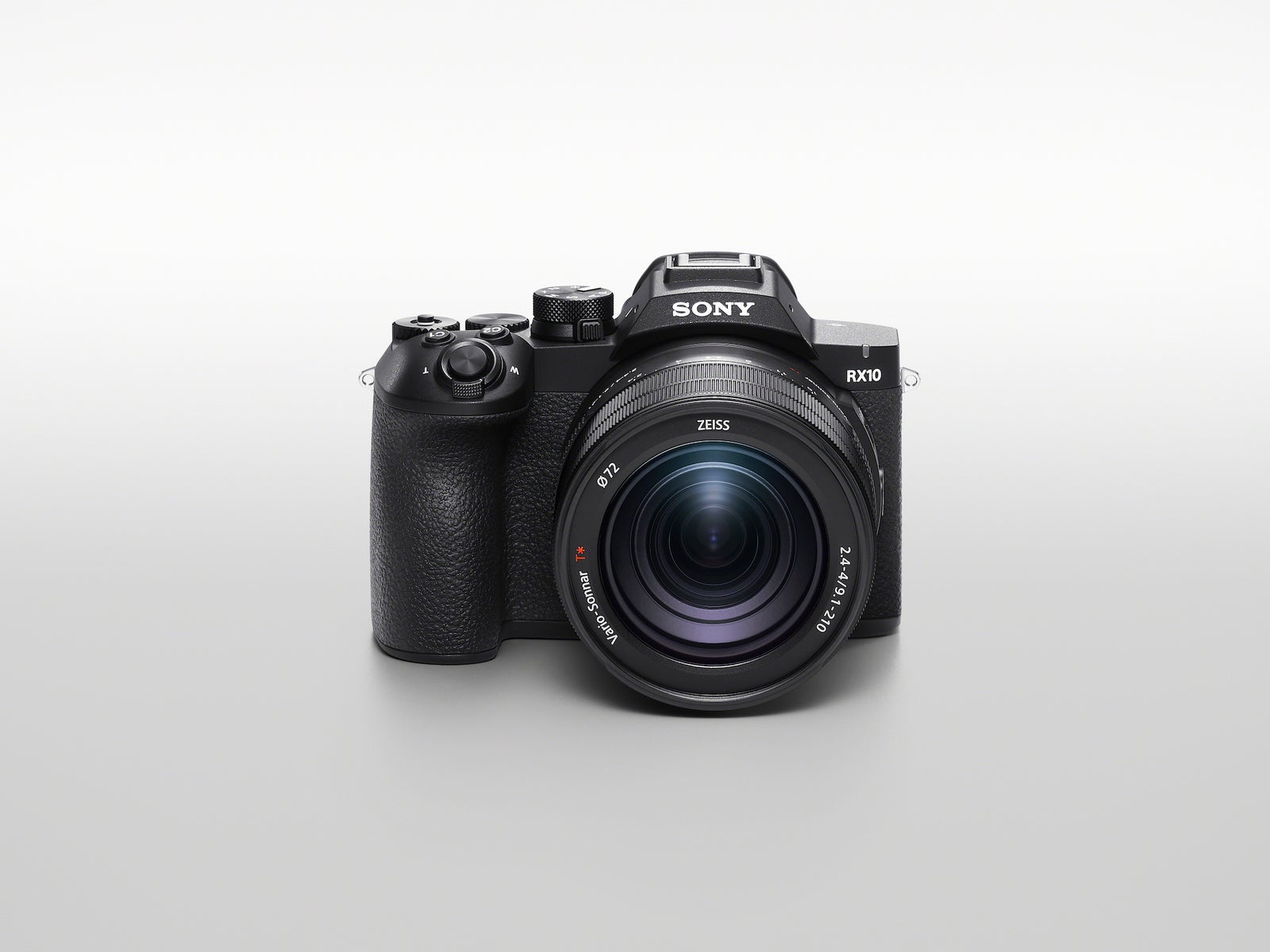
On July 9, 2026, Sony announced the RX10 V, an all-in-one super-telephoto camera built around a large sensor. It keeps the core of the series—a ZEISS 24-600mm lens and a 20.1-megapixel 1.0-type stacked sensor—while adding features borrowed from the higher-end Alpha (α) mirrorless line, including AI-driven subject recognition autofocus, blackout-free continuous shooting at up to 30 fps, and 4K 120p video. The suggested retail price in North America is 2,299.99 USD (about 370,000 yen), with availability planned for August 2026.
The Core Carries Over, the Internals Move to the Alpha Era
The RX10 V inherits the large-aperture ZEISS Vario-Sonnar T* F2.4-4.0 lens, covering 24mm wide-angle to 600mm-equivalent super-telephoto (25x) in a single body, paired with a 20.1-megapixel 1.0-type stacked Exmor RS CMOS sensor. This combination underpins the RX10 series' signature strength: handling everything from everyday snapshots to wildlife and sports without swapping lenses. Macro focusing to about 3cm at 24mm and about 72cm at 600mm adds to the versatility of an all-in-one design.
The body, however, has been thoroughly reworked. The grip shape and button layout follow the Alpha series, with an eight-direction multi-selector for intuitive operation even while looking through the viewfinder. The camera uses the latest BIONZ XR processing engine, also found in higher-end Alpha models, keeping noise low at mid-to-high ISO while rendering skin tones, skies, and greenery naturally. Twelve customizable Creative Look presets let you shape color and texture in-camera.
AI Recognition AF and Up to 30 fps Continuous Shooting
At the heart of this update is Real-time Recognition AF, driven by an AI processing unit. It automatically recognizes people, animals, birds, and insects, as well as cars, trains, and airplanes, and offers an Auto mode that identifies the subject type for you. For people, pose estimation keeps tracking going even when the subject turns away or wears a helmet or sunglasses. Touch a subject to start Real-time Tracking, which follows it steadily while you concentrate on composition.
Continuous shooting has also been strengthened. Using the electronic shutter, the camera delivers blackout-free bursts at up to 30 fps, letting you keep watching the viewfinder image without interruption. Up to 60 AF/AE calculations per second maintain focus and exposure on fast-moving wildlife and sports. A Continuous Shooting Speed Boost function can further raise burst speed on demand during a sequence.
Video Tops Out at 4K 120p, with Alpha-Derived Tools
Video capability takes a big step forward in this generation. The RX10 V records up to 4K 120p, including 4K slow motion at up to 5x. It supports Active Mode stabilization to smooth handheld footage, an Auto Framing function that keeps the subject centered, S-Cinetone for cinematic color, and S-Log3 for grading in post. You can import up to 16 user LUTs and monitor the graded look while shooting. The Multi Interface (MI) Shoe supports digital audio input for clean recording with compatible microphones, and the camera can live stream at 4K 30p over USB Type-C.
Viewfinder, Battery, and Weather Resistance Step Up Too
The fundamentals that shape handling have been revised as well. The viewfinder grows to a 0.5-type Quad-VGA OLED panel with about 3.68 million dots and about 0.78x magnification, showing fine detail clearly even in bright outdoor light. The rear monitor remains 3.0-type but is now higher resolution at about 1.62 million dots. Power comes from the Z-series NP-FZ100 battery, delivering about 630 shots per charge (using the LCD monitor)—roughly 50% more than the previous model.
The camera also adopts a dust- and moisture-resistant design for use in varied conditions and supports fast data transfer over 2.4/5GHz Wi-Fi. With the Creators' App on a smartphone, you can send files to the cloud or phone, shoot remotely, and update the camera's software.
Pricing and Availability
The RX10 V carries a North American suggested retail price of 2,299.99 USD (about 370,000 yen), with availability planned for August 2026. The price is a significant increase over the 2017 predecessor, the RX10 IV, but for users with a clear target—covering a super-telephoto range that would otherwise require several lenses on an interchangeable-lens system—it remains a distinctive one-camera solution. Pricing and availability for Japan had not been announced at the time of this release.
※1 USD = 161 JPY (as of July 10, 2026)
Summary
The RX10 V preserves the appeal of the RX10 series—covering wide-angle to super-telephoto in a single lens-integrated body—while pulling in Alpha-generation assets such as AI Recognition AF, up to 30 fps shooting, 4K 120p video, a larger viewfinder, and longer battery life. It looks well suited to wildlife, birding, sports, and travel, where photographers want to pack light. The price has risen from the previous model, but for those seeking a super-telephoto camera that does it all in one body, it shapes up as a long-awaited successor.