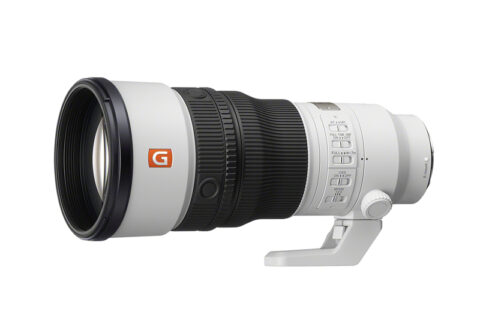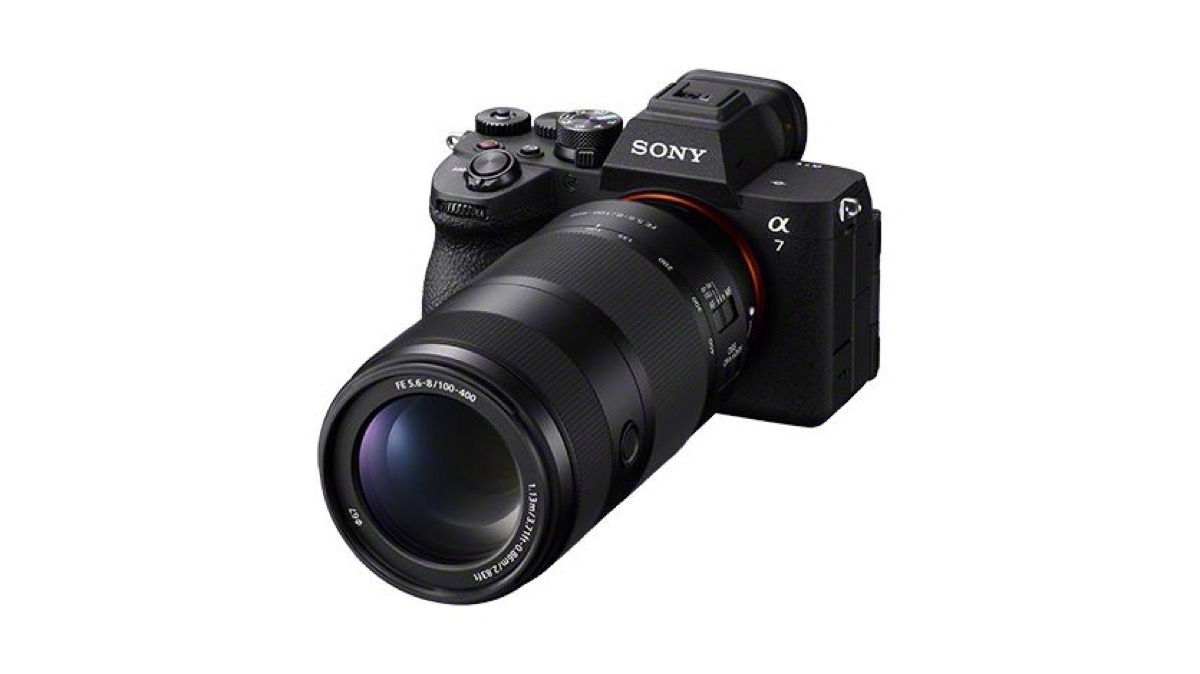
On August 4, Sony announced the FE 100-400mm F5.6-8 OSS (model SEL100400), a super-telephoto zoom for 35mm full-frame E-mount cameras. It ships on September 4 at an estimated street price of around 140,000 yen. Compared with the G Master that covers the same 100-400mm range, Sony traded away maximum aperture to bring the weight down to roughly 654g. Pre-orders open on August 18 at 10:00.
Reaching 400mm at 654g
The usual barrier to a super-telephoto zoom is weight rather than price. Lenses in the 100-400mm class routinely pass the 1kg mark, which pushes owners toward a tripod or monopod. This one measures roughly 78.2 x 164.5mm, weighs about 654g and takes 67mm filters. Those numbers are closer to a standard zoom, which tells you it was designed to be carried by hand all day.
The trade-off is the aperture. It opens at F5.6 at the wide end and closes to F8 at 400mm, so daylight outdoors and well-lit stadiums are its natural territory. For birds at dusk or a dim gymnasium, you will want a body with room to push ISO.
The optical formula uses 15 elements in 10 groups, including two ED (Extra-low Dispersion) glass elements and two aspherical elements. ED glass suppresses chromatic aberration, the color fringing that shows up along edges at long focal lengths. A 9-blade circular aperture keeps out-of-focus highlights from turning angular.
A super-telephoto that also focuses close
The minimum focus distance may end up mattering more than the spec sheet suggests: 1.13m at the wide end and 0.86m at the telephoto end, for a maximum magnification of 0.41x. That figure is close to half life-size, which is unusually strong for a super-telephoto zoom. Beyond pulling in distant subjects, it lets a single lens render flowers or insects large with telephoto compression.
The lens also accepts the SEL14TC (1.4x) and SEL20TC (2.0x) teleconverters. With the 2.0x attached, reach extends to 800mm. The aperture gets darker accordingly, but having the option matters when the subject is the moon or a distant bird.
Controls on the barrel
Autofocus is driven by a linear motor and keeps up with burst shooting at up to 120 frames per second on the Alpha 9 III. Optical image stabilization is built in, again pointing to handheld use as the design assumption.
The barrel carries a customizable focus hold button, a focus mode/range switching dial and a zoom lock switch[1]. That focus mode/range control combines AF/MF switching with the focus limiter in a single switch. A focus limiter restricts the focusing range so autofocus hunts less, which is genuinely useful at these focal lengths. Being able to change that setting without moving your fingers while tracking a fast subject is the practical benefit.
Sealing is applied throughout for dust and moisture resistance. A round bayonet lens hood, the ALC-SH188, is included.
Price and availability
In Japan the estimated street price is around 140,000 yen including tax, with pre-orders from 10:00 on August 18 and shipping on September 4. In the United States the suggested retail price is 849.99 USD (about 134,000 yen), also scheduled for September.
※1 USD = 158 JPY
The 100-400mm range has until now been G Master territory, built around an F4.5-class maximum aperture. Adding a lighter, slower option makes the entry point clear for anyone who wants to try super-telephoto work for the first time. It will not match the brightness of the higher-end model, but if angle of view at 400mm and portability are the priorities, the balance holds up.
Summary
The FE 100-400mm F5.6-8 OSS packs the 100-400mm range into roughly 654g. Holding the aperture to F5.6-8 is what buys the lower weight and the lower price. The practical details are there too: 0.41x maximum magnification, teleconverter support, and a focus mode/range switch that handles both AF/MF switching and the focus limiter. The estimated street price is around 140,000 yen, pre-orders start at 10:00 on August 18, and the lens ships on September 4.
References
- [1] Sony Japan news release: FE 100-400mm F5.6-8 OSS https://www.sony.jp/CorporateCruise/Press/202608/26-0804/
- [2] Sony Alpha Universe「Sony Electronics Launches FE 100-400mm F5.6-8 OSS」 https://alphauniverse.com/stories/sony-electronics-launches-fe-100400mm-f5-68-oss-the-perfect-hobbyist-s-supertelephoto-zoom-lens/