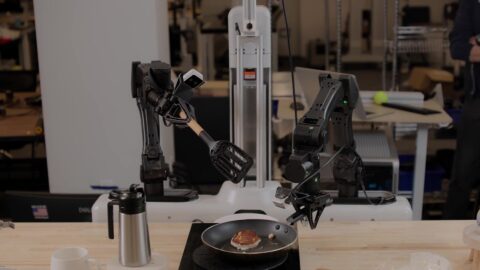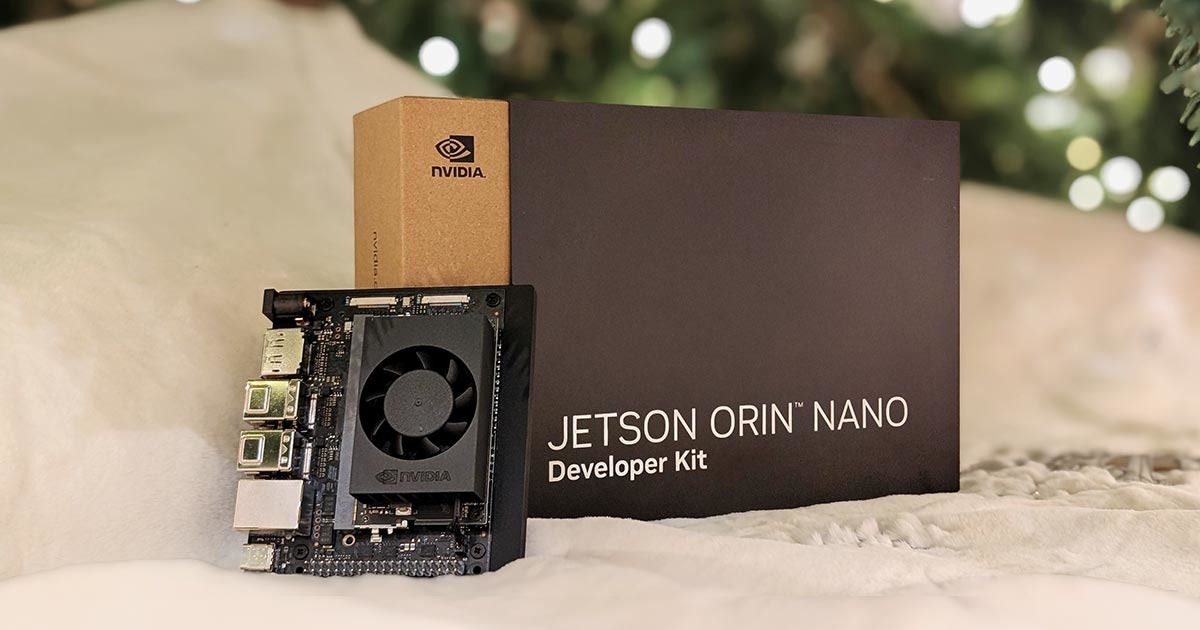
NVIDIA has kicked off a series on its official blog covering Jetson, its edge AI and robotics platform. The opening entry centers on the entry-level Jetson Orin Nano Super Developer Kit, which delivers 67 TOPS of AI performance for 249 USD (about 40,000 yen). With software updates that now bring AI coding agents into the development workflow, the barrier to building a robot brain on a palm-sized board keeps dropping.
A robot brain that fits in a handbag
To open the series, NVIDIA highlighted a video from Sarah Guo, founder of the AI-native venture capital firm Conviction and co-host of the AI podcast No Priors. Guo dropped a Jetson Orin Nano Super into a compact handbag to show that an entire AI development environment can be carried around[1].
The staging aside, the point NVIDIA is making is clear. Jetson modules and developer kits are built to run robots and autonomous machines in classrooms, labs, and makerspaces, so development can start wherever there is power and a bag to carry the hardware in[1].
NVIDIA also lays out who each tier is for. A student starting a first robotics project uses Jetson Orin Nano Super, a professor bringing AI into a curriculum uses Jetson AGX Orin, and a researcher pushing the limits of autonomous systems uses Jetson AGX Thor[1]. The company says it will publish examples throughout the week, beginning with Jetson Orin Nano Super[1].
Inside the Jetson Orin Nano Super
The Jetson Orin Nano Super Developer Kit is aimed at running generative AI on small edge devices. AI performance is 67 INT8 TOPS, a 1.7X increase over the previous 40 TOPS[2].
The GPU uses the NVIDIA Ampere architecture with 1,024 CUDA cores and 32 Tensor cores. The CPU is a 6-core Arm Cortex-A78AE v8.2 64-bit part, with clock speed raised from 1.5 GHz to 1.7 GHz. Memory is 8 GB of 128-bit LPDDR5, with bandwidth widened from 68 GB/s to 102 GB/s[2].
The price is 249 USD (about 40,000 yen), available through NVIDIA authorized distributors worldwide[2]. What stands out is that owners of the earlier Jetson Orin Nano Developer Kit can get the same performance gain through a software upgrade alone[2]. Moving from 40 TOPS to 67 TOPS without replacing hardware makes this an easy board to keep on hand for experiments.
※1 USD = 163 JPY (as of July 28, 2026)
Handing development work to AI agents with Jetson skills
The series also points to Jetson Device Skills and Jetson BSP Skills. These give AI coding agents the Jetson-specific procedures they need, making it easier to delegate the work of creating, optimizing, and deploying edge AI[1].
In practice these are features of JetPack 7.2, released in June 2026. NVIDIA describes them as repeatable, agent-executable instructions that define which tools to call, what outputs to produce, and how to validate the results. Three categories ship: Jetson Linux customization for custom carrier boards, memory optimization covering everything from bootloader carveouts to user space, and model benchmarking to settle on the right inference configuration[3]. The implementations are published on GitHub[4].
JetPack 7.2 also adds one-command deployment of NemoClaw, an open source stack that layers privacy and security controls onto OpenClaw. On Jetson Thor, it enables Multi-Instance GPU (MIG), splitting the Blackwell GPU into two instances so one partition (12 SMs, 1,536 CUDA cores) can handle inference and rendering while the other (8 SMs, 1,024 CUDA cores) handles robot control and safety monitoring[3].
A new Super Mode for Jetson AGX Orin 32 GB arrives as well. Raising the GPU clock from 930 MHz to 1.3 GHz and lifting the power envelope to 60 W pushes AI performance from 200 TOPS to 241 TOPS, a gain of more than 20 percent[3]. Getting more out of the same board is exactly the approach used for Orin Nano Super, now extended to a higher-end module.
Projects already running
NVIDIA points to several projects built on Jetson Orin Nano Super. SidewalkPilot, which drives a toy electric vehicle autonomously, uses a custom AI model to execute driving maneuvers on its own[1].
Reachy Mini Jetson Assistant, built for the small Reachy Mini Lite robot, runs a voice and vision assistant entirely on the device. GPU acceleration stays local, and nothing about the runtime requires the cloud, API keys, or an internet connection[1]. That tradeoff pays off in places with unreliable connectivity, or in use cases where video should never leave the device.
A project from Coding with Lewis builds an AI robot from scratch using the open-weight Mistral model[1]. It is a direct demonstration of what running at the edge buys you: model choice that is not tied to any particular cloud service.
A livestream series is available for learning as well. It is organized into three modules covering running generative AI, building agents, and bringing VLM and VLA models to real-world physical AI, all on Jetson[1].
Summary
NVIDIA's new Jetson series starts from the 67 TOPS, 249 USD (about 40,000 yen) Jetson Orin Nano Super Developer Kit and maps out entry points from students to researchers. The GPU is Ampere with 1,024 CUDA cores, and memory is 8 GB of LPDDR5 at 102 GB/s. Owners of the earlier kit reach the same performance through a software update alone. Combined with the Jetson agent skills and one-command NemoClaw deployment added in JetPack 7.2, prototyping edge AI takes noticeably less effort than it used to.
Source[1]: https://blogs.nvidia.com/blog/build-ai-with-nvidia-jetson/
Source[4]: https://github.com/NVIDIA-AI-IOT/jetson-device-skills